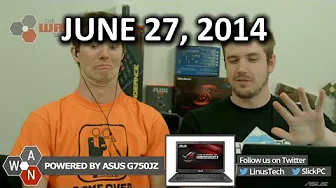
The WAN Show: Ubisoft is trying to be cool and YouTube supports 60FPS now! - June 27th, 2014
0 up · 0 down · 0 ratings
Promos
WAN Show Document: linustechtips.com Sponsors! Join Dollar Shave Club: dollarshaveclub.com Squarespace Link: squarespace.com - Offer code Linus to save 10% - Use hashtag #LinusSquarespace to tweet your Squarespace site for a chance to win a year worth of hosting for free!
Channels and socials
Check out this week's "Ask the Expert" stream about Intel's new Devil's Canyon CPUs! youtube.com Table of Contents (thanks DoozyDiglett) 0:02:23 Intro & Sponsors (Dollar shave club, squarespace & Intel "Ask the expert") 0:04:05 Luke Beatboxing 0:05:10 Youtube Supports 60 FPS, Crowdsource captions and more 0:06:41 Browser discussion 0:16:04 Ubisoft says "DRM doesn't stop piracy" 0:24:35 Android TV 0:32:04 Co-op games discussion 0:36:35 Razer's android tv "micro-console" 0:42:12 Proprietary standrards rant 0:45:15 Intel "Ask the expert" Sponsor Spot 0:47:50 Dollar shave club Sponsor Spot 0:50:35 Squarespace Sponsor Spot 0:56:46 WAN Show with 30% more handsome 0:58:06 Playstation Now Price leak 1:01:35 Android Newscaster 1:04:21 Google Cardboard VR 1:08:22 Intel has asked AMD for access to Mantle 1:12:31 Oral-B's Toothbrush that pairs with your phone 1:13:50 Solar Roadways are BS 1:15:08 Plan for scamming ecofreaks 1:16:22 Witcher 3 to feature Boob Physics 1:17:45 Junk Physics Concept 1:19:53 Microsoft offering $650 to exchange macbook air for surface 1:20:07 Microsoft Surface "Review" 1:29:18 Outro
The WAN Show episode from June 27th, 2014 covers a wide range of technology and gaming topics, anchored by the big news that YouTube has started supporting 60 frames per second, with implications for video quality, browser support, and how creators might optimize their content. The hosts discuss how 60 FPS affects both gameplay footage and traditional video, noting that higher frame rates improve motion clarity but may not automatically translate to every type of video content. They explain that for live action or camcorder footage, motion benefits exist but depend on encoding, display, and the viewer’s browser, with particular attention to how HTML5 and Firefox interact with YouTube’s 60 FPS rollout. A notable portion is dedicated to how this feature could influence popular creators like PewDiePie and how crowd-sourced captions and tip jars might shape creator revenue on the platform. The discussion then shifts to the practicality of 60 FPS for different genres, arguing that gameplay and fast action benefit most, while slower or narrative videos may not gain as much, unless paired with other enhancements like improved motion blur and slower playback. Throughout, the hosts emphasize the collaborative, community-driven evolution of YouTube features, highlighting that user feedback is guiding platform improvements rather than a purely corporate agenda. They also poke fun at browser compatibility issues, with a running thread about Firefox versus Chrome performance and the occasional crash or session restore problem, reflecting the broader ecosystem challenges of web video in 2014. The show pivots to creator-centric software, noting YouTube’s new creator-app interface and the ongoing pains of the comment system, which affect engagement and audience interaction, especially as creators try to manage large audiences. The team then delves into Ubisoft and DRM, presenting Ubisoft’s stance that DRM should not punish paying customers and that the industry needs to rethink how protection interacts with player experience, a discussion that touches on industry-wide piracy debates and the broader difficulty of balancing security with accessibility. They compare Ubisoft’s public statements with perspectives from CD Projekt Red and Bethesda on DRM, offering a nuanced view of piracy’s real-world effects on sales and the complexity of measuring impact. Android TV surfaces as a convergence point for entertainment and gaming, with discussions of Google IO announcements, Android L (Lollipop), and the evolving smart-TV landscape, including comments on hardware design, circular interfaces, and the potential for a new wave of living-room devices powered by Android. The panel also covers hardware players, such as Razer’s micro-console, NVIDIA’s chips (K1), and the broader question of whether Android TV can deliver a compelling gaming experience without alienating traditional PC and console gamers. They entertain ideas about cross-platform streaming, second-screen dynamics, and how services like game streaming could reshape living room gaming through devices like Shield, Ouya-inspired ecosystems, or TV-integrated platforms. A recurring theme is the tension between open standards and proprietary ecosystems, with the hosts arguing for greater interoperability and vendor cooperation to avoid another generation of closed, underperforming hardware. The conversation cycles back to ongoing game franchises and upcoming PC-to-console parity challenges, with specific attention to Ubisoft’s PC release timing, the Witcher 3 discussion, and how cross-platform performance issues influence consumer trust. The WAN Show crew also pepper their chat with hardware humor, amusing anecdotes about topic-related jokes, and a candid, informal style that underlines the show’s ethos of balancing deep technical detail with accessible, entertaining commentary. In closing, they tease future segments and sponsor plugs, reflecting the show’s multi-faceted format that combines news, hardware discussion, community feedback, and lively banter about the state of technology and gaming in mid-2014.
Topics · technology · gaming · video-platforms · hardware · entertainment · internet · software · streaming
Questions answered
- Why does 60 FPS matter for YouTube videos and who benefits the most?
- 60 FPS improves motion clarity and enables smoother slow motion in certain video types, especially gameplay footage. Gamers and streamers benefit the most, while some non-action videos may see less impact.
- What are the main concerns about DRM discussed in the video?
- The discussion centers on whether DRM punishes paying players and the difficulty of stopping piracy without harming legitimate customers, suggesting that DRM policies should focus on preserving a good player experience.
- How is crowdsource captioning viewed, and what potential issues are anticipated?
- Crowdsource captions are seen as a way to make videos more accessible but raise concerns about accuracy and potential abuse or vandalism until systems are in place to moderate quality.
- What is the stance on Ubisoft DRM in the segment?
- The segment critiques Ubisoft for appearing to chase popular opinions and questions the effectiveness of DRM if it negatively affects paying customers.
- What hardware topics are covered related to living-room experiences?
- Android TV devices, Razer’s micro-console, NVIDIA chip utilization, and the potential for game streaming hardware to converge with smart TVs are discussed as future living-room gaming solutions.