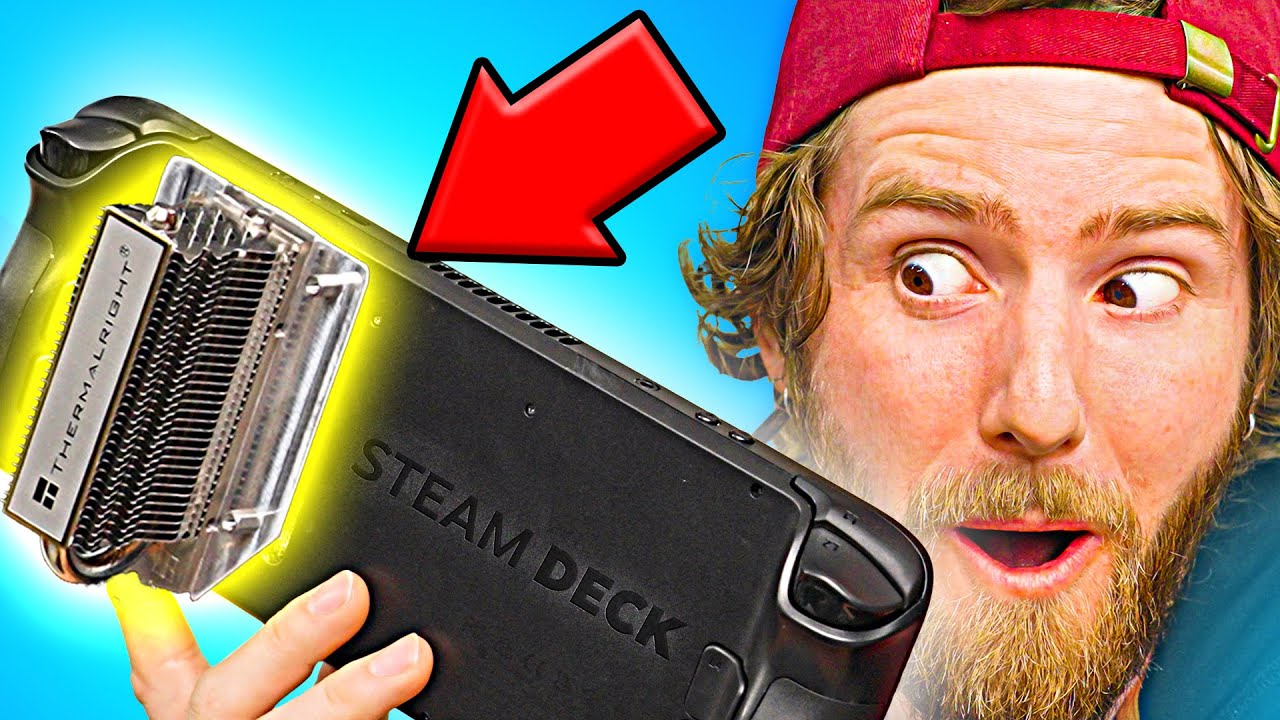
I'm shocked how well this worked - Steam Deck Cooler Upgrade
0 up · 0 down · 0 ratings
Description
Visit manscaped.com/TECH for 20% OFF + Free Shipping PDQ.com: Start your FREE trial now! At lmg.gg I love the Steam Deck, but unfortunately it can be a bit loud and runs kinda hot.. well today we change that. Discuss on the forum: linustechtips.com 3D Model: grabcad.com
Promos
Check out the Steam Deck: lmg.gg Buy a Thermalright HR-09 2280 Heatsink :geni.us Buy a Thermalright HR-09 2280 Pro Heatsink: geni.us Buy a Noctua NF-A4x10 FLX: geni.us Purchases made through some store links may provide some compensation to Linus Media Group. ► GET MERCH: lttstore.com ► SUPPORT US ON FLOATPLANE: floatplane.com ► AFFILIATES, SPONSORS & REFERRALS: lmg.gg ► PODCAST GEAR: lmg.gg FOLLOW US --------------------------------------------------- Twitter: twitter.com Facebook: @LinusTech Instagram: @linustech TikTok: @linustech Twitch: twitch.tv MUSIC CREDIT --------------------------------------------------- Intro: Laszlo - Supernova Video Link: youtube.com iTunes Download Link: itunes.apple.com Artist Link: soundcloud.com Outro: Approaching Nirvana - Sugar High Video Link: youtube.com Listen on Spotify: spoti.fi Artist Link: youtube.com Intro animation by MBarek Abdelwassaa @mbarek_abdel Monitor And Keyboard by vadimmihalkevich / CC BY 4.0 geni.us Mechanical RGB Keyboard by BigBrotherECE / CC BY 4.0 geni.us Mouse Gamer free Model By Oscar Creativo / CC BY 4.0 geni.us CHAPTERS --------------------------------------------------- 0:00 - Our crazy idea... 0:55 - PDQ! 1:20 - Why Linus wants this 4:25 - The Plan 8:19 - It... might actually work? 9:40 - Manufacturing 13:44 - Assembly, thermal pads 16:50 - Firing it up 19:30 - This looks awesome 20:50 - Fan? 22:40 - Manscaped! 23:15 - Outro
The video kicks off by framing a remarkable idea: applying a strap-on cooling solution to a Steam Deck to combat heat and audible fan noise. It begins with a high-energy, almost playful tone, describing the challenge of thermal management on handheld gaming devices and the intention to push beyond simple fan-curve tweaks. The team outlines the plan to repurpose an M.2 cooler from Thermalright and mount it in a way that could extend the device’s thermal envelope without sacrificing usability. Early on, they establish the baseline temperatures and fan speeds during demanding gaming, showing the problem they aim to solve. The discussion then shifts to practical constraints, including how to create a mounting mid-plate and how to avoid interference with the Steam Deck’s Wi-Fi module. The crew tests ideas using a mix of prototyping, laser cutting, and careful measurement, emphasizing repeatability and controlled experimentation. In the mid section, the video pivots to actual fabrication, with the team using a Tormach CNC mill and a Dremel-like tool to fashion a custom backplate, verify alignment, and ensure parts would fit within tolerances. As they assemble the modular cooler, they repeatedly validate fitment and adjust component heights, thermal pad thickness, and contact pressure to maximize heat transfer. The final testing phase reveals dramatic improvements: lower GPU and CPU temperatures, quieter operation, and a noticeably cooler system overall. The hosts celebrate the success, reflecting on how this “hot rod” approach could be refined further, potentially adding a fan or more fins for even greater dissipation. The video closes with appreciation for engineering teamwork, a nod to the sponsor, and a vision for a future where the Steam Deck can operate like a compact PC cooler while remaining portable and user-friendly.
Topics · technology · engineering · hardware_modding · diy · cooling · pc_hardware
Questions answered
- What was the main goal of the Steam Deck cooler upgrade?
- The goal was to reduce heat and fan noise on the Steam Deck by adding a strap-on M.2 cooler and a custom mounting solution to improve thermal performance without compromising usability.
- Which tools were used for the fabrication and testing?
- The team used a Tormach CNC mill for precise cuts, a laser cutter for templates, a Dremel-like tool for material removal, and thermal pads and epoxy to assemble and test the cooling solution.