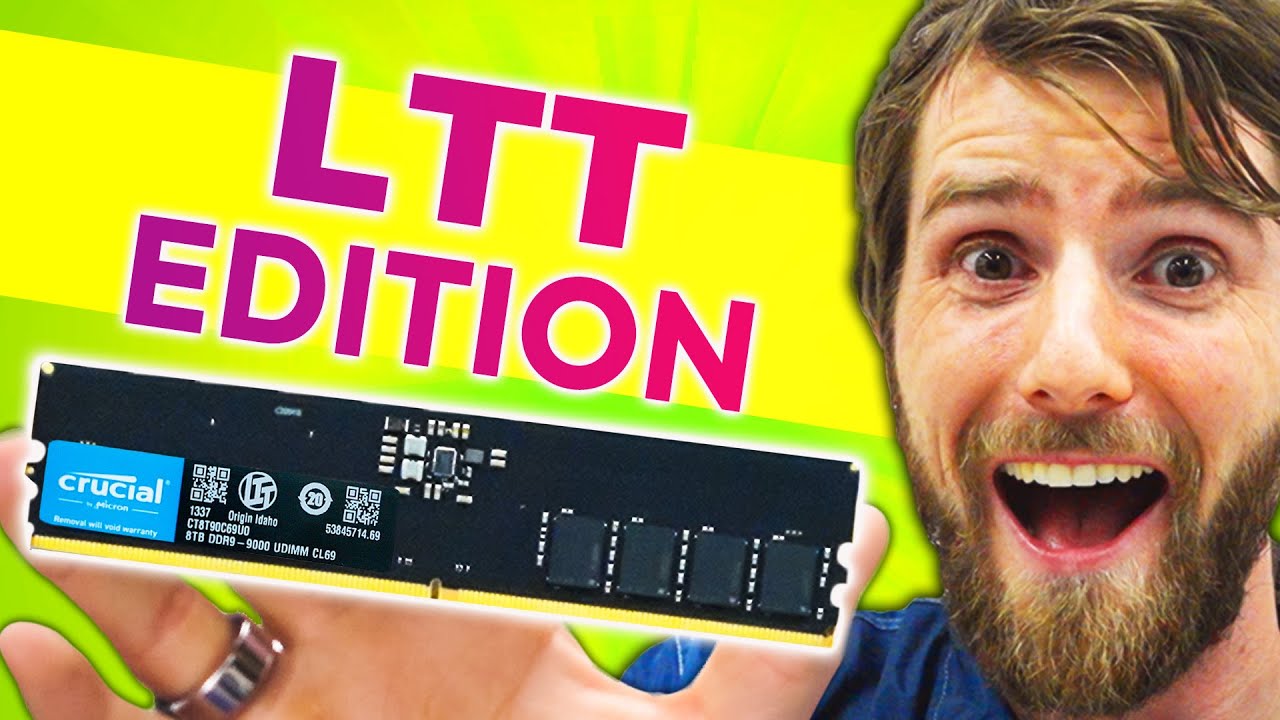
I made my own RAM! - Micron Factory Tour
0 up · 0 down · 0 ratings
Promos
Thanks to Micron for sponsoring this video! Learn more about how Crucial by Micron can make upgrading your setup easy by checking them out at: crucial.gg Linus doesn't travel for projects often anymore, but when Micron invited him out to their 200,000 sq. ft. facilities in Boise, Idaho to make his own RAM from scratch, he knew that he had to go. Making RAM isn't easy, so sit back and take a look at how RAM goes from raw components to powering the device you're watching this on! Discuss on the forum: linustechtips.com ► GET MERCH: lttstore.com ► SUPPORT US ON FLOATPLANE: floatplane.com ► AFFILIATES, SPONSORS & REFERRALS: lmg.gg ► PODCAST GEAR: lmg.gg FOLLOW US --------------------------------------------------- Twitter: twitter.com Facebook: @LinusTech Instagram: @linustech TikTok: @linustech Twitch: twitch.tv MUSIC CREDIT --------------------------------------------------- Intro: Laszlo - Supernova Video Link: youtube.com iTunes Download Link: itunes.apple.com Artist Link: soundcloud.com Outro: Approaching Nirvana - Sugar High Video Link: youtube.com Listen on Spotify: spoti.fi Artist Link: youtube.com Intro animation by MBarek Abdelwassaa @mbarek_abdel Monitor And Keyboard by vadimmihalkevich / CC BY 4.0 geni.us Mechanical RGB Keyboard by BigBrotherECE / CC BY 4.0 geni.us Mouse Gamer free Model By Oscar Creativo / CC BY 4.0 geni.us CHAPTERS --------------------------------------------------- 0:00 Intro 1:20 Fab 4 tour 3:40 Wafer probing 5:18 Manual probing 7:59 Grinding down the wafer 10:22 Characterization testing 13:08 Checking for issues using X-Ray scanning 14:26 Testing and binning machine 16:01 Assembling and manually fixing our modules 22:15 Cutting machine 24:01 Validation labs and MoBo hall of fame 26:04 Anechoic chamber testing 27:08 Putting our RAM into a PC! 30:29 Outro
Linus tech show takes viewers on a rare, hands-on tour inside Micron’s Boise, Idaho facilities to build a DDR5 memory kit from scratch. The video opens with a sweeping view of Micron’s 200,000 square foot campus and sets up the premise: an R&D focused lab where new production techniques are tested before deployment at global manufacturing centers. The host introduces Fab 4, a Class 100 clean room dedicated to advanced testing rather than direct customer production, highlighting the split between research and mass production in memory tech. Early on, the video emphasizes the scale and ambition of Micron’s expansion, including a multi-billion dollar investment and the move toward future nodes like 1-gamma and 1-delta, supported by ASML EUV lithography equipment. As the narrative progresses, the focus shifts to the delicate, nanometer-scale challenges of making memory, including lithography, polishing, and implantation, with a candid admission that many dies fail during testing. The host then dives into the UF 3000 wafer probing machine, showing how dies are probed with precision via a combination of machine vision and manual intervention to determine electrical function at the die level. The demonstration highlights the strategic value of manual probing for deep investigations and rapid iteration, including the use of picoprobes to access IO and internal die signals, and even touching on the difficulties of aligning probe points on microscopic pads. In the thinning and encapsulation stage, the video explains why wafers are thinned, and how protective films and diamond blade sawing enable stacking and packaging, followed by an overview of the encapsulation process and the construction of 3D memory modules. The screening and testing stages continue with a DDR4 load board used for probing, an explanation of oscilloscope signals, and the staggering cost of high-end test equipment, illustrating the gap between R&D testing and mass production. The narrative then covers X-ray inspection for non-destructive analysis, SEMs for gate-level inspection, and the idea that most wafers are tested multiple times across several stations before final qualification. The video culminates with a peek at the memory module assembly line and a “pizza oven” style thermal process that brazes dies onto PCB panels, followed by automated testing and packaging, with Linus joking about the unpredictability of results and the occasional on-camera defect. The closing act broadens the scope to a long-term burn-in lab and validation suites that simulate real-world usage, emphasizing that aggressive testing is essential to meet regulatory and performance standards, and ending with a playful wrap-up that teases future Intel and other factory tour content while underscoring Micron’s vast patent and collaboration footprint. Throughout, the video balances educational detail with engaging, sometimes humorous commentary, revealing the extraordinary complexity behind even a small RAM module and the careful orchestration required to bring cutting-edge memory from concept to consumer hardware.
Topics · technology · manufacturing · science · education · engineering · laboratory · automation
Questions answered
- What is the UF 3000 wafer probing machine used for in memory development?
- The UF 3000 is used to align and probe individual dies on a wafer to test electrical function, enabling deep investigations beyond automatic probing and helping engineers diagnose issues at the die level.
- Why are wafers thinned and encapsulated in this process?
- Wafers are thinned to enable stacking, improve assembly practicality, and reduce material stress; encapsulation then protects the dies, wires, and bonded areas during handling and operation in a module.
- What is the purpose of the anechoic chamber and EMI testing shown in the lab tour?
- The anechoic chamber and EMI testing setup ensure that the memory modules meet regulatory emissions standards and remain stable under electromagnetic interference, preventing failures or bit flips in real-world use.