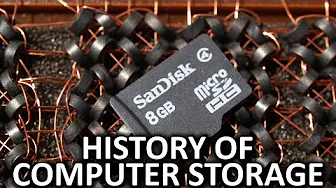
The History of Computer Storage
0 up · 0 down · 0 ratings
Channels and socials
How did computer storage evolve from super-old-school punch cards to the multi-terabyte SSDs of today? Thanks to Braintree for supporting our channel. To learn more, and for your first $50,000 in transactions fee-free, go to braintreepayments.com Follow: twitter.com Join the community: linustechtips.com License for images used: creativecommons.org
The History of Computer Storage tracks the evolution of how we store information from the earliest punched cards to today’s fast, multi terabyte solid state drives. The video begins by noting that storage precedes modern digital abundance, tracing its roots to paper punched cards used in the 1700s and 1800s to encode instructions and data for machines. It then explains the progression from drum memory, which used rotating cylinders and fixed read/write heads, to magnetic tape, which provided inexpensive bulk storage but suffered from slow random access. The narrative further explores the shift to RAM with core memory in the 1940s and 1950s, which offered faster access and no moving parts, followed by the iconic early IBM hard drives of the 1950s that scaled in capacity and helped validate a disk-based architecture. The timeline continues with portable storage breakthroughs, starting from the 8-inch floppy in 1971, through the 3.5-inch floppy, and the rise of optical media and flash memory, which ultimately displaced early magnetics for everyday data, leading to todays SSDs and SD cards. Concluding observations highlight how each generation improved access times, density, and durability, enabling the modern computer experience where terabytes can be stored on devices small enough to fit in a pocket, while also noting ongoing advances in storage technologies like NVMe and SSDs. The video blends historical milestones with practical implications for how we interact with data on a daily basis, underscoring the rapid pace of change and the enduring push for smaller, faster, and more capacious storage solutions.
Topics · science_and_technology · history · computing · hardware
Questions answered
- What was the first mass storage device used in computing, and how did it influence later designs?
- Drum memory and magnetic storage were early mass storage concepts; drum memory offered more capacity than punch cards but relied on moving parts, while magnetic storage, including tapes, laid groundwork for later, cheaper bulk storage and influenced the move toward fixed disks and modern HDD architectures.
- Why did core memory become a preferred form of working memory despite its small capacity?
- Core memory offered faster access times and had no mechanical moving parts, making it quicker and more reliable for RAM compared to earlier magnetic storage methods, which helped establish its dominance before semiconductor RAM became widespread.