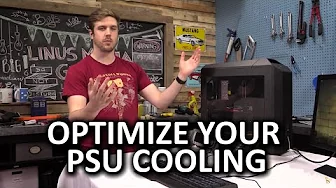
Does Power Supply Orientation Matter? - The Workshop
0 up · 0 down · 0 ratings
Promos
Thanks to Braintree for supporting our channel. To learn more, and for your first $50,000 in transactions fee-free, go to braintreepayments.com Up or down? Do PSU basements matter? So many questions, and hopefully we'll be able to find some answers!! G-Fuel link: Check them out at bit.ly and use promo code "LINUS" to save 10%! Pricing & discussion: linustechtips.com Support us: linustechtips.com Join our community forum: bit.ly twitter.com @LinusTech Intro Screen Music Credit: Title: Laszlo - Supernova Video Link: youtube.com iTunes Download Link: itunes.apple.com Artist Link: soundcloud.com Outro Screen Music Credit: Approaching Nirvana - Sugar High youtube.com Sound effects provided by freesfx.co.uk
The Workshop episode investigates whether the orientation of a power supply unit (PSU) affects overall system thermals and component performance. The video runs through a structured series of controlled experiments in different cases and with different PSU orientations: bottom-mounted fans pulling air up and exhausting out the back, the PSU facing up into the case with various basement configurations, and later a rear-exhaust GPU setup with the PSU fan oriented upward. Each scenario uses the same high-end gaming hardware,a 390x/290x GPU, an overclocked 4790K CPU with a Hyper 212 Evo cooler, and a few ambient temperature probes around the case,to compare ambient, PSU, GPU, and CPU temperatures, as well as GPU clock speeds and CPU behavior. The host emphasizes repeating trials with both basement and open cases, and with internal versus rear exhaust layouts, to isolate how airflow direction might influence thermal dynamics. Across tests, results show that while certain configurations can slightly shift PSU temperatures, the overall impact on GPU and CPU performance is minimal, reinforcing that PSU orientation is not a reliable lever for improving gaming performance or system cooling in most setups. The takeaway is pragmatic: if a particular case design or a personal preference subtly alters PSU temperature, that change is unlikely to meaningfully affect GPU or CPU thermals, but users may still gain small longevity benefits from chasing cooler PSU operation in some scenarios. The episode concludes with a cautious endorsement of empirical testing,experiment with your own hardware and share results on the forum,while noting that broad claims about dramatic thermal improvements from PSU orientation are not strongly supported by the data. Finally, the host plugs additional resources and invites viewers to discuss the topic further on the forum, reinforcing the show’s evidence-based approach to common hardware myths.
Topics · hardware testing · computer hardware · science_and_technology · circuits_and_electronics · cooling · benchmarks · thermal_dynamics
Questions answered
- Does orienting the PSU fan up or down make a noticeable difference to GPU temperatures in a high-end gaming build?
- In the tested configurations, PSU orientation caused only minor changes to PSU temperature and did not meaningfully alter GPU or CPU temperatures or performance.
- Do basement or internal PSU compartments significantly affect overall cooling?
- Basement and internal exhaust configurations can influence local PSU cooling, but the broader impact on graphics card and CPU thermals is minimal in the scenarios shown.
- Should I rely on PSU orientation as a strategy to improve gaming performance?
- No, the results indicate that changing PSU orientation is not a reliable method for improving gaming performance; any potential gains are small and case-dependent.