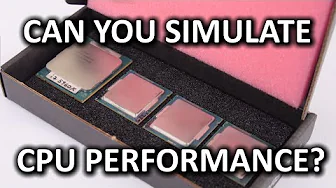
CPU Simulation - Can You Simulate Performance of One CPU with Another?
0 up · 0 down · 0 ratings
Channels and socials
After our "CPU Cores for Gaming" video, you guys raised some questions about my testing philosophy. Today, we try to find answers to those questions... Gigabyte P35X v3 link: gigabyte.com Sponsor link: linustechtips.com Pricing & discussion: linustechtips.com Support us: linustechtips.com Join our community forum: bit.ly twitter.com @LinusTech Intro Screen Music Credit: Adhesive Wombat -
Check out his channel here: youtube.com Outro Screen Music Credit: Approaching Nirvana - Sugar High youtube.com
In this video, the creator revisits a controversial benchmarking approach by explaining the rationale behind simulating CPU performance across different processors. He describes a carefully designed workload meant to stress multi-core configurations without causing a total system choke, allowing high-end CPUs to stretch their capabilities while still producing usable results. The method hinges on artificially limiting the best processor, the i7 5960X, to the specifications of other contenders to compare estimated performance across architectures that share a similar Haswell lineage. He acknowledges that this approach cannot perfectly replicate real hardware differences such as binning, heat output, and power consumption, but argues that for the purpose of comparing core counts and multitasking proficiency, the time savings and overall trend fidelity justify the technique. Throughout, he discusses the constraints of using a single test bench, the practical trade-offs of swapping motherboards versus CPUs, and how differences in cache, memory type (DDR3 vs DDR4), and memory channel configuration influence the results. The video concludes with a measured assessment of the results, noting that the simulated G3258 sometimes outperformed the real CPUs in certain benchmarks, and that while the approach is useful for rapid, broad comparisons, it is not a universal replacement for traditional, fully fledged hardware tests. He also mentions ongoing work and future directions, including the possibility of continuing board and chip swaps to measure genuinely different behaviors that can arise from architectural and design variations, and he underscores the importance of methodological transparency and openness to feedback from viewers. The narration ties back to the initial question of whether one can simulate another CPU’s performance and whether such a method reliably indicates real-world behavior, ultimately concluding that while not perfect, the approach offers valuable efficiency gains and informative insights when applied with clear caveats and controlled variables.
Topics · science_and_technology · hardware_benchmarking · computer_hardware · cpu_performance
Questions answered
- Why use the BIOS to constrain a higher end CPU to match the specifications of other CPUs?
- The BIOS-based constraint is used to create a controlled, artificial limitation that approximates the performance of lower-end CPUs within the same architectural family, allowing a direct comparison of core count and multitasking capability without swapping hardware.
- Why were AMD CPUs not included in the test?
- The focus of the video was on comparing configurations with different core counts rather than a red team versus blue team comparison. Including AMD would require additional benches, drivers, and motherboard changes, which would significantly increase the scope of the test.
- Are the simulation results reliable enough to inform purchasing decisions?
- The simulations provide useful directional insights and show where the method aligns with real hardware in several benchmarks, but they are not a perfect substitute for full hardware tests that account for binning, heat, and power in real-world usage.