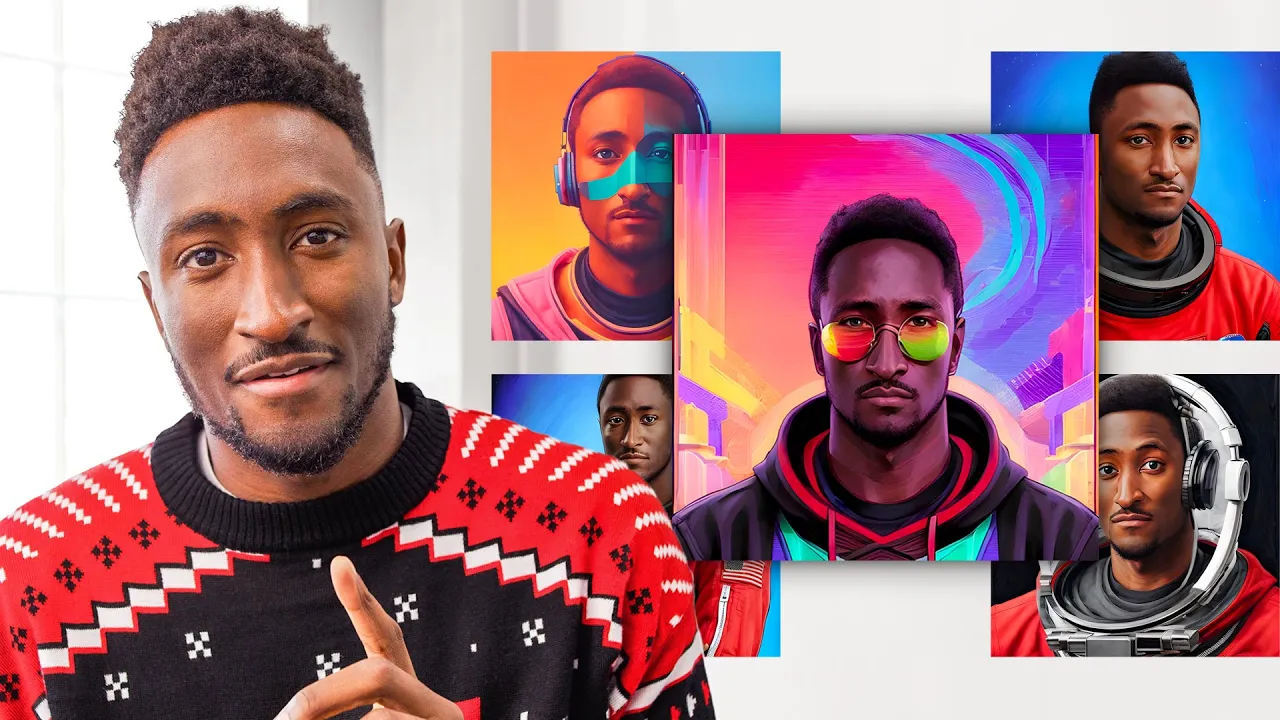
The Truth About AI Getting "Creative"
0 up · 0 down · 0 ratings
Channels and socials
Let's talk about AI Art, Lensa, ChatGPT, and why it's all deeper than you think. Save money with Karma at shop.karmanow.com and get double the Karma cash for a limited time! The sweater: shop.mkbhd.com Search LAION-5B: haveibeentrained.com Tech I'm using right now: amazon.com Intro Track: youtube.com Playlist of MKBHD Intro music: goo.gl 0:00 AI Art vs Creators 1:50 An Incredible AI Chat Bot 3:00 My Take on AI Tools 5:20 The Imperfections 8:20 AI Stealing Art Without Consent 14:08 Karma! ~ twitter.com @MKBHD @MKBHD
The video opens by acknowledging the buzz around AI across multiple forms, from AI art and portraits to chat bots and poetry. The creator immediately frames a central existential question many viewers have: can AI eventually replace human creators? He agrees that AI can do impressive things but argues that it cannot replicate the core aspects of being an online creator, such as imagination, human perspective, and audience engagement. He defines an online creator as someone who generates ideas, develops content, publishes it, and builds relationships with viewers, all through a distinctly human lens. The discussion then moves to practical realities, emphasizing that AI is a powerful tool rather than a replacement for creative work. The speaker uses personal experience with ChatGPT to illustrate how AI can draft scripts and brainstorm ideas, while reserving final editorial judgment and creative control for the human creator. He stresses that the ideal use of AI is to accelerate the early, ideation phases, with humans applying the final touches to preserve style and authenticity. The video then broadens to the concept of generative AI, acknowledging its ability to create from scratch and the promise of rapid outputs for brainstorming or initial drafts, while noting potential factual inaccuracies in AI-generated content and the importance of verifying information. The host identifies two major risks: the error rate of AI outputs and the complex issue of credit and ownership for AI-derived material. He demonstrates how a script generated by an AI can diverge from factual details, such as camera specifications and color options, highlighting the current limitations in accuracy. The discussion then focuses on AI art specifically, pointing to Lensa AI and similar tools that create image sets from user-provided photos. He explains the privacy and consent concerns, the question of who owns the training data, and the ethical implications for artists whose work informs these models. The video discusses the data sources behind AI models, including LAION-5B and Common Crawl, and poses the critical question of how to credit artists whose works contribute to AI training data. The host suggests that inspiration for human artists is broad and ongoing, while AI acts as a speedier conduit for pulling together influences. He presents an optimistic view that human appreciation for traditional art may increase as AI augments the creative process, but he urges vigilance and ongoing dialogue about legal and cultural frameworks. In closing, the creator reiterates that tools like AI are in the early stages of a revolution, and he signs off with a sponsor mention for Karma, framing it as a practical, unrelated note to the main topic. The overall message is balanced: AI is a transformative tool with immense potential, but the human element remains essential for meaning, accountability, and ethical practice in creative work.
Topics · technology · ai · art · ethics · copyright · society
Questions answered
- What is the video’s core argument about AI replacing human creators?
- The video argues that AI cannot replace human creators because it lacks imagination, a human perspective, and the ability to engage an audience. It is presented as a powerful tool that can assist with brainstorming and drafting but requires human judgment and final edits to preserve authenticity.
- How does the creator describe the best way to use AI in the creative process?
- The recommended approach is to use AI for early ideation and drafting, then apply human creativity, style, and editorial control in later stages to shape the final work.
- What are the two major risks of AI highlighted in the video?
- The two major risks are errors in AI outputs (inaccurate facts) and questions about credit and ownership for AI-generated content and training data.
- Why are artists concerned about AI training data and consent?
- Artists are concerned because AI models are trained on large datasets that include many artists' works without explicit permission or clear attribution, raising ethical and legal questions about how their art is used and who benefits financially.