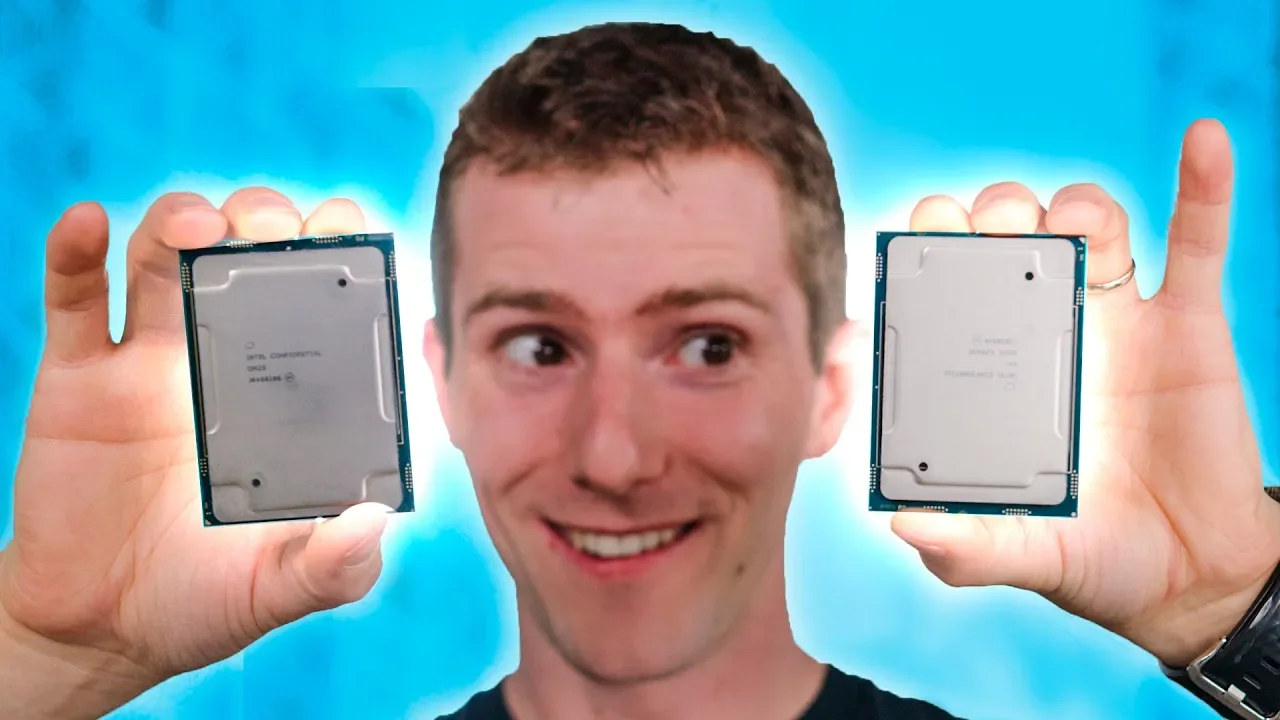
Do Dual CPU Sockets Matter in 2018?
0 up · 0 down · 0 ratings
Promos
Join the Club for only $5 at dollarshaveclub.com Thanks to Dollar Shave Club, new members get their 1st month of the Daily Essentials Starter Set for ONLY $5 with FREE shipping. Use offer code TECHTIPS to get 20% off your next Mack Weldon order at geni.us Xeon Scalable is Intel's "true" high-end workstation CPU line, with multi-CPU support baked in. But that comes at a cost... Buy a Xeon Scalable CPU: On Amazon: geni.us On Newegg: geni.us Buy an ASUS WS C621E SAGE motherboard: On Newegg: geni.us Discuss on the forum: linustechtips.com Our Affiliates, Referral Programs, and Sponsors: linustechtips.com Linus Tech Tips merchandise at designbyhumans.com Linus Tech Tips posters at crowdmade.com Our Test Benches on Amazon: amazon.com Our production gear: geni.us Get LTX 2018 tickets at ltxexpo.com Twitter - twitter.com Facebook - @LinusTech Instagram - @linustech Twitch - twitch.tv Intro Screen Music Credit: Title: Laszlo - Supernova Video Link: youtube.com iTunes Download Link: itunes.apple.com Artist Link: soundcloud.com Outro Screen Music Credit: Approaching Nirvana - Sugar High youtube.com Sound effects provided by freesfx.co.uk
Dual CPU socket systems once defined high-end workstation and server capabilities, but the video Do Dual CPU Sockets Matter in 2018? investigates whether multi-socket configurations still offer a meaningful edge amid now common high-core single CPU solutions. The host explains the architectural differences between Xeon scalable processors and Core i9 equivalents, emphasizing ECC memory and business-grade features in Xeon versus consumer-grade parts. Through a controlled set of benchmarks, including Cinebench, 7-zip, Y-Cruncher, Blender, and real-world virtualization tests, the video reveals that a dual-socket setup with 56 total cores often outperforms a single high-core CPU in certain workloads, yet the gains are not uniform across all tasks. The discussion also highlights latencies introduced by NUMA, separate CPU caches, and memory banks which can erode expected multi-core gains in memory-bound or data-sharing scenarios. The presenter then explores virtualization with unRAID to illustrate how splitting resources into independent VMs impacts performance, generally showing that the latency costs can offset some advantages of raw parallelism. Finally the host frames the practical takeaway: multi-socket systems are valuable for specific workloads like large-scale render farms and datacenter-like densities, but for prosumers and many enterprise tasks the economics, power, and complexity make single, high-core CPUs a more pragmatic choice. The conclusion suggests that dual sockets are unlikely to make a broad comeback for general consumers, serving instead as a niche solution aligned with very particular virtualization, scaling, or data-center use cases. Overall, the video blends historical context, architectural theory, and empirical benchmarks to map out when dual sockets pay off and when they do not, grounding the discussion in concrete test results and practical realities.
Topics · Technology · Hardware · Data Center · Virtualization · Performance Benchmarking