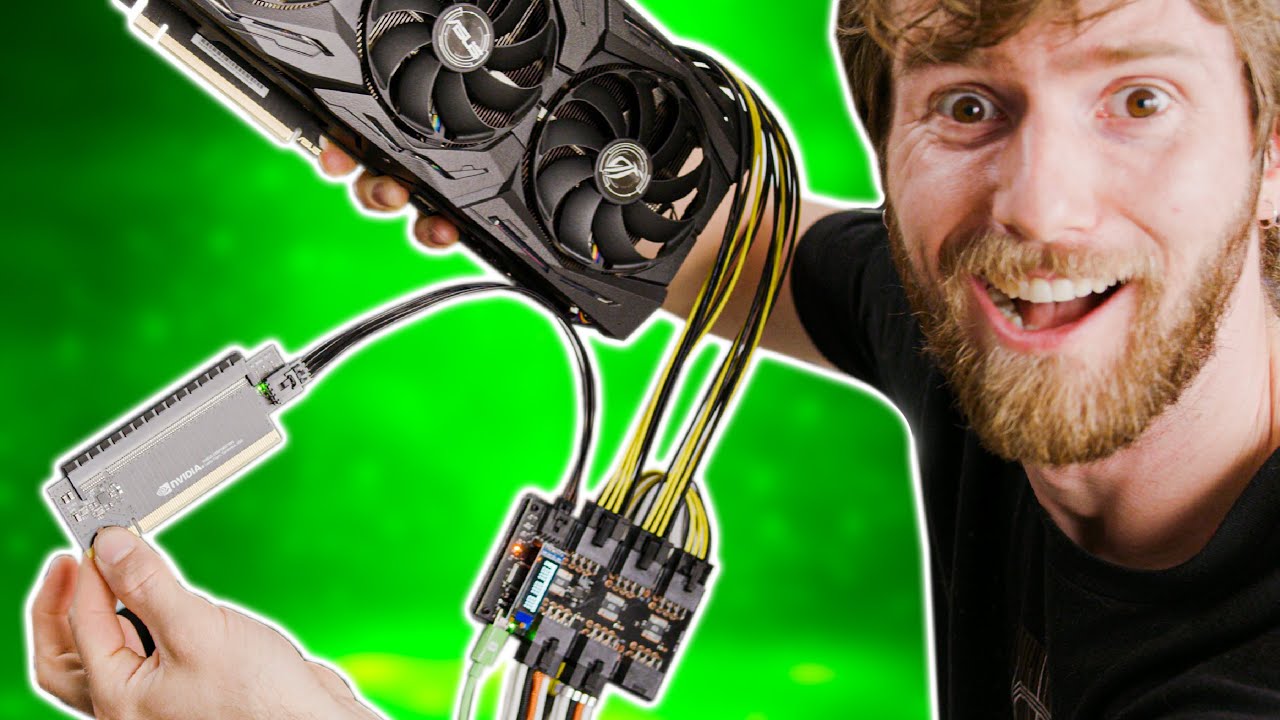
Nvidia gave us their internal tools… What could go wrong?
0 up · 0 down · 0 ratings
Promos
Check out the Drop Objective 2 Headphone Amp Desktop Edition at dro.ps Use code LINUS and get 25% off GlassWire at lmg.gg When Nvidia asked us to attend a presentation on something “not graphics related”, we had no idea how much we’d love what they were about to show us… Buy Logitech G203 Prodigy On Amazon (PAID LINK): geni.us On Newegg (PAID LINK): geni.us Purchases made through some store links may provide some compensation to Linus Media Group. Discuss on the forum: linustechtips.com ►GET MERCH: lttstore.com ►SUPPORT US ON FLOATPLANE: floatplane.com ►LTX EXPO: ltxexpo.com AFFILIATES & REFERRALS --------------------------------------------------- ►Affiliates, Sponsors & Referrals: lmg.gg ►Private Internet Access VPN: lmg.gg ►MK Keyboards: lmg.gg ►Nerd or Die Stream Overlays: lmg.gg ►NEEDforSEAT Gaming Chairs: lmg.gg ►Displate Metal Prints: lmg.gg ►Epic Games Store (LINUSMEDIAGROUP): lmg.gg ►Amazon Prime: lmg.gg ►Audible Free Trial: lmg.gg ►Streamlabs Prime: geni.us ►Our Gear on Amazon: geni.us FOLLOW US ELSEWHERE --------------------------------------------------- Twitter: twitter.com Facebook: @LinusTech Instagram: @linustech Twitch: twitch.tv FOLLOW OUR OTHER CHANNELS --------------------------------------------------- Techquickie: lmg.gg TechLinked: lmg.gg ShortCircuit: lmg.gg LMG Clips: lmg.gg Channel Super Fun: lmg.gg Carpool Critics: lmg.gg MUSIC CREDIT --------------------------------------------------- Title: Laszlo - Supernova Video Link: youtube.com iTunes Download Link: itunes.apple.com Artist Link: soundcloud.com Outro Screen Music Credit: Approaching Nirvana - Sugar High youtube.com Monitor And Keyboard by vadimmihalkevich / CC BY 4.0 geni.us Mechanical RGB Keyboard by BigBrotherECE / CC BY 4.0 geni.us Mouse Gamer free Model By Oscar Creativo / CC BY 4.0 geni.us
Nvidia gave Linus Tech Tips a look at two of their internal measurement tools, LDAT and PCAT, and the team breaks down what these devices are designed to do. The LDAT is presented as a latency and display analysis tool that uses a hardware mouse input and a light sensor to measure end-to-end latency from mouse click to photon display, offering a high-precision, automated data collection workflow. The hosts examine how the tool captures thousands of data points quickly, how it can be configured to auto fire, and how raw sensor data helps identify the optimal sensor placement on a screen. They explain the importance of separating total delay into components such as USB polling, OS processing, game engine latency, and display pixel response, and they demonstrate live use with a G203 Prodigy mouse and a small 3D printed housing. The PCAT tool, focused on power consumption, is introduced as a rigorous way to measure real world power draw flowing through PCIe power connectors and motherboard rails, with a removable OLED display and an onboard measurement board that Nvidia claims to be within a small margin of oscilloscope accuracy. The discussion shifts toward trust and accountability, noting that these tools are designed for reviewers and enthusiasts and could be sold to consumers if there is demand, while also addressing concerns about data integrity and the potential advantage conferred by having such measurement capabilities publicly available. Finally, the hosts explore how these tools integrate with existing software like Frame View and FurMark to render real-time graphs of latency and power, and they tease the potential impact on the industry if Nvidia and others provide open access to high-quality measurement hardware, promising a future where product performance can be reproducibly benchmarked across multiple variables at a granular level.
Topics · technology · hardware · benchmarking · power · testing · graphics
Questions answered
- What are the main purposes of Nvidia's LDAT and PCAT tools?
- LDAT is designed to measure end-to-end latency from mouse input to display output using a hardware sensor setup, while PCAT measures real-world power draw across PCIe connections and motherboard rails with high accuracy.
- Can these tools be used by consumers today?
- For now they are described as reviewers’ tools or prototypes, with the possibility of later consumer availability if there is enough demand.
- What aspects of performance do the tools help isolate?
- They help isolate latency components such as USB polling, operating system processing, game engine delays, render-to-display delay, and per-source power consumption to produce detailed performance graphs.