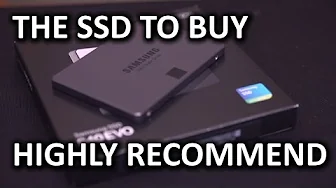
Samsung 840 EVO SSD Unboxing & Overview
0 up · 0 down · 0 ratings
Channels and socials
Samsung's 840 EVO SSD is the mainstream drive that matters. With a better software suite than other SSD makers, Samsung has found a way to really differentiate their drives without just selling them for cheaper. Sponsor link: linustechtips.com Pricing & availability: linustechtips.com Link to Anandtech article: anandtech.com Join our community forum: bit.ly twitter.com @LinusTech Intro Screen Music Credit: Adhesive Wombat -
Check out his channel here: youtube.com Outtro Screen Music Credit: Approaching Nirvana - Sugar High youtube.com
LinusTechTips presents an in-depth unboxing and overview of the Samsung 840 EVO SSD, portraying it as a well-rounded package rather than the absolute fastest or cheapest option. The video begins by framing the drive as a mainstream product with strong value, highlighting its availability in capacities such as 120 GB, 250 GB, 500 GB, and 1 TB, all priced competitively. The host then dives into hardware specifics, noting Samsung’s 19 nanometer class manufacturing process, TLC NAND flash, and an enhanced MDX controller now labeled as MEX Three core. He explains how these elements together enable solid performance despite TLC’s slower inherent write speeds, and mentions SATA 3.1 compatibility along with hardware AES 256 encryption for data security. The discussion also covers endurance concerns common with TLC, pointing to industry estimates and Samsung’s own testing, while contrasting real-world expectations with official write-cycle ratings. Overall, the segment establishes the EVO as a balanced choice that combines practical features like encryption and migration tools with competitive performance metrics.
Topics · technology · hardware
Questions answered
- What makes the Samsung 840 EVO a strong mainstream SSD option?
- The drive combines competitive pricing across multiple capacities with a feature set that includes a capable 3-core controller, TLC NAND with enhanced management, SATA 3.1 interface, hardware AES encryption, and software tools like Samsung Magician for optimization and data migration.
- What are Turbo Write and Rapid, and how do they affect performance?
- Turbo Write uses part of the TLC flash as an SLC cache to accelerate write operations, while Rapid caches data in system memory to speed reads and writes. Turbo Write improves real-world throughput during bursts, and Rapid can significantly boost performance when power stability allows memory caching to be used.