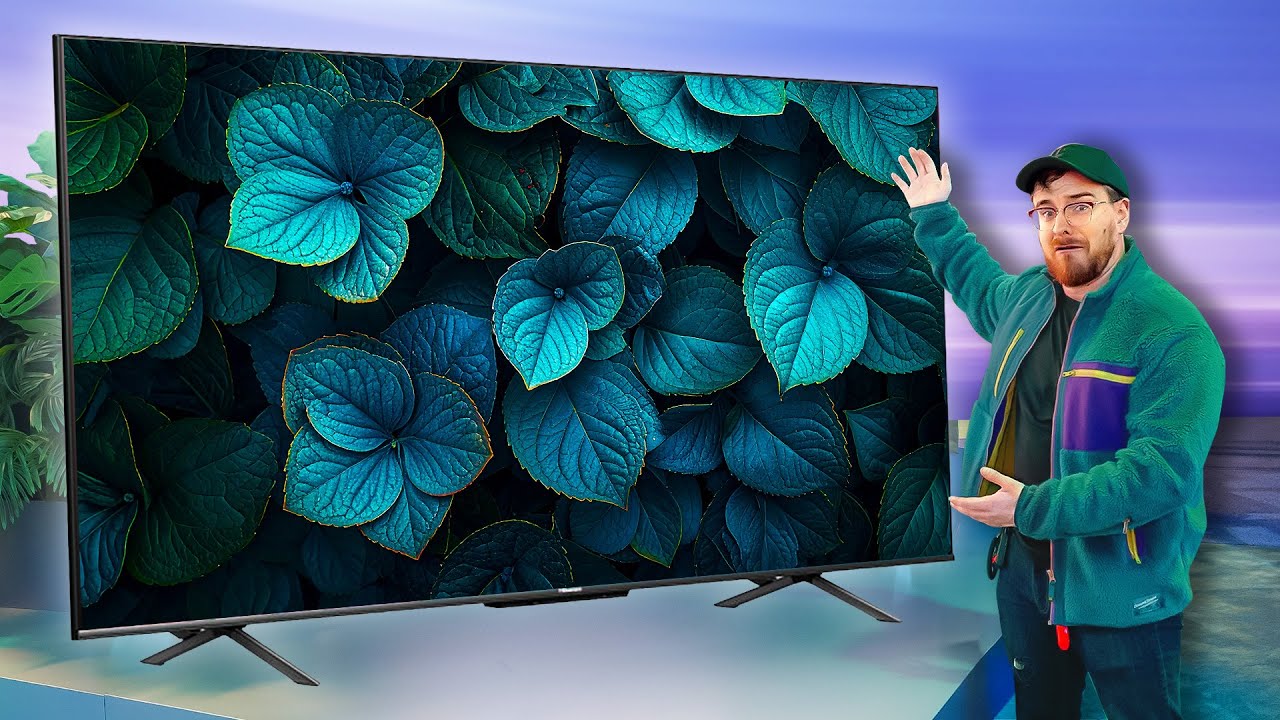
This TV Has an Extra Color(?) - Hisense @ CES 2026
0 up · 0 down · 0 ratings
Promos
Thanks to dbrand for sponsoring our CES 2026 coverage. Buy some stickers or whatever at: mysponsorkeepsdroppingout.com Hisense is showcasing some new TVs here at CES 2026 including an updated refresh to their 116" TV from last year. The new 116UXS has RGB LED EVO adds cyan to the MiniLEDs, supposedly resulting in more lifelike colours. Is that true? Well you'll just have to watch and decide yourself. Want us to unbox something? Make a suggestion at lmg.gg ► GET MERCH: lttstore.com ► GET A VPN: piavpn.com ► GET EXCLUSIVE CONTENT ON FLOATPLANE: lmg.gg ► SPONSORS, AFFILIATES, AND PARTNERS: lmg.gg Purchases made through some store links may provide some compensation to Linus Media Group. Affiliate links powered in part by affilimate.com Studio lighting by Aputure: aputure.com Linus Sebastian is an investor in Framework Computer, Inc and HexOS by Eshtek. CHAPTERS --------------------------------------------------- 0:00 Hisense 116UXS 2:20 dbrand! 2:50 Yep, that's a 163" TV 4:03 Hisense projectors 5:15 Outro
At CES 2026, the host opens with excitement about Hisense and its lineup of premium displays, highlighting the 116UXS as the flagship update to last year’s model. He explains that the 116UXS uses RGB LED Evo, adding cyan to the mini-LEDs, a choice aimed at delivering more natural gradients and lifelike color reproduction. He cites Hisense’s claim that cyan sits in a sensitive part of the color spectrum to improve subtle shifts and transitions, though he notes that real-world results depend on the content being played. The host also touts a 110 percent BT.2020 color space coverage, marking a 15 percent jump from the previous year and signaling strong color performance on this screen. While pricing isn’t officially announced for the current year, he estimates it will follow last year’s near $30,000 price point, and he discusses Hisense’s broader lineup that pairs high-end tech with more approachable options. The segment then pivots to practical takeaways, including how the Halo-based tech in other models might translate into price-to-performance value for mainstream buyers, and he teases additional coverage of AI-powered features across Hisense devices. He closes the section by noting the ongoing sponsorships and promising more CES material, setting up a broader view of Hisense’s strategy for 2026. In the middle portion, attention shifts to a second high-end display, a 163-inch microLED TV also equipped with yellow subpixels, intended to boost highlights, skin tones, and overall vibrancy. The host points out trade-offs common to large displays, including intense contrast that can flatten blacks and visible panel seams when viewed off-axis, which he argues may be less desirable for living-room use at extreme sizes. He compares this to the 116UXS, suggesting the 163 MX targets premium storefront demos rather than typical household living rooms, and he notes that pricing remains speculative but likely well into the premium range far beyond mass-market affordability. In parallel, the presenter discusses Hisense’s XR10 projector, boasting an optical zoom range claimed to be among the widest in the industry and a large, hybrid optical-digital zoom capability, as well as a claim of an all-glass lens and 6,000 lumens in a compact form. Throughout, the host emphasizes the importance of real content demos to gauge true performance and acknowledges that pricing details may surface later in the year. The segment concludes with a nod to AI features in development, inviting viewer input on what AI-powered devices they want covered next, and a reminder to subscribe for more CES coverage, while playfully acknowledging sponsorship dynamics.
Topics · technology · display technology · consumer electronics · television
Questions answered
- What is the key color enhancement on the 116UXS and why does it matter?
- The 116UXS adds cyan to the RGB LED Evo, aiming to improve gradients and color transitions by targeting a color in the spectrum where human vision is most sensitive, potentially yielding more natural and lifelike colors.
- What are the main trade-offs mentioned for the 163-inch microLED TV?
- The 163-inch model offers exceptional vibrancy with yellow subpixels but can exhibit overly aggressive contrast that makes blacks look off and may show panel seams when viewed off-axis, making it less ideal for typical living-room setups.