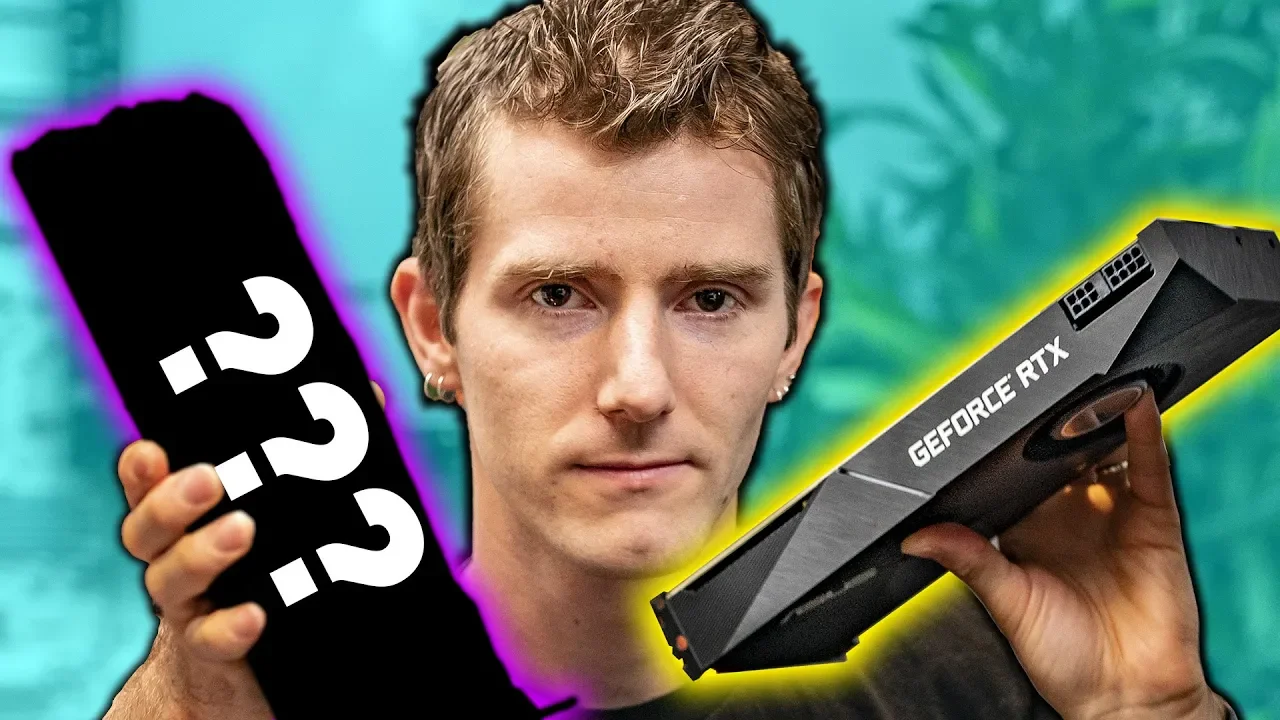
Buy THIS Instead - RTX 2070 Review
0 up · 0 down · 0 ratings
Promos
Receive an additional $25 credit for Ting today when you use code LINUS2018 at linus2018.ting.com GlassWire Firewall: Use code LINUS and get 25% off GlassWire at geni.us It’s been almost a month after Nvidia dropped RTX… In more ways than one. Today, the least expensive RTX-capable cards are out. Did they learn from their mistakes? Buy an ASUS Turbo RTX 2070: On Amazon: geni.us On Newegg: lmg.gg Buy an ASUS STRIX RTX 2070: On Amazon: geni.us On Newegg: lmg.gg Buy a GTX 1080 instead: On Amazon: geni.us On Newegg: lmg.gg Discuss on the forum: linustechtips.com Our Affiliates, Referral Programs, and Sponsors: linustechtips.com Get Private Internet Access today at geni.us Linus Tech Tips merchandise at designbyhumans.com Linus Tech Tips posters at crowdmade.com Our Test Benches on Amazon: amazon.com Our production gear: geni.us Twitter - twitter.com Facebook - @LinusTech Instagram - @linustech Twitch - twitch.tv Intro Screen Music Credit: Title: Laszlo - Supernova Video Link: youtube.com iTunes Download Link: itunes.apple.com Artist Link: soundcloud.com Outro Screen Music Credit: Approaching Nirvana - Sugar High youtube.com Sound effects provided by freesfx.co.uk
The video conducts a thorough look at the RTX 2070, starting from Nvidia’s price positioning and how the card fits into the current lineup. The host notes that despite the 2070 being the lowest tier of RTX cards, its pricing is still high relative to older silicon, with a $500 reference MSRP and a $600 Founders Edition, which puts it more against last generation GTX 1080 and AMD Vega 56 than the mere step from the 1070. He highlights that Nvidia has removed SLI from the 2070, leaving a curiosity about what enthusiasts actually gain beyond the ray tracing and encoder improvements, since there are currently few RTX-enabled games to showcase the new features. The discussion then turns to real-world value, comparing performance across directX 11/12 workloads, 3DMark, and OpenCL where Vega might lead in some tasks, while the 2070 generally sits near or just above a reference GTX 1080 in many scenarios. The host emphasizes that price-to-performance is clouded by used market dynamics, as mining booms have flooded the market with older high-end GPUs at steep discounts, sometimes matching or surpassing the 2070 in affordability. He concludes that Nvidia’s launch positioning signals a need for competition to keep pricing in check, and that consumers must weigh the promised RTX features against current game content availability and the risk of paying a premium for a technology that has yet to prove its real-time ray tracing advantage in actual titles. The video closes with practical purchase cues, suggesting that careful shoppers could consider older or used options, and that the 2070 may appeal more to enthusiasts who want the newest features despite imperfect content support and higher entry costs.
Topics · technology · hardware-reviews · gpu · gaming · consumer-electronics
Questions answered
- Is the RTX 2070 a better buy than the GTX 1080 or AMD Vega 56 at launch price?
- At launch, the RTX 2070 is often close in performance to the GTX 1080 in many tasks, with several tests showing similar or slightly better results but at a higher price point. The lack of real-time RTX game titles makes its ray tracing benefits hard to gauge, and the used market for older GPUs can undercut new RTX cards, complicating the value proposition.
- Why is there no SLI support on the RTX 2070 and how does that affect purchasing decisions?
- The RTX 2070 removes SLI support, which reduces the upgrade incentive for users who relied on multi-GPU setups. This shifts the decision toward single-card performance and new RTX features, rather than scaling power via SLI, and can diminish the appeal for enthusiasts who previously valued multi-GPU configurations.
- What factors should a buyer consider beyond raw benchmarks?
- Buyers should consider price-to-performance relative to last generation cards, the current and future availability of RTX-enabled games, the real-world benefits of the new encoder and ray tracing, and potential depreciation or discounts in the used market, as well as whether they value features like improved encoding for streaming.