Tiny Liquid Cooled PC Un-build Log!
0 up · 0 down · 0 ratings
Channels and socials
In our latest Un-build Log Linus takes a look inside the Magnus EN980 from Zotac! Massdrop link: dro.ps Feenix Vitesse: bit.ly Enter the Feenix giveaway: linustechtips.com Buy Zotac Magnus EN980 on Newegg: bit.ly Buy Zotac Magnus EN980 on Amazon: geni.us Discuss on the forum: linustechtips.com Affiliates, referral programs, & sponsors: linustechtips.com Join our community forum: bit.ly twitter.com @LinusTech Intro Screen Music Credit: Title: Laszlo - Supernova Video Link: youtube.com iTunes Download Link: itunes.apple.com Artist Link: soundcloud.com Outro Screen Music Credit: Approaching Nirvana - Sugar High youtube.com Sound effects provided by freesfx.co.uk
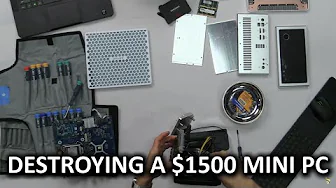
The video opens with Linus introducing another installment of his ongoing unbuild or teardown livestreams, this time focusing on the Zotac Magnus EN980, a surprisingly compact PC designed around a full 120 mm liquid cooling loop. He notes that this system is smaller than the MSI Vortex and that Zotac squeezed a complete water cooling setup into a miniature chassis, a design choice he finds impressive yet a bit baffling from a maintenance perspective. Early on he outlines the core specs: a Core i5 6400, 16 to 32 GB RAM, a GTX 980, an M.2 slot, a SATA slot, and notably no internal power supply as the unit uses external power bricks for a combined around 360 watts of delivery. He remarks that the GPU is the primary heavy-load component and that the machine uses external power bricks to keep the internal footprint tiny, a decision he supports for space efficiency though it raises questions about heat and power management. The first disassembly steps are straightforward; the bottom panel is held by four thumb screws which can be removed easily, and Linus carefully uses a magnetic parts tray to catalog screws and components as the teardown begins. He identifies the internal components he added or upgraded, including DDR3L memory and an SSD, and comments on the flexibility of Skylake to support both DDR3L and DDR4, which helps manufacturers offer a more affordable option. Throughout, he emphasizes the unique design approach, such as the external power configuration and the overall minimalistic chassis while praising the aluminum build quality, even though he thinks the visual aesthetic could be improved with a more cohesive color scheme. As the unbuild progresses, Linus pulls back the outer shell to reveal the first glimpse of the internal blocks, including the CPU backplate, the wireless module, and the dual DIMM slots, while continuing to discuss the design implications of a stand-alone external power solution. He then expands his focus to the cooling system itself, noting the custom nature of Zotac’s GPU block and the pump, and transitions into the more complex task of removing the water loop as a single unit to study its integration. The video continues with a careful, camera-angle rich exploration of the radiator, GPU block, CPU block, and VRMs, where Linus discusses the choice of the mixed metal pump and block materials, the potential corrosion considerations, and the cooling efficiency of the system. He considers how the radiator, pump, and reservoir interplay, and points out the layout challenges posed by the vertical orientation and tight clearance, while also acknowledging that the cooling architecture is innovative even if it risks maintenance difficulty. In the later stages, Linus disassembles the GPU block, inspects the MXM GTX 980 card, and examines the DC power inputs, VRM cooling strategies, and IO layout, including a surprising M.2/PCIe interface used for front USB connectivity. He offers technical commentary on the USB controller choice and port standards, then removes the CPU to reveal the heavy thermal paste application and contemplates future upgrades, such as testing a 6700K CPU to stress-test the power and thermal envelope. The video wraps with reflections on user serviceability, where Linus challenges Zotac’s claim of non-serviceability by noting the relative ease of reassembly, and invites viewers to subscribe and explore more content including shopping links and related channels. The closing moments tease the possibility of future experiments and transitions to other channels for additional content, leaving the door open for more deep-dive hardware explorations in this unique compact water-cooled PC space.
Topics · hardware_teardown · compact_form_factor · water_cooling · pc_hardware · computer_teardown · modding · tech_review
Questions answered
- What makes the Zotac Magnus EN980's cooling system unique for its size?
- It uses a full 120 mm radiator and a dedicated custom GPU block connected to a standalone pump and reservoir, all integrated into a compact chassis, enabling liquid cooling in a small form factor.
- Why does the setup rely on external power bricks, and what is the claimed benefit?
- External power bricks reduce internal heat and space usage, enabling a smaller chassis while delivering enough total power (about 360 W) to support the CPU and GTX 980, albeit with potential thermal management considerations.
- Is the GTX 980 GPU in this MXM-like form factor identical in performance to desktop GTX 980?
- Yes, when not throttled thermally, the GPU performs equivalently to a desktop GTX 980; the MXM PCB hides the same performance under a constrained cooling and power envelope.
- What modification risks are discussed regarding warranty and serviceability?
- Zotac advertises limited user serviceability, but the reviewer argues that reassembly is feasible and the unit can be serviced if care is taken, potentially voiding warranty if the motherboard is tampered with.}