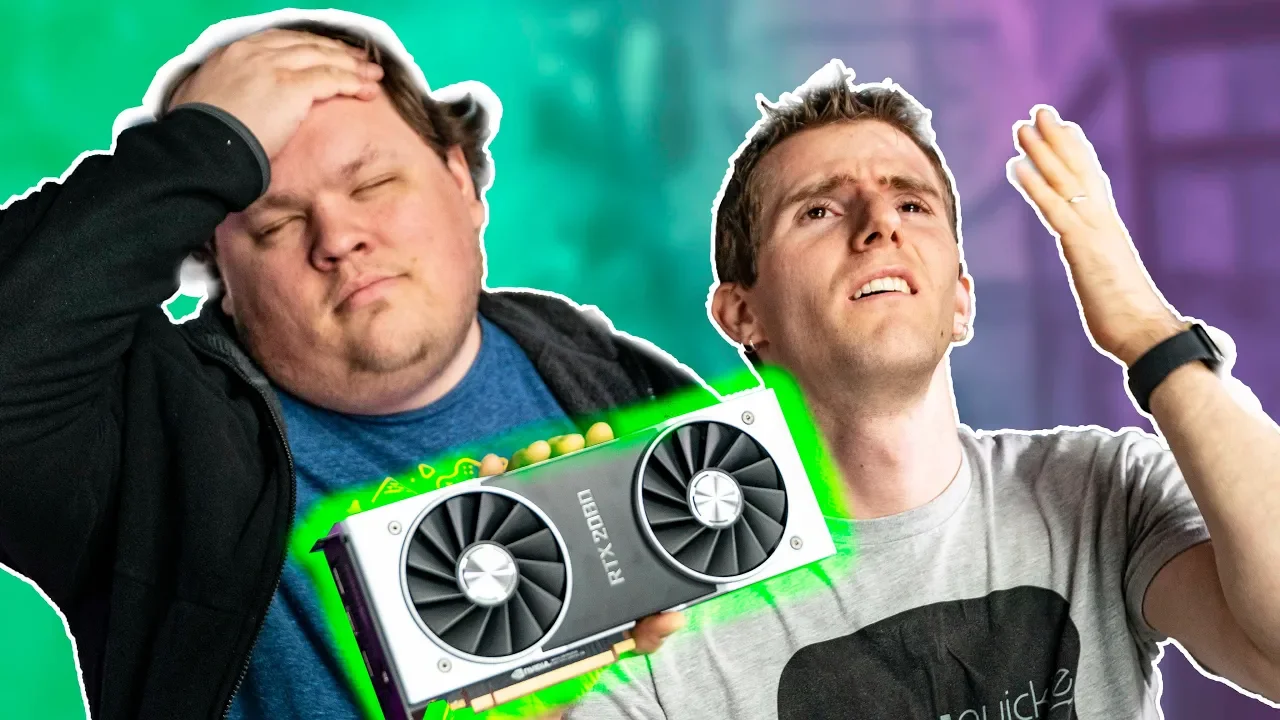
We Broke the WRONG Record! - RTX Overclocking
0 up · 0 down · 0 ratings
Promos
Visit squarespace.com and use offer code LTT for 10% off Mack Weldon: Use offer code TECHTIPS20 to get 20% off your next Mack Weldon order at geni.us We started out with one goal: Overclock Nvidia's new GeForce RTX 2080 Ti and document the process. But we got a little ahead of ourselves... Discuss on the forum: linustechtips.com Our Affiliates, Referral Programs, and Sponsors: linustechtips.com Get Private Internet Access today at geni.us Linus Tech Tips merchandise at designbyhumans.com Linus Tech Tips posters at crowdmade.com Our Test Benches on Amazon: amazon.com Our production gear: geni.us Twitter - twitter.com Facebook - @LinusTech Instagram - @linustech Twitch - twitch.tv Intro Screen Music Credit: Title: Laszlo - Supernova Video Link: youtube.com iTunes Download Link: itunes.apple.com Artist Link: soundcloud.com Outro Screen Music Credit: Approaching Nirvana - Sugar High youtube.com Sound effects provided by freesfx.co.uk
The video opens with Linus outlining the objective to push the GeForce RTX 2080 Ti beyond stock performance through extreme overclocking while documenting the process for viewers. They start by evaluating the stock card, a MSI RTX 2080 Ti Gaming X Trio, and demonstrate the built-in OC scanner which attempts to auto-tune core clocks to a stable frequency. The team cautions that even with automatic overclocking, power targets and memory clocks require manual tuning to maximize results, and they emphasize the importance of cooling as a limiting factor in extreme overclocks. With the OC scanner achieving around 1500 MHz and an average core overclock around 154 MHz, they proceed to manual tweaks, including voltage adjustments via a mod and memory tuning, to squeeze more headroom from the GPU. The video then shifts to a heavy cooling plan, featuring dual chillers and a liquid cooling setup, and they discuss practical constraints like backplate cooling, heat pads, and the challenges of integrating cooling for a high-TDP GPU within a compact chassis. As the overclocking session advances, they encounter stability issues, power-state transitions, and condensation management, steering the project toward sub-zero ambitions and a bespoke cooling solution using a GPU block, a CPU block, and a makeshift mounting strategy. The hosts document on-screen results, including stability tests at various clock speeds and the impact of the ramping power states on benchmark runs like 3DMark, with progress measured against community benchmarks such as JaysTwoCents and GamersNexus. In later phases, the team introduces a second power supply and refinements to RAM speed, CPU core frequency, and cooling topology to address stability during intense testing, culminating in a high-stakes push toward a top leaderboard position while contending with condensation and super-cooling risks. The video concludes with the team reporting a 2080 Ti overclock that lands in the high echelons of the leaderboard, followed by a lighthearted outro and calls to action for sponsors and community engagement, while acknowledging the ongoing challenges of safe, sustainable extreme overclocking. Throughout, the creators balance technical detail with humor, transparency about issues like coolant flow and condensation, and an emphasis on collaboration with the broader overclocking community.
Topics · technology · hardware · overclocking · benchmarking · extreme-computing
Questions answered
- What is the initial target for the RTX 2080 Ti in this video?
- The team aims to push the RTX 2080 Ti beyond stock performance through extreme overclocking and custom cooling, documenting the process from setup to sub-zero testing.
- What tool is used to automatically set core clocks, and what do the hosts caution about it?
- The OC scanner is used to auto-tune core clocks, but the hosts caution that manual tuning of power targets and memory clocks is still necessary for maximum stability and performance.
- Why do they modify the card to increase voltage, and what risks are discussed?
- Voltage modifications are discussed as a way to unlock higher clock speeds, but they acknowledge risks including potential damage to the GPU and warranty voiding.
- What cooling strategy is employed after the initial overclocks fail to satisfy stability tests?
- They move to aggressive sub-zero cooling using dual chillers, a GPU block, and a CPU block, along with evading condensation, to sustain higher clocks during testing.
- How do they address power delivery during extended benchmarking?
- They add a second power supply dedicated to supporting the GPU and CPU under extreme load to prevent power bottlenecks during long benchmark runs.
- What is the final achievement highlighted in the video?
- The team achieves a high-end RTX 2080 Ti overclock that places them among the top contenders on the leaderboard, following extensive tuning and cooling work.