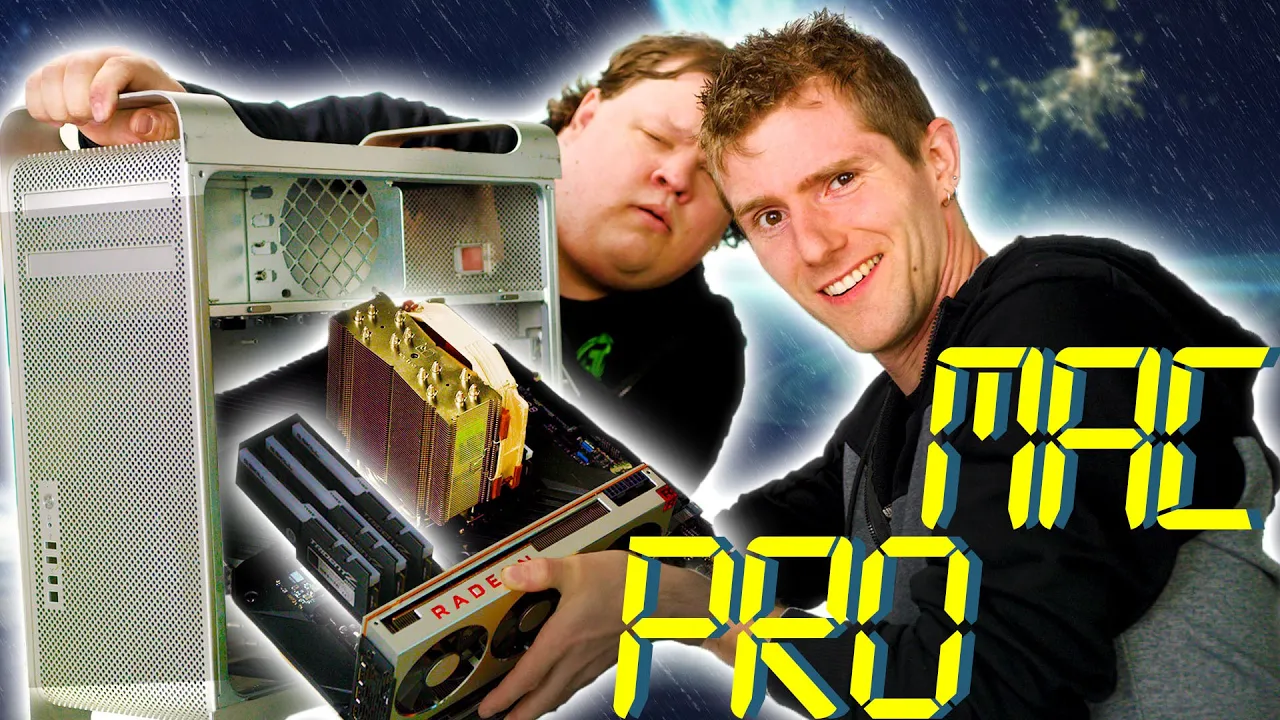
Challenging Apple's New Mac Pro
0 up · 0 down · 0 ratings
Promos
Check out the Massdrop CTRL Mechanical Keyboard at dro.ps Use offer code LINUS to save 50% on Madrinas Coffee for 72 hours at madrinascoffee.com Apple’s new Mac Pro will max out at 28 CPU cores, but that’s projected to cost as much as a midrange sports car. Nothing a bare metal Hackintosh can’t fix… Buy a Gigabyte C621 AORUS XTREME On Amazon: geni.us On Newegg: lmg.gg Buy a Xeon W-3175X On Amazon: geni.us On Newegg: lmg.gg Discuss on the forum: linustechtips.com Our Affiliates, Referral Programs, and Sponsors: linustechtips.com Get Private Internet Access today at geni.us Displate metal posters: lmg.gg Linus Tech Tips merchandise at lttstore.com Linus Tech Tips posters at crowdmade.com Our Test Benches on Amazon: amazon.com Our production gear: geni.us Twitter - twitter.com Facebook - @LinusTech Instagram - @linustech Twitch - twitch.tv Intro Screen Music Credit: Title: Laszlo - Supernova Video Link: youtube.com iTunes Download Link: itunes.apple.com Artist Link: soundcloud.com Outro Screen Music Credit: Approaching Nirvana - Sugar High youtube.com
The video documents Linus Tech Tips team attempting to build a bare metal Hackintosh to challenge Apple’s announced Mac Pro, focusing on a high core count Xeon system and intensive hardware preparation. The crew begins by outlining the plan to use a 28 core configuration, water cooling, and overclocking, aiming to outperform Apple’s new Mac Pro before it becomes widely available. They switch from an Asus Dominus board to a Gigabyte C621 Aorus Extreme due to expansion needs and Mac OS compatibility, highlighting the difference in PCIe slots and internal layout. Throughout the early segments, the team emphasizes the goal of achieving a Mac-like experience while staying on non-official software and hardware combinations, noting the compromises and tradeoffs inherent in a Hackintosh approach. The discussion also covers memory configurations, with an initial six 32 GB DDR4 modules and a long term plan for 384 GB using the fastest available sticks, which underlines their intent to maximize bandwidth and capacity beyond typical consumer builds. The video then transitions into installation steps, issues with Clover bootloader, and the initial boot attempt, clarifying that this is not a tutorial but a guided exploration of the practical steps involved and the hurdles faced when trying to macOS boot on non-Apple hardware. Closing sections pivot to performance results and future ambitions, where Geekbench, LuxMark, Blender, Final Cut Pro, and HandBrake are used to compare to Apple’s hardware. The team reports notable gains in multi-threaded cpu performance and single-thread improvements that exceed their previous virtualization-based approach, while gpu-related tests reveal a smaller uplift, suggesting that virtualization overhead affects CPU workloads more than GPU workloads. They conclude that the project shows promise, with the expectation that additional core counts, improved cooling, and further RAM expansion could push the Hackintosh closer to the Mac Pro’s capabilities, while acknowledging the time and engineering required to realize such a build. The video ends with a teaser for further progress, a sponsored segment, and a nod to community engagement and DIY hardware culture, inviting viewers to follow the project as it unfolds.
Topics · hardware · technology · benchmarks · computer_build · overclocking · macintosh_compatibility · performance
Questions answered
- What is the main goal of this Hackintosh project?
- To build a bare metal Hackintosh with a high core count Xeon system that can compete with or exceed the performance of Apple’s new Mac Pro, before the Mac Pro becomes publicly available.
- Which motherboard and GPU are used in the initial build?
- Gigabyte C621 Aorus Extreme motherboard and Radeon RX 7 graphics cards are used initially to maximize expansion and Mac OS compatibility.