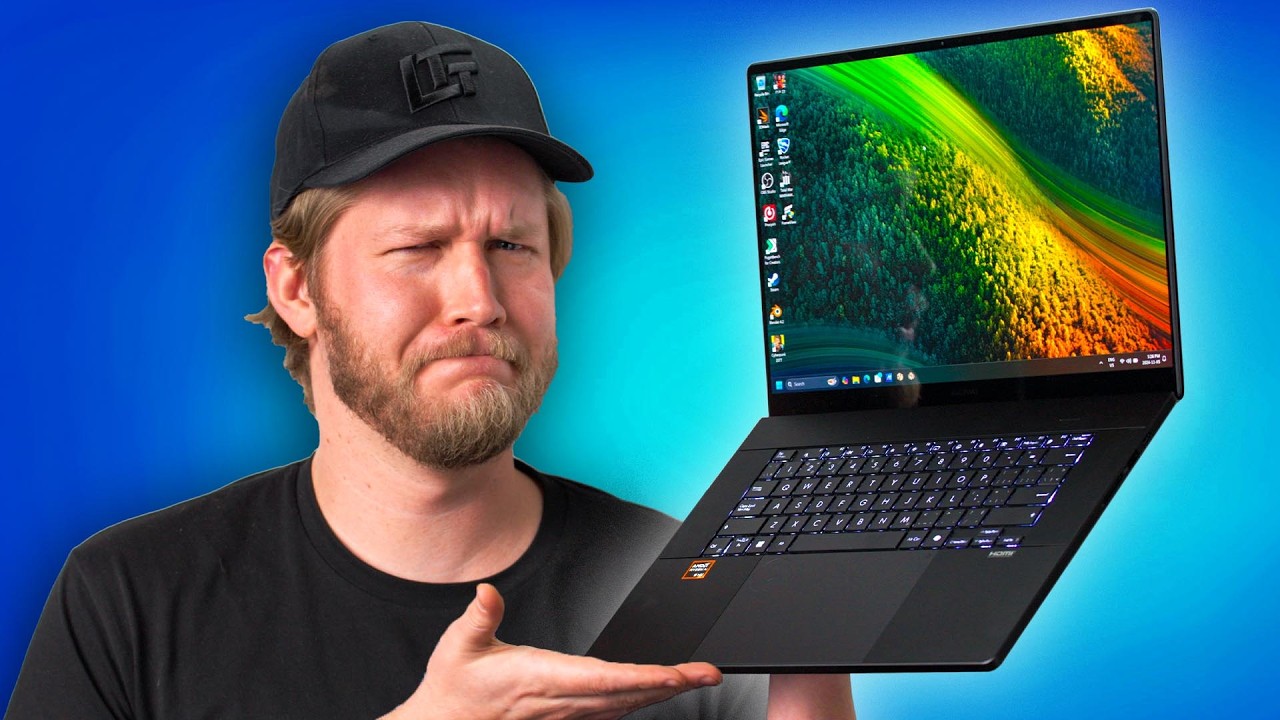
Trick your company in to buying this - ASUS ProArt P16 Laptop
0 up · 0 down · 0 ratings
Promos
Enter to win an ASUS ProArt P16 4K OLED Touchscreen Laptop ft. AMD Ryzen AI: bit.ly Or pick one up for yourself at bit.ly Learn more about AMD Ryzen AI: amdailaptops.com AMD sponsored us to take a look at the ASUS ProArt P16 and see for ourselves how their Ryzen AI can make life easier for content creators. But how's the laptop? What are the specs? And most importantly: how does Crab Rave sound? Join Alex as he dives in and finds out! Want us to unbox something? Make a suggestion at lmg.gg ► GET MERCH: lttstore.com ► GET A VPN: piavpn.com ► GET EXCLUSIVE CONTENT ON FLOATPLANE: lmg.gg ► SPONSORS, AFFILIATES, AND PARTNERS: lmg.gg CHAPTERS --------------------------------------------------- 0:00 Intro 0:50 First Impressions 1:20 Quick Look at the IO 2:23 Typing Test 2:45 The Trackpad Passes the A+ Exam 3:34 The Display 4:39 Touchscreen 4:51 What's Inside? CPU, RAM, Etc. 6:02 Testing out the AI Capabilities Feat. Cats & Dogs 7:16 Time for Some Gaming 7:49 Cooling Capabilities 8:13 Sound Test! 8:32 Camera & Microphone 9:03 Other Features 9:16 Let's Open it Up! 9:36 Battery Life 10:34 Limited Time Giveaway 10:40 Pricing 11:25 Outro
The video opens by framing the ASUS ProArt P16 as a high end laptop option in the G16 family with a professional twist, highlighting its touchscreen feature as a key differentiator. The host shares initial impressions about the chassis, noting its slim 17.3 mm profile and solid IO including USB A and USB C, HDMI 2.1, and a full sized SD card reader, which is praised for making photo editing workflows convenient. We get a close look at the keyboard, trackpad, and a small dial on the top edge used for quick system adjustments, with the impression that build quality is strong and the input device suite is well suited for creators. Display considerations are introduced early, emphasizing the Lumina OLED panel with 4K resolution at 16 by 10 aspect and 500 nits brightness, while acknowledging a 60 Hz refresh rate that may affect some use cases. The host explains the processor and memory configuration, featuring an AMD Ryzen AI 9 HX, 12 cores and 24 threads, up to 5.1 GHz, with 32 GB RAM and a 1 TB NVMe SSD, and touches on the optional 4070 GPU upgrade. The overall aim is to assess whether the machine can deliver color accurate visuals, performant AI assisted tasks, and a practical balance of portability and power for creators. The segment also previews AI capabilities like Muse AI for on device image generation, and transitions into practical tests for gaming, thermals, acoustics, camera performance, and battery life, building a comprehensive picture of what creators can expect in real world workflows.
Topics · Technology · Laptops · Consumer electronics · Artificial intelligence · Creative professionals
Questions answered
- What are the key hardware specs of the ASUS ProArt P16 as reviewed in the video?
- The laptop uses an AMD Ryzen AI 9 HX processor with 12 cores and 24 threads, up to 5.1 GHz, 32 GB of fast RAM, a 1 TB NVMe SSD, and an RTX GPU (4060 with 8 GB VRAM in the tested configuration, with an optional 4070 upgrade). The display is a 4K OLED Lumina panel at 16 by 10 with 500 nits brightness, and it includes a touchscreen and a built in pen friendly input approach.
- What are the main strengths and stated limitations of the ProArt P16 according to the reviewer?
- Strengths include the color accurate 4K OLED display, strong keyboard and excellent trackpad, robust IO including a full size SD card reader, capable AI on device performance, and solid thermal design. Limitations mentioned are the 60 Hz display refresh rate which may be a drawback for gaming, and some notes about touchscreen artifacts on the OLED panel. The price and regional configuration differences are also highlighted as considerations.
- Is the ProArt P16 considered more suitable for creators or gamers according to the video?
- The reviewer positions the ProArt P16 as a creator first laptop with strong color accuracy and AI capabilities, rather than a gaming machine, acknowledging that gaming is possible but not its primary focus.