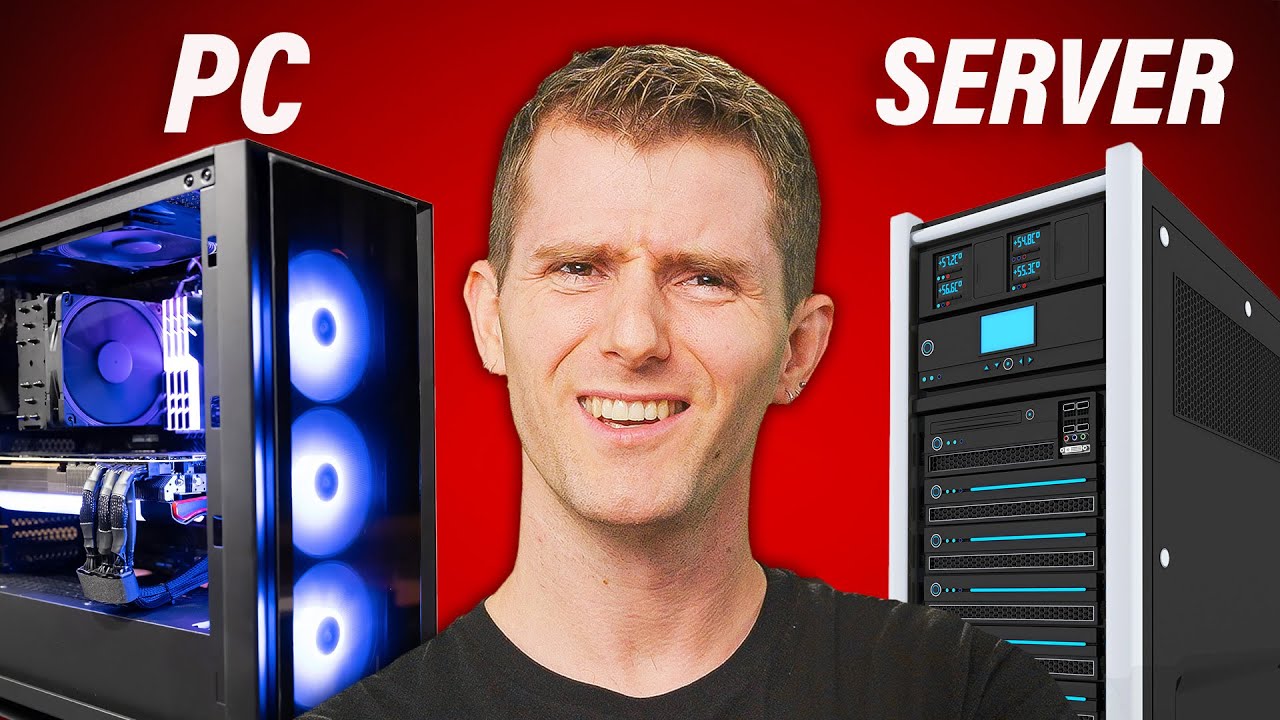
What’s The Difference Between A Server and a PC?
0 up · 0 down · 0 ratings
Promos
Check out Seasonic’s Vertex and Focus line of PSUs at seasonic.com How exactly does a server at a big business differ from that gaming PC sitting next to you? Find out in this video! Leave a reply with your requests for future episodes. ► GET MERCH: lttstore.com ► GET A VPN: piavpn.com ► GET EXCLUSIVE CONTENT ON FLOATPLANE: lmg.gg ► SPONSORS, AFFILIATES, AND PARTNERS: lmg.gg
In this Tech Quickie episode, the host explains that the fundamental components of both servers and gaming PCs are the same at a high level, including CPU, RAM, storage, motherboard, power, and cooling. The key distinction lies in how these components are configured to meet different goals. The video highlights three major design priorities for servers: power efficiency, reliability, and scalability, with data centers hosting thousands of machines where space and cooling costs are critical concerns. The host notes that servers often use rackmountable cases and specialized cooling layouts to maximize density, while power efficiency is driven not just by better power supplies but by selecting components and architectures that minimize waste. The discussion then delves into server CPUs, which typically feature many cores but operate at lower clock speeds to sustain high parallel workloads with controlled power usage. The episode also touches on technologies like virtualization and ECC memory as pivotal for reliability and flexible resource management in data centers. The segment concludes by illustrating how memory capacity, caching, and high-speed storage are deployed to support large-scale applications, with servers sometimes employing one-unit rack designs and advanced drive form factors to scale storage responsibly. Finally, the host emphasizes that server boards are often proprietary and purpose-built rather than DIY, underscoring the differences in use cases between enterprise infrastructure and consumer gaming rigs. The video wraps by tying these hardware choices to real-world outcomes in cloud services, data-center scale, and enterprise workloads, and it invites viewers to consider how design priorities shape performance per watt, latency, and reliability in large deployments. Throughout, several concrete examples are offered, such as cloud providers designing their own CPUs for efficiency and the role of high-speed RAM and ECC in safeguarding data integrity. By the end, viewers gain a clearer sense of why cloud giants do not simply deploy gaming PCs across data centers, and why the evolution of server hardware centers on optimizing scalability, reliability, and power efficiency rather than chasing consumer-grade specifications.
Topics · technology · data_center
Questions answered
- What is the main hardware difference between a server and a gaming PC according to the video?
- The main difference is in configuration and design goals: servers emphasize power efficiency, reliability, and scalability, often with many cores, large RAM, ECC memory, and optimized storage, while gaming PCs prioritize higher clock speeds and consumer performance.
- Why do servers use many cores at lower clock speeds?
- To handle a large number of simultaneous requests efficiently while keeping power consumption and heat output under control, improving performance per watt in data-center workloads.