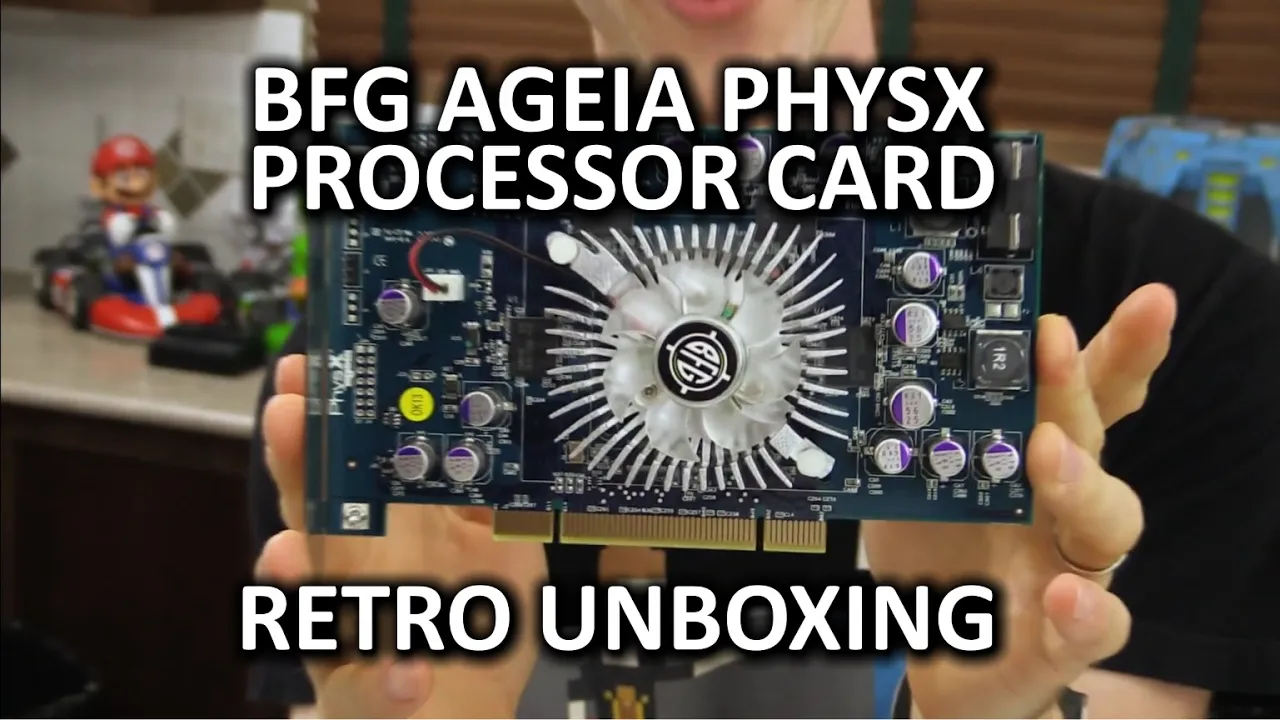
BFG Ageia PhysX Processor Card - Retro Unboxing
0 up · 0 down · 0 ratings
Channels and socials
Unboxing this PhysX Processor Card from BFG was a really cool look back at "what could have been" if NVIDIA didn't acquire Ageia back in 2008. I hope you enjoy this retro unboxing! Sponsor link: linustechtips.com Pricing & discussion: linustechtips.com Support us: linustechtips.com Join our community forum: bit.ly twitter.com @LinusTech Intro Screen Music Credit: Adhesive Wombat -
Check out his channel here: youtube.com Outro Screen Music Credit: Approaching Nirvana - Sugar High youtube.com
The video presents a retro unboxing of the BFG Ageia PhysX Processor Card, a relic from a time when hardware-accelerated physics was pitched as a core PC gaming feature. The host walks through the unboxing, highlighting the card’s minimal packaging, a blank IO shield, 128 MB of GDDR3 memory, and a simple aluminum heatsink with push pins. He notes that the card required external power via a four-pin Molex connector and used a PCI interface, indicating the bandwidth and era for which it was designed. The host frames the card within the broader history of physics acceleration, explaining that Ageia envisioned a dedicated physics processor working alongside the CPU and GPU, and discusses how Nvidia later acquired Ageia in 2008, bringing PhysX functionality onto the GPU rather than into a separate accelerator. He references a notebook from Dell featuring an Ageia mobile solution and recalls that, for a time, manufacturers experimented with dedicated physics hardware before the trend migrated to GPU-based acceleration. The discussion then pivots to the practical outcome: hardware-accelerated PhysX never became as ubiquitous as envisioned, with only a handful of titles offering true hardware paths, and even those were not deeply integrated across most modern games. The video ends with reflections on the missed opportunity for a killer app and a light commentary on the current state of physics in games, followed by a plug for affiliate links and a request for support through merchandise and sponsorships. Overall, the unboxing serves as a nostalgic look at a forked path in PC gaming hardware, contrasting the potential of a dedicated physics coprocessor with the eventual dominance of GPU-based PhysX and standard CPU-based physics in many titles.
Topics · technology · hardware · retro computing · video games
Questions answered
- What was the BFG Ageia PhysX Processor Card designed to do in gaming?
- It was intended as a dedicated hardware accelerator to offload physics calculations from the CPU, enabling more realistic object interactions such as collisions, deformations, and environmental reactions within games.
- Why did hardware-accelerated PhysX not become widespread after Ageia?
- Nvidia acquired Ageia in 2008 and shifted PhysX support onto the GPU, reducing the need for a separate PCIe physics card and resulting in hardware-accelerated PhysX becoming less common in practice, with only a small subset of games implementing true dedicated hardware acceleration.