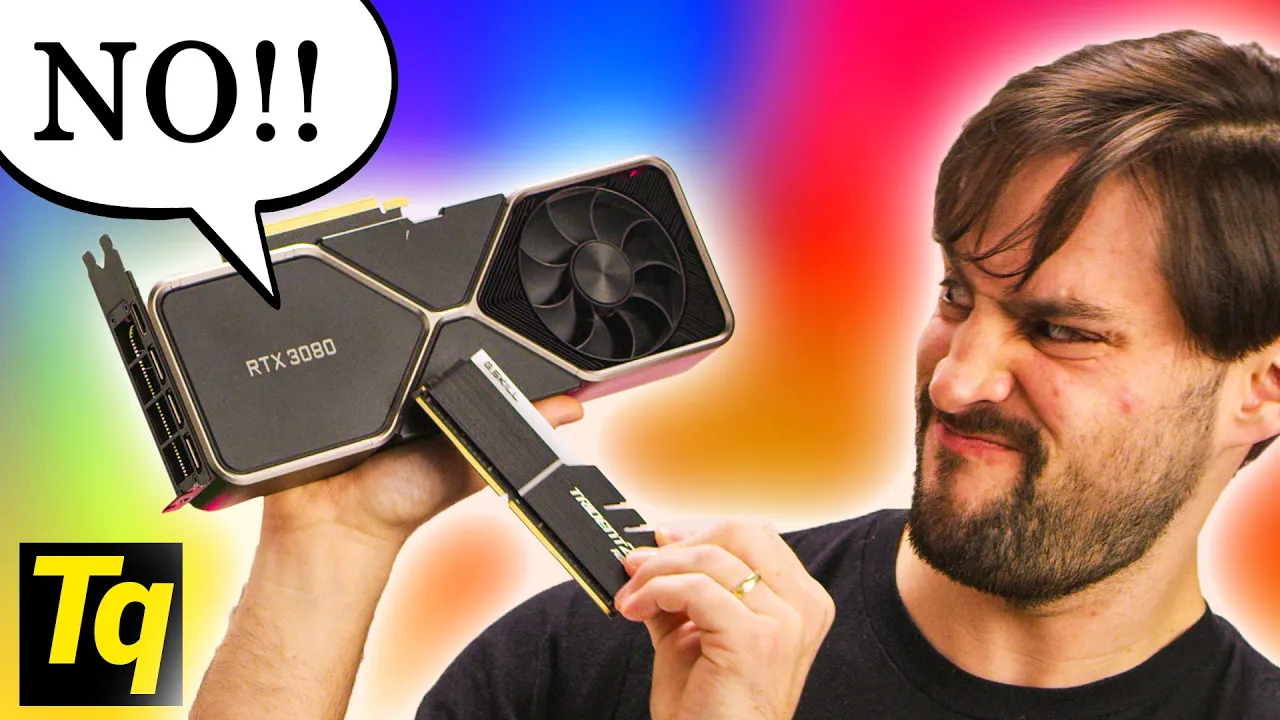
Your Graphics Card WON'T Do This (Upgrading VRAM)
0 up · 0 down · 0 ratings
Promos
Check out Bitdefender for your special offer: geni.us Why can't you add more memory to your graphics card? Leave a reply with your requests for future episodes, or tweet them here: twitter.com ►GET MERCH: lttstore.com ►SUPPORT US ON FLOATPLANE: floatplane.com ►LTX EXPO: ltxexpo.com AFFILIATES & REFERRALS --------------------------------------------------- ►Affiliates, Sponsors & Referrals: lmg.gg ►Private Internet Access VPN: lmg.gg ►MK Keyboards: lmg.gg ►Nerd or Die Stream Overlays: lmg.gg ►NEEDforSEAT Gaming Chairs: lmg.gg ►Displate Metal Prints: lmg.gg ►Epic Games Store (LINUSMEDIAGROUP): lmg.gg ►Official Game Store: nexus.gg ►Amazon Prime: lmg.gg ►Audible Free Trial: lmg.gg ►Our Gear on Amazon: geni.us FOLLOW US ELSEWHERE --------------------------------------------------- Twitter: twitter.com Facebook: @LinusTech Instagram: @linustech Twitch: twitch.tv FOLLOW OUR OTHER CHANNELS --------------------------------------------------- Linus Tech Tips: lmg.gg TechLinked: lmg.gg ShortCircuit: lmg.gg LMG Clips: lmg.gg Channel Super Fun: lmg.gg Carpool Critics: lmg.gg
The video explains why you cannot simply upgrade a graphics card by adding more VRAM. It starts by contrasting system RAM upgrades with graphics VRAM, emphasizing that VRAM stores textures and other visual assets that the GPU processes to render frames, and that these assets require extremely fast access. The host details how VRAM bandwidth is much higher than typical system RAM bandwidth, using concrete figures such as a 1 GB GDDR6X chip delivering around 84 gigabytes per second versus DDR4-3200 at about 26 GB/s. This high bandwidth necessitates many physical connections and is one reason why VRAM modules are soldered directly to the GPU board rather than in an exchangeable socket, and why upgrades by end users are impractical. The video notes that some memory types like HBM are integrated with the GPU to save space and reduce data errors, and explains that attempting to solder on higher-capacity VRAM is risky and likely to fail or brick the card due to firmware tuning and compatibility concerns. Viewers are reminded that, in many cases, performance issues are more often due to an underpowered GPU rather than insufficient VRAM, so upgrading the entire GPU is typically a better solution. For integrated GPUs, part of the system RAM can be used as VRAM, but even there, increasing the allocated video memory is done through BIOS settings rather than a hardware upgrade. The host concludes with a practical takeaway: research whether a GPU upgrade offers real benefits before buying more VRAM, and hints at additional topics suggested by viewers. The video closes with a sponsor plug for Bitdefender Total Security, highlighting features that help maintain gaming performance and privacy while receiving a special offer through the description link.
Topics · technology · hardware · graphics · gaming · computer science