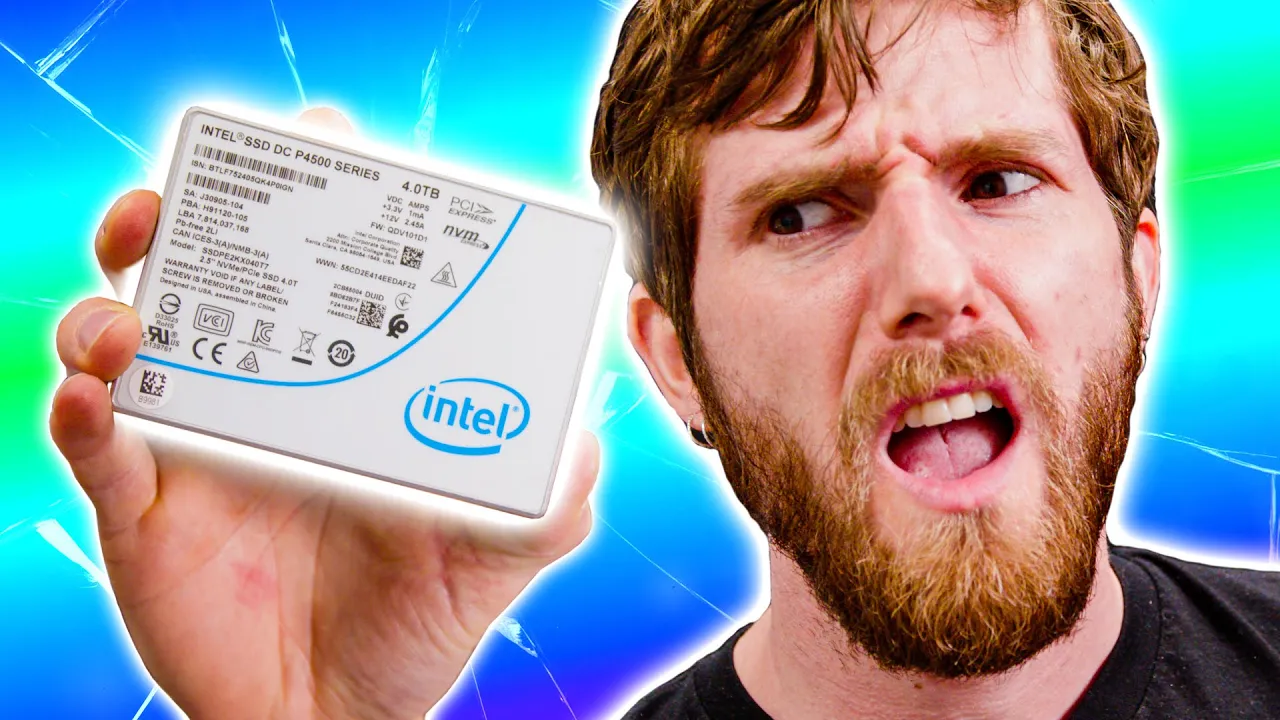
They sent my flawed product back.
0 up · 0 down · 0 ratings
Promos
Check out the DROP ENTR Mechanical Keyboard at dro.ps SmartDeploy: Claim your free IT software (worth $882!) at lmg.gg My RMA return from Intel finally arrived so I'm going to find out if they solved the problem I was having with these storage drives -and if so- what they changed. Buy Intel P4500 SSD (PAID LINK): geni.us Purchases made through some store links may provide some compensation to Linus Media Group. Discuss on the forum: linustechtips.com ►GET MERCH: lttstore.com ►SUPPORT US ON FLOATPLANE: floatplane.com ►LTX EXPO: ltxexpo.com AFFILIATES & REFERRALS --------------------------------------------------- ►Affiliates, Sponsors & Referrals: lmg.gg ►Check out our podcast gear: kit.co ►Private Internet Access VPN: lmg.gg ►Our Official Charging Partner Anker: lmg.gg ►MK Keyboards: lmg.gg ►Nerd or Die Stream Overlays: lmg.gg ►Official Game Store: nexus.gg ►Amazon Prime: lmg.gg ►Audible Free Trial: lmg.gg ►Our Gear on Amazon: geni.us FOLLOW US ELSEWHERE --------------------------------------------------- Twitter: twitter.com Facebook: @LinusTech Instagram: @linustech Twitch: twitch.tv FOLLOW OUR OTHER CHANNELS --------------------------------------------------- Mac Address: lmg.gg Techquickie: lmg.gg TechLinked: lmg.gg ShortCircuit: lmg.gg LMG Clips: lmg.gg Channel Super Fun: lmg.gg Carpool Critics: lmg.gg MUSIC CREDIT --------------------------------------------------- Title: Laszlo - Supernova Video Link: youtube.com iTunes Download Link: itunes.apple.com Artist Link: soundcloud.com Outro Screen Music Credit: Approaching Nirvana - Sugar High youtube.com Monitor And Keyboard by vadimmihalkevich / CC BY 4.0 geni.us Mechanical RGB Keyboard by BigBrotherECE / CC BY 4.0 geni.us Mouse Gamer free Model By Oscar Creativo / CC BY 4.0 geni.us
This video follows a high-stakes hardware troubleshooting journey centered on a large shipment of Intel P4500 SSDs that initially proved defective in a server deployment. The host revisits the claim that the drives were fundamentally flawed and recalls the prior testing that led to a decision to replace them under warranty. He walks through the surprise of receiving replacement drives that appear identical to the ones sent back, noting markings that suggest refurbishment rather than brand-new units. The narrative then delves into the uncertainty around whether Intel actually swapped in functional units or simply repackaged the same drives, highlighting the challenge of verifying RMA outcomes in complex enterprise systems. Throughout, the host frames the problem as an edge case involving drive-CPU interrupt timing, setting up the central question of what Intel may have changed in the replacement and whether the new drives resolve the original instability. The video shifts to hands-on testing with an AMD EPYC Rome server and a 96-terabyte NVMe storage array to probe the behavior of the drives under load. Initial observations reveal that isolated drives perform fine, but when placed into large arrays and subjected to sustained activity, the drives intermittently drop out and degrade array performance. A key diagnostic insight is explained: rapid CPU responses to storage interrupts can lead to data not yet buffered, causing repeated retries and performance penalties. A workaround is demonstrated that reduces the impact by limiting how aggressively the OS polls the drives, accompanied by a comparison to a courier system to illustrate the concept of scheduling work rather than reacting constantly. The host summarizes the overall pattern: the problem emerges under specific workloads and configurations, not in isolated tests. Further experimentation tests four and then eight drives in different storage modes, revealing that the system becomes more stable but still exhibits nuanced performance behaviors. The eight-drive configuration in parody mode shows improved throughput with caveats around how certain benchmarking tools report performance. A notable moment comes when a drive unexpectedly disappears from the array, prompting a closer look at hardware and firmware interactions. The video closes by weighing what changed during the replacement process, concluding that no firmware update appeared to have occurred and that the incompatibility is likely tied to the interaction between newer drives and second-generation AMD EPYC hardware. In the end, the host retains the replacement drives in a different chassis to maintain usable capacity, thanks Intel for the initial support and Liqid for a faster storage solution, and pivots to promoting related gear and sponsor content.
Topics · technology · hardware · enterprise-it · data-storage
Questions answered
- What did Intel change in the replacement drives, if anything?
- Based on the test results, there appears to be no firmware change between the replacement drives and the originals, suggesting that the issue may be tied to a specific edge-case interaction with certain platforms rather than a simple hardware or firmware fix.
- Did the replacement drives resolve the instability when used in large arrays?
- The replacement drives did not fully resolve the instability in all configurations; in some tests the drives behaved better under certain loads, but the overall problem persisted when driving large arrays, indicating the root cause is a complex interaction with the host system and workloads.
- Why did the host keep the new drives in a different chassis?
- To gain usable capacity while continuing to investigate, the host retained the new drives in a different server to avoid bottlenecked PCIe lanes in the original setup and to maintain a working storage path for video work.
- Was there a definitive conclusion about what Intel actually changed?
- No clear modification was identified; the investigation leaned toward a compatibility edge case rather than a documented firmware or hardware change, pointing to broader platform interactions as the likely culprit.