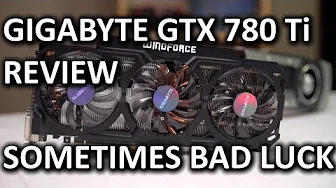
Gigabyte GTX 780 Ti Windforce Graphics Card
0 up · 0 down · 0 ratings
Channels and socials
Our unboxing & review of the GTX 780 Ti Windforce from Gigabyte reinforced an unfortunate truth about buying graphics cards. Sometimes, even if you buy a "good" card, you can get a dud overclocker :( Sponsor link: linustechtips.com Pricing & discussion: linustechtips.com Graphics card overclocking master sheet: docs.google.com Join our community forum: bit.ly twitter.com @LinusTech Intro Screen Music Credit: Adhesive Wombat -
Check out his channel here: youtube.com Outtro Screen Music Credit: Approaching Nirvana - Sugar High youtube.com
The video presents an unboxing and review of the Gigabyte GTX 780 Ti Windforce graphics card. It opens with an overview of the card’s specifications, highlighting a base clock around 1,20 GHz and boost clocks near 1,85 GHz, along with 3 GB of GDDR5 memory on a 384-bit bus. The Windforce cooler is described in detail, featuring a six-heat-pipe, triple-fan arrangement and a redirection block claimed to deliver strong cooling capacity up to 450 W. The card uses a reference PCB, and includes standard GPU features such as SLI up to four-way, CUDA, PhysX, GeForce Experience, and the new G-Sync technology. The unboxing covers the typical accessories and the box contents, but the focus quickly shifts to testing: stock performance suggests good cooling and stable operation, with the higher base clock possibly boosting performance relative to reference cards. The reviewers note that while the card runs cool and quietly, they did not achieve the same overclock potential as their reference GTX 780 Ti, likely due to silicon lottery on that specific unit. They emphasize that aging silicon and power/voltage limits can cap overclocking, with artifacts and instability appearing when attempting aggressive clocks, even as the card remains quiet and thermally solid. The verdict comes down to a balance between strong cooling, quiet operation, and OC variability, making it a strong but not universally overclocking-dominant option, especially for buyers who prefer reference PCB behavior with aftermarket cooling. The host invites viewers to share preferences between reference designs with aftermarket coolers versus aftermarket PCBs, and closes with a reminder to subscribe and engage with the Linus Tech Tips community.
Topics · hardware · graphics_cards · overclocking · reviews · technology
Questions answered
- What are the key specs of the Gigabyte GTX 780 Ti Windforce card?
- The card features a base clock around 1,20 GHz, a boost clock near 1,85 GHz, 3 GB of GDDR5 memory on a 384-bit bus, and a Windforce six-heat-pipe triple-fan cooler. It uses a reference PCB and supports SLI up to four-way, CUDA, PhysX, GeForce Experience, and G-Sync.
- How did the card perform in overclocking tests?
- Stock performance was solid with good temperatures and quiet operation. Overclocking results varied due to silicon lottery; one unit did not overclock as well as a reference card and showed instability at higher clocks, while another reference unit performed very well.