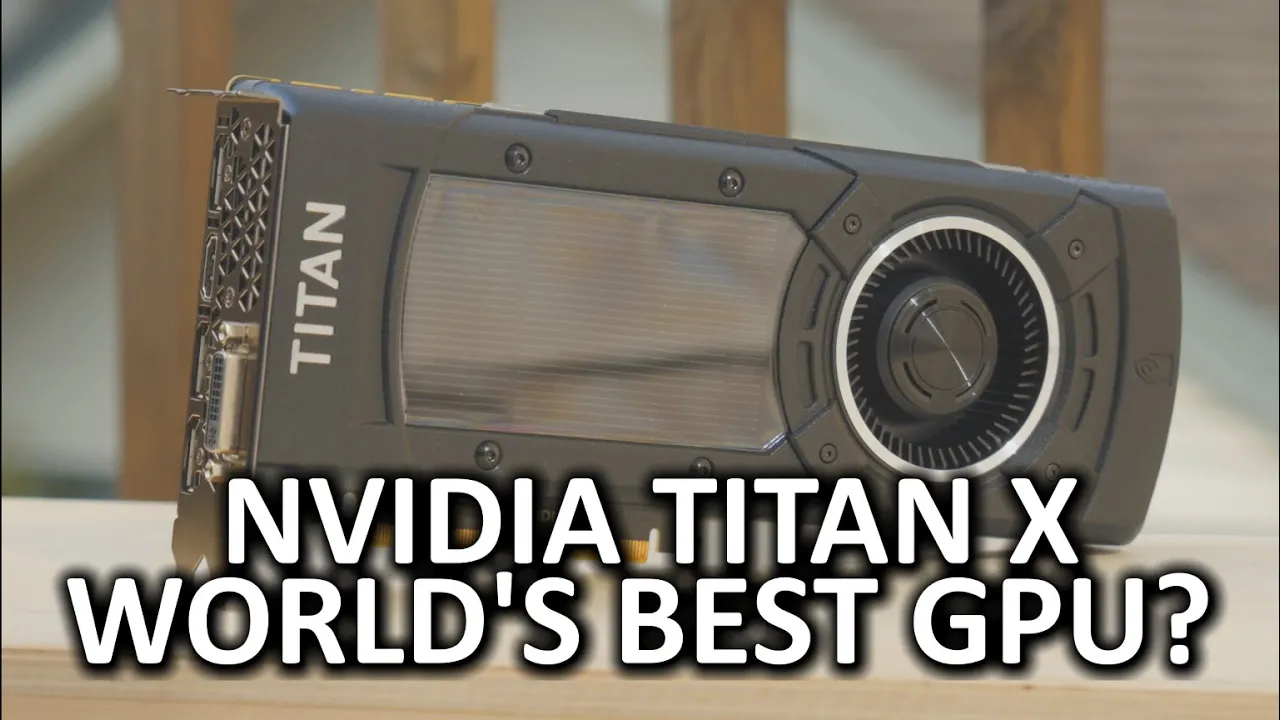
Nvidia GeForce GTX Titan X - The Best Video Card on the Market?
0 up · 0 down · 0 ratings
Channels and socials
Did Nvidia pull out all the stops on the Titan X, or does its performance leave something to be desired? Cheero link: cheero.net Corsair link: linustechtips.com Pricing & discussion: linustechtips.com Support us: linustechtips.com Join our community forum: bit.ly twitter.com @LinusTech Intro Screen Music Credit: Title: Laszlo - Supernova Video Link: youtube.com Outro Screen Music Credit: Approaching Nirvana - Sugar High youtube.com
The video opens with Linus expressing a mix of sympathy and skepticism toward Nvidia after the GTX 970 misstep, immediately setting up Titan X as the pinnacle of their current lineup. The host sets the stage by positioning the Titan X as the world’s fastest GPU and dives into the core specifications, highlighting an enormous 8 billion transistor GM200 GPU, a base clock around 1 GHz with boost clocks near 1075 MHz, and a hefty 12 GB of GDDR5 memory on a 384-bit memory bus. The narrative then shifts to cooling and chassis design, comparing the reference cooler to past Titan iterations and noting the robust copper vapor chamber, aluminum fins, and shroud. In the procedural portion, the video covers power delivery, PCIe connectivity, and multi-GPU readiness with SLI, while also pointing out the GPU’s multimedia capabilities like HDMI 2.0 and 5K support. The presenter touches on new Maxwell-era features integrated into the Titan X, including VXGI for real-time lighting, GeForce Experience AA techniques, and open-sourced PhysX paths, all framed as enhancements that will bleed into future games. The mid-section then emphasizes VR readiness, latency reductions for head-mounted displays, and a novel SLI mode that could dedicate one GPU to each eye in VR rendering, signaling a leap in immersive performance. Finally, the host turns to overclocking prospects, reporting on power draw, temperature, and clock ceiling while noting real-world constraints such as ambient temperature and cooling limits. The verdict suggests Titan X is an exemplary single-GPU solution for high-end gaming and computational workloads, albeit with power, price, and cooling considerations, inviting viewers to discuss upgrades, potential SLI comparisons, and next-generation Nvidia strategies on the forum. The closing segments tease additional products and accessories, praising the Titan X’s dominance while acknowledging the ongoing race for the next breakthrough, and inviting audience engagement through likes, comments, and affiliate-linked contributions.
Topics · technology · hardware · gaming · pc_components · vr · overclocking
Questions answered
- What are the key specifications of the Nvidia GeForce GTX Titan X as discussed in the video?
- The Titan X features an 8 billion transistor GM200 GPU, a base clock around 1 GHz with typical boost speeds near 1075 MHz, 12 GB of GDDR5 memory on a 384-bit bus, and 250 W TDP with power limits up to 275 W in overclocked scenarios, plus dual SLI connectors for multi-GPU configurations.
- What VR related improvements or features does the Titan X bring, according to the video?
- The video notes reduced latency between rendering and display for VR headsets, a VR-focused SLI mode to render left and right eye images on separate GPUs, and overall enhancements aimed at smoother VR experiences.