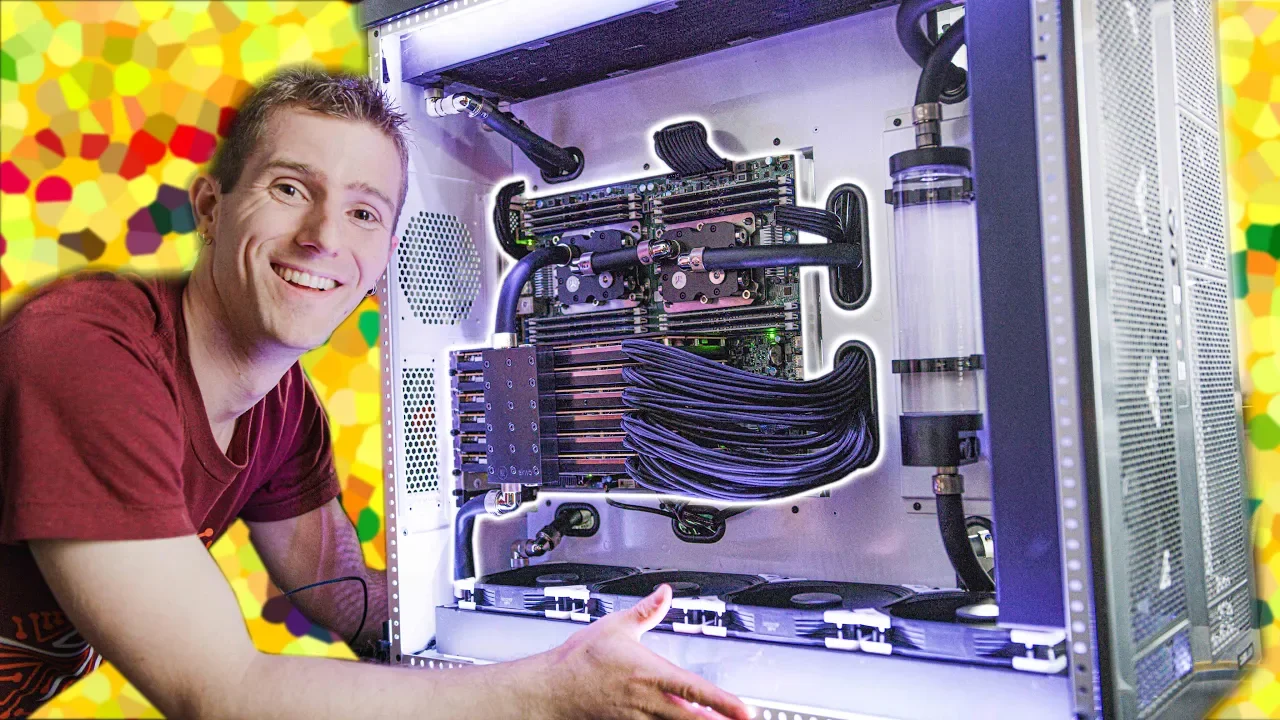
We FINISHED the $100,000 PC! - 6 Editors 1 CPU Pt. 6
0 up · 0 down · 0 ratings
Promos
Check out the Massdrop x Sennheiser HD 6XX Headphones at dro.ps Use code LTT and save 15% on Game and Web hosting at pebblehost.com After all the kinks have been worked out, we finally build and watercool the 6 Editors 1 CPU PC - let's see if it works! Buy Tyan Motherboards: On their site: lmg.gg Buy EKWB Watercooling Parts: On their site: lmg.gg On Newegg: lmg.gg Buy Kingston RAM: On Amazon: lmg.gg On Newegg: lmg.gg Buy Intel CPUs On Amazon: lmg.gg On Newegg: lmg.gg Buy Intel Optane SSDs On Amazon: lmg.gg On Newegg: lmg.gg Buy Cablemod Cables: On their site: lmg.gg Buy Noctua fans: On Amazon: lmg.gg On Newegg: lmg.gg Buy EVGA Power Supplies: On Amazon: lmg.gg On Newegg: lmg.gg Buy WD Hard Drives: On Amazon: lmg.gg On Newegg: lmg.gg Buy OneStopsSystems PCIe Expansion Cards: On their site: lmg.gg Buy Mellanox ConnectX Cards: On their site: lmg.gg Buy ASUS USB Cards: On Amazon: lmg.gg On Newegg: lmg.gg Buy NVIDIA Titan GPUs: On Amazon: lmg.gg On Newegg: lmg.gg Discuss on the forum: linustechtips.com Our Affiliates, Referral Programs, and Sponsors: linustechtips.com Get Private Internet Access today at geni.us Displate metal posters: lmg.gg Linus Tech Tips merchandise at lttstore.com Linus Tech Tips posters at crowdmade.com Our Test Benches on Amazon: amazon.com Our production gear: geni.us Twitter - twitter.com Facebook - @LinusTech Instagram - @linustech Twitch - twitch.tv Intro Screen Music Credit: Title: Laszlo - Supernova Video Link: youtube.com iTunes Download Link: itunes.apple.com Artist Link: soundcloud.com Outro Screen Music Credit: Approaching Nirvana - Sugar High youtube.com
This video documents the culmination of the $100,000 PC build, where the team completes a six editors, one CPU concept housed in a massive chassis. The hosts recap the extensive preparation, noting that the dual Xeon setup uses qualification-sample 8180 CPUs sourced from eBay to match a retail model, all cooled by an EK water cooling system. They explain the unique PCIe expansion strategy via a dedicated daughter board that breaks out a single 16x slot into multiple slots, enabling 14 expansion cards and two hot-pluggable USB ports per editor. The build also integrates dual 1600W EVGA power supplies for headroom, ten 10TB NAS drives for shared storage, and Optane as a fast cache to keep boots and programs snappy for all six editing stations. The crew emphasizes the ambitious goal of running six independent editing workstations with full virtualization, six Titan V GPUs, and substantial RAM, all without overclocking, to test both performance and reliability. As the rig comes together, the video details the aesthetic and practical choices, including water blocks on each GPU, a large aluminum chassis, and a layout designed for maximum cooling. They describe mounting challenges, such as reusing a Thermaltake case to accommodate the eight PCIe slots and integrating the EK water blocks and radiators to handle potentially 2000 watts of heat under full load. Despite the size and weight, the system is assembled with modular components to facilitate future upgrades, including the ability to reconfigure devices via the Unraid virtualization environment. The team also notes a temporary limitation in cooling capacity and the necessity of using high-end radiators and fans to keep temperatures in check during stress testing. Overall, the moment showcases both the engineering passion and the practical hurdles involved in turning a colossal concept into a functioning, multi-user workstation. The first power-on tests are executed with a minimal drive setup to verify basic operation, after which Cinebench and Blender stress tests are run to gauge thermal performance and stability. The results are promising: GPUs idle around mid-50s to 60C under load, CPUs stay in the 48-49C range on the board with an 8-core per editor configuration, and the system maintains stability under multi-application stress. The team discusses how multi-socket configurations do not automatically translate to perfect multi-threaded scaling, using Blender as an example where one CPU may be utilized more heavily than the other. They conclude that cooling is adequate and stability is achieved for running six virtual editing desktops, each with ample memory and dedicated Titan V GPUs, validating the core premise of a shared, high-performance workstation network. In the closing segments, the hosts reflect on the spectacle of the build, sharing sponsor notes and summarizing the practical outcomes. They highlight the successful demonstration of six fully provisioned editing workstations in a single tower, powered by two 1600W supplies and the tailored PCIe expansion architecture. Viewers are reminded of the project’s practical value for high-end video work and the potential for future upgrades, while also enjoying the sense of achievement from completing a complex engineering challenge. The video ends with appreciation for EK water cooling and the team’s willingness to push hardware boundaries, leaving the door open for more iterations and refinements in subsequent episodes.
Topics · technology · hardware · video-production · computer-hardware · system-design · custom-builds
Questions answered
- What was the primary goal of the six editors one CPU project, and was it achieved?
- The goal was to create six independent editing workstations within a single chassis using one CPU, six Titan V GPUs, and high-end storage and RAM, with virtualization handling six editors. The video demonstrates successful boot and stability tests, indicating the goal was achieved for the tested workload.
- Why did the team use qualification-sample CPUs instead of retail CPUs?
- They used QS 8180 CPUs because matching a retail Xeon 8180 for dual-socket systems was expensive, and QS chips are often functionally equivalent to retail parts aside from labeling, providing a cost-effective option for the build.