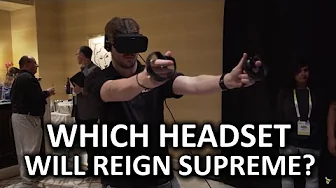
Oculus Rift vs HTC Vive - The current state of VR
0 up · 0 down · 0 ratings
Channels and socials
VR headsets have come a long way in a very short time. With the Oculus Rift CV1 release right around the corner, we wanted to give you an idea of what to look for. Ting link: linus.ting.com Corsair link: linustechtips.com Pricing & discussion: linustechtips.com Support us: linustechtips.com Join our community forum: bit.ly twitter.com @LinusTech Intro Screen Music Credit: Title: Laszlo - Supernova Video Link: youtube.com iTunes Download Link: itunes.apple.com Artist Link: soundcloud.com Outro Screen Music Credit: Approaching Nirvana - Sugar High youtube.com Sound effects provided by freesfx.co.uk
The video opens by framing Oculus Rift and HTC Vive as the two main contenders in early VR, noting that Rift initially held a lead in public attention but Vive quickly surged with new prototypes. The host references a poll showing a near equal split in public opinion, setting up a balanced comparison rather than a clear winner. He then refreshes the key hardware specs for the Rift consumer version, including 2160 by 1200 resolution on two OLED displays, 90 Hz refresh, and portrait orientation to optimize optics and IPD accommodation. Design choices are explained in detail, such as a lighter build, washable face foam, upgraded head straps with springs for a snug fit, and built-in on-ear headphones that aim to stay in place during active use. The discussion moves to sensor improvements and the promise of Oculus Touch as a future input method, emphasizing how independent handheld controllers could enhance immersion by aligning physical and virtual actions, from gripping objects to gesturing. The Vive side is then explored with its own set of improvements, including better screen quality, lighter weight distribution, camera integration for room awareness, and a novel tracking system that reduces occlusion issues. The host highlights that Vive’s Lighthouse sensors and revised controllers give more consistent tracking, while noting that the two platforms pursue different experiences: Rift leans toward seated or limited-movement demos, while Vive emphasizes room-scale locomotion and more natural interaction in space. The comparison delves into practical tradeoffs like tethered cables for Vive versus wireless-feel separation for Rift, and the ongoing challenge of power requirements and hardware costs, with the Rift priced around $600 and Vive positioned as a premium but potentially higher-cost setup. Finally the host previews broader market dynamics, acknowledging that VR adoption hinges on both hardware affordability and content availability, while hinting at optimizations for future PC builds and the ongoing evolution of VR input and experience design. The video closes with a candid note on long-form content, encouragement to engage with the channel, and a tease of upcoming VR-focused discussions and demos.
Topics · virtual reality · technology · gaming
Questions answered
- What are the main hardware differences between the Oculus Rift and HTC Vive as described in the video?
- The Rift uses two OLED displays with 2160 by 1200 total resolution at 90 Hz, with portrait orientation and improved lenses for clarity, plus newer head straps and integrated headphones. Vive uses similar display specs but emphasizes a lighter weight distribution, a front camera for room awareness, and a revised Lighthouse tracking system with improved sensors and a tracking ring on the controllers for better pose accuracy.
- How do the two systems approach VR interaction and movement differently?
- Oculus favors a more stationary or smaller-space experience with the possibility of room-scale using upcoming Touch controllers to mimic natural hand motions and gestures. Vive prioritizes room-scale movement with freedom to walk around within a larger tracked area, using lighthouse-based tracking and wand-like controllers to enhance immersion.
- What price points and market considerations are highlighted for Rift and Vive?
- Rift is discussed with a $600 price point, while Vive is positioned as a premium headset that could run closer to $899-$999, with total costs including computer hardware. The video notes the broader challenge of PC upgrade costs and content availability affecting early adoption.