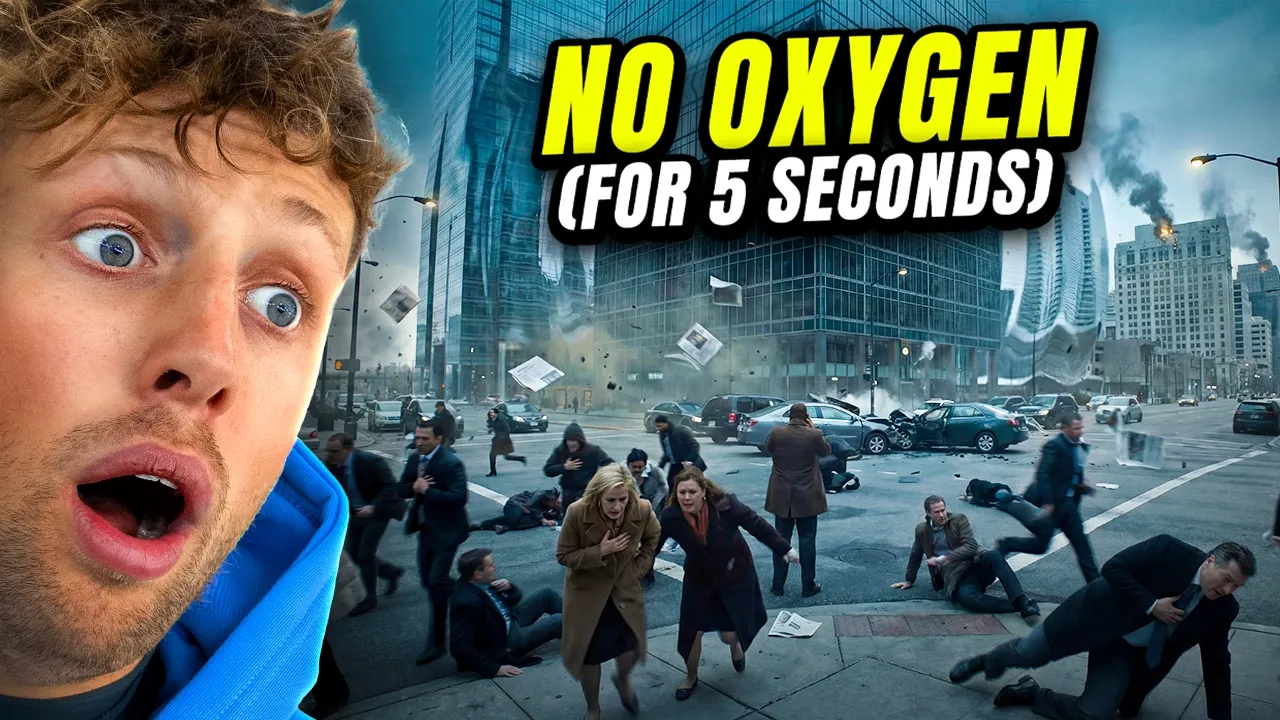
What If the World Lost Oxygen for Five Seconds?
0 up · 0 down · 0 ratings
Channels and socials
Original Videos: youtube.com youtube.com youtube.com SEND CLIPS TO REACT USING #SidemenReacts on Social Media! : Order food NOW at: eatsides.com : Access exclusive content at: sideplus.com : XIX Vodka: xixvodka.com : Subscribe to our Reacts Channel: youtube.com
: Sidemen Clothing: sidemenclothing.com Subscribe to our 2nd Channel: youtube.com : Sidemen Instagram: @Sidemen : Sidemen Twitter: twitter.com #SidemenReacts #Reacts #ReactsClips
The video explores the provocative thought experiment: what would happen if the world briefly lost oxygen for five seconds? It starts by noting that while five seconds might seem negligible for human breathing, the broader effects would cascade through infrastructure and geology. The discussion highlights that oxygen is not only vital for respiration but also for maintaining the air pressure, protecting the ozone layer, and enabling combustion. The hosts speculate on concrete structures losing their binding, metals fusing due to the removal of oxidation layers, and the atmosphere becoming unable to shield Earth from UV radiation. They also touch on the immediate visual and physical consequences, such as the sky appearing darker and the crust beginning to crumble, underscoring how a tiny loss of oxygen rapidly destabilizes many systems. The segment wraps by acknowledging the extreme improbability of such a scenario while framing the exercise as a basis for understanding oxygen’s central role in everyday and planetary processes. In the second portion, the hosts pivot to the consequences of a nearby black hole event, discussing gravitational forces, spaghettification, and the potential for planetary disruption. They explain that even a minuscule black hole could pose a threat if close enough, and they illustrate the catastrophic chain reactions: a distorted atmosphere, heat from accretion disks, and radiation hazards that would affect any survivors on asteroids or spacecraft. The conversation weaves in thought experiments about event horizons and multiple time scales, including what might happen to Earth’s orbit and the long term fate of the planet if it were drawn into a black hole. They acknowledge uncertainty in physics, noting that many aspects of such extreme events are not fully understood and could redefine fundamental concepts like gravity and matter interactions. The hosts balance awe and humor to keep the dialogue engaging while grounding claims in known physics. The final segment widens to long term futures, projecting how even in the far distant future life and planetary conditions could evolve under radically altered circumstances. They discuss ice ages, volcanic activity, asteroid impacts, and the potential reshaping of continents and oceans over hundreds of millions of years. The tone remains exploratory and speculative, tagging along with dramatic imagery (glaciers advancing, supervolcanoes erupting, and cosmic events) to illustrate how fragile planetary equilibrium is. Throughout, the hosts emphasize the importance of oxygen and other planetary safeguards, while acknowledging that many of these scenarios are theoretical bounds rather than predictions. The video closes with a reminder that, in reality, these events are extremely unlikely, and the audience is left with a sense of respect for the intricate balance sustaining Earth and life.
Topics · science · education · space · hypothetical scenarios · entertainment