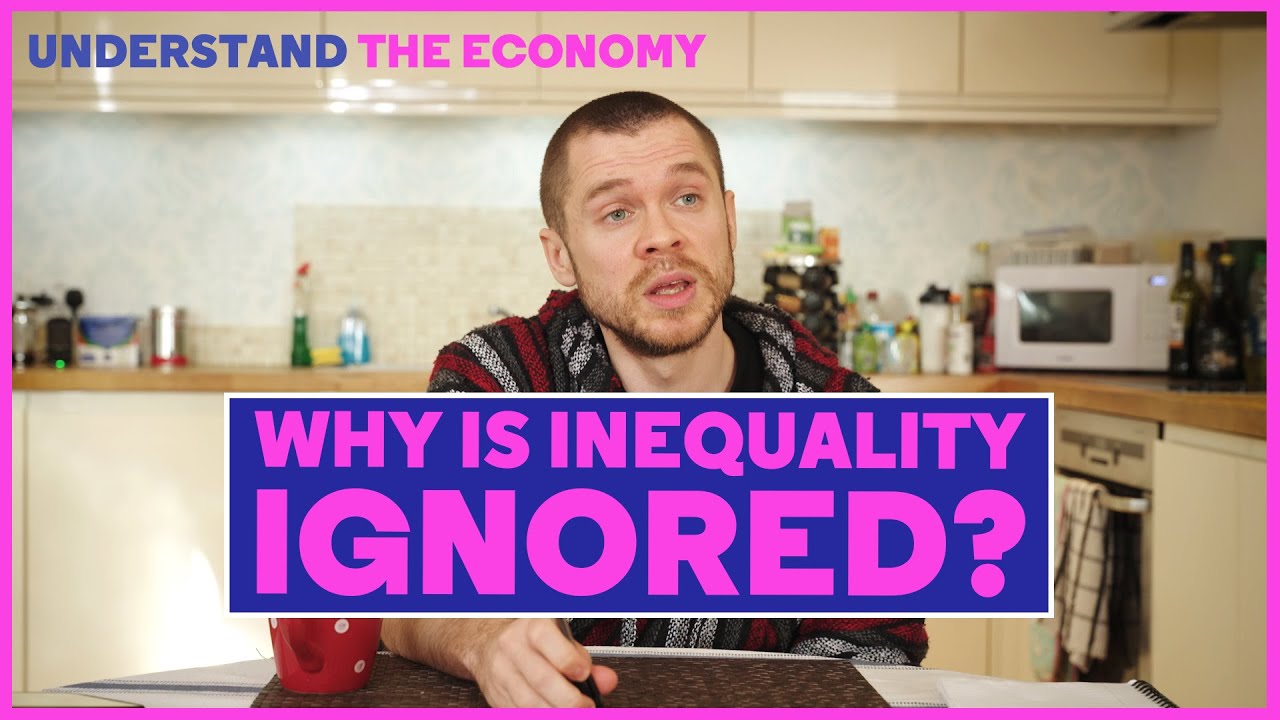
Understand the Economy Part 3: Why is Inequality Ignored?
0 up · 0 down · 0 ratings
Promos
Wealth inequality is surging in the UK and around the world. But economists in the media and universities are blind to it, leading to poor and misleading analysis. Why? Part 3 of Gary's Understand the Economy course. The Trading Game is out in paperback, order here: Amazon: amazon.co.uk Waterstones: waterstones.com First video on the channel (mentioned in this video re: correct predictions) - youtu.be UNDERSTAND, SHARE & PUSH BACK SPOTIFY - open.spotify.com INSTAGRAM - @garyseconomics TIKTOK - @garyseconomics BLUESKY - bsky.app X - twitter.com FACEBOOK - @garyseconomics PATREON - patreon.com DISCORD - discord.gg WEBSITE - garyseconomics.org SUBSCRIBE, SHARE & START A CONVERSATION Performed by Gary Stevenson @garyseconomics
Part 3 of Gary Stevenson’s Understand the Economy course delves into why wealth inequality is routinely ignored in mainstream economic discourse and policy. The video argues that modern economics is heavily mathematized and relies on representative agent models that erase distribution and inequality from consideration. It explains that this modeling choice makes it difficult to discuss how wealth is actually distributed across populations, since the models focus on aggregates like GDP, unemployment, inflation, and interest rates rather than on individual outcomes. The presenter also exposes structural incentives within academia and economics as a field, where successful prediction and prestige are tied to configurations that do not highlight unequal outcomes. He juxtaposes the long training path, high barriers to entry, and financial rewards of careers outside academia with the limited attention to inequality inside elite departments. The result, he contends, is a professional ecosystem that subtly discourages acknowledging or addressing growing disparities. The video then broadens the critique to the educational system itself, arguing that the lack of focus on inequality is reinforced by the way economics is taught, learned, and rewarded in top universities, which in turn shapes policy discussions and public understanding. A central thread is the idea that the mathematical complexity and abstraction of economic models act as a form of intellectual gatekeeping. Once a student invests many years in solving highly stylized models, the questions they are encouraged to ask become narrowly constrained, centering around policy levers like interest rates, taxes, and government spending without considering how those levers affect different groups. The speaker emphasizes that this leads to a cognitive bias where inequality is not regarded as a pressing empirical problem. He uses vivid analogies, such as Copernicus challenging the Earth-centered model, to illustrate how entrenched scholarly consensus can resist paradigm shifts even in the face of ample evidence. The narrative asserts that when predictions repeatedly fail, the discipline should adapt, yet the status quo persists because of institutional incentives to maintain the existing paradigm. The conclusion invites ordinary people to push back against elite economic narratives and to demand a more explicit treatment of inequality in both education and policy discussions. Further, the video discusses the personal and professional costs of maintaining the current setup. It argues that top economists who predict poorly,especially on topics like interest rates during crises,face little professional penalty, while those who challenge the prevailing framework are marginalized or leave academia for finance, where lucrative opportunities and less scrutiny attend their work. The speaker describes a career pipeline that discourages dissent: doing well in elite programs often means pursuing routes that reward conformity, not bold rethinking of distributional issues. He also points to the social composition of economics faculties, noting a concentration of wealth and elite background that reduces incentives to challenge the system publicly. The lecturer contends that this dynamic creates a powerful feedback loop, reinforcing inequality-consensus and muffling calls for redistribution or alternative economic models. The video closes by contrasting the complacent status quo with a call for collective action from ordinary viewers to demand more honest treatment of inequality in economics and policy, signaling upcoming content focused on personal experiences behind these viewpoints and practical educational material. Overall, Part 3 builds a cohesive critique of why inequality remains under-discussed in economics: dominated curricula, prestige-driven career paths, wealth-related incentives, and a lack of empirical attention to distribution all contribute to a systemic blind spot. The narrative invites viewers to view economics as a field capable of substantial reform, should it embrace questions about who is advantaged or harmed by policy choices. It also frames addressing inequality as essential to improving living standards, which the speaker argues are being eroded by unequal outcomes. The video ends with a promise to continue the conversation, expanding on personal experiences and further educational content to empower ordinary people to participate in shaping economic discourse and policy.
Topics · Economy · Wealth Inequality · Economic Education · Public Policy · Education
Questions answered
- Why do economists tend to overlook wealth inequality in models?
- Because modern economics often uses representative agent models that focus on aggregates and exclude distribution, making it difficult to analyze inequality.
- What incentives push economists away from discussing inequality?
- Academic career paths reward safe, high-visibility predictions and prestige, while wealth and employment opportunities in finance discourage dissenting voices and discussion of inequality.
- How does the video compare economic paradigm shifts to scientific revolutions?
- It argues that, like Copernicus challenging the geocentric model, new insights about inequality threaten established, prestigious models that lack distribution and are deeply entrenched.
- What evidence is cited for incorrect economic predictions?
- The video cites repeated incorrect predictions about interest rates after the 2008 crisis and during COVID, highlighting misaligned policy responses.
- What does the presenter propose for future content?
- To share personal experiences and provide educational material that helps ordinary people understand and challenge economic narratives surrounding inequality.