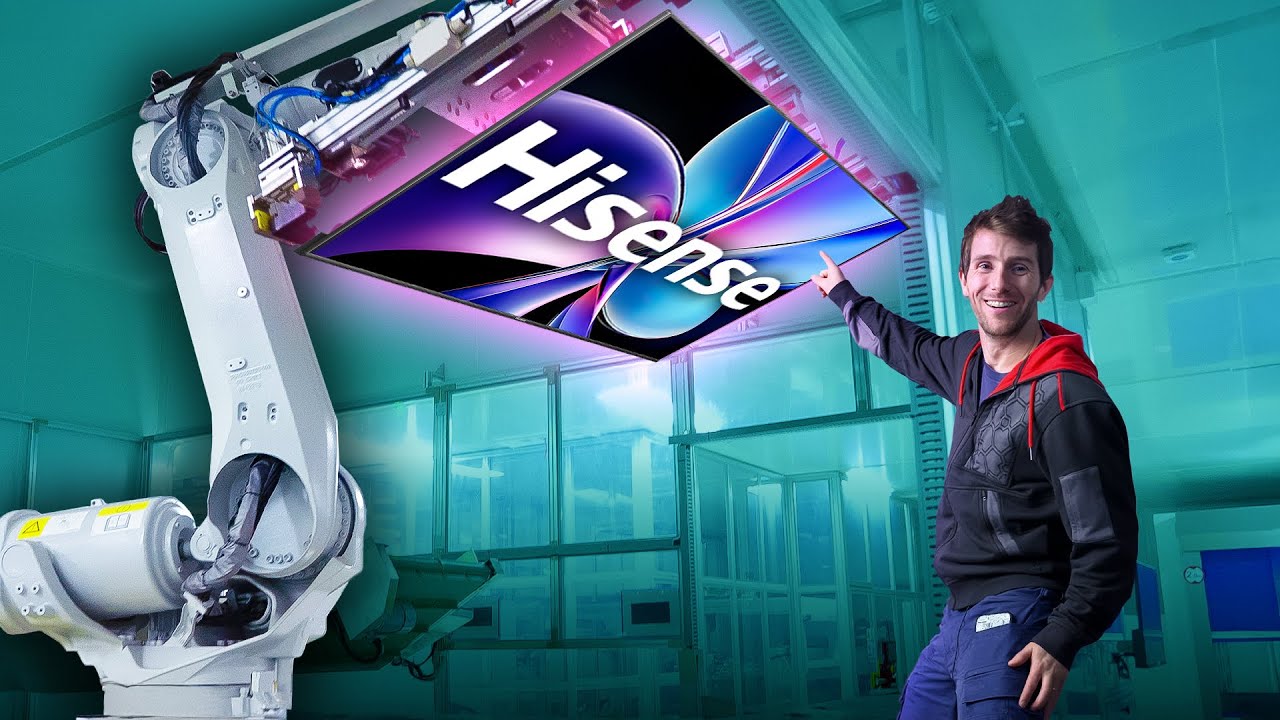
This TV Factory is the Coolest I’ve Ever Seen
0 up · 0 down · 0 ratings
Description
Thanks to Hisense for inviting us to their factory and sponsoring this video! Check them out at lmg.gg Get your own Hisense 116" UX RGB-MiniLED TV at lmg.gg Today Linus gets the joy of touring Hisense new state of the art factory in China. The TV factory is almost 100% automated and demonstrates everything from the back panel assembly to the circuit board to QA testing! Discuss on the forum: linustechtips.com
Promos
Check out our Channel Partners: Secretlab - Get up to $249 off during their Black Friday/Cyber Monday sale (ends Dec. 5 2025): lmg.gg PIA - Get the VPN of our choice: piavpn.com dbrand - Buy a "Circuit" series skin for your device: dbrand.com ► GET OUR MERCH: lttstore.com ► GET EXCLUSIVE CONTENT ON FLOATPLANE: lmg.gg ► SPONSORS, AFFILIATES, AND PARTNERS: lmg.gg Purchases made through some store links may provide some compensation to Linus Media Group. Affiliate links powered in part by affilimate.com Linus Sebastian is an investor in Framework Computer, Inc CHAPTERSs --------------------------------------------------- 0:00 Intro 0:52 Back Panel Assembly 3:10 Backlight 4:29 Panel Assembly 5:12 Front Bezel 6:09 Mainboard + PSU 6:43 Speakers 7:00 Wiring Harness 7:24 Onto Inspection 8:50 QA 9:22 Packaging 10:43 R&D Center 12:42 Outro
This video takes viewers on an in-depth guided tour of Hisense’s latest TV factory, highlighting how automation and AI are reshaping modern electronics manufacturing. The host describes a production line featuring seven first-of-their-kind machines and an automation rate exceeding 70 percent, with AI assisting various stages from backplane handling to glue application. A key focus is on quality and reliability, as the automation minimizes human error and deformation risks when dealing with ultra-large backplanes, while real-time machine vision and AI feedback drive continuous adjustments to processes such as primer application and backlight consistency. The segment then delves into the panel assembly stage, where automated peel, alignment, and bezel placement reduce breakage and improve precision to sub-0.02 mm tolerances, illustrating how advanced robotics are replacing many manual tasks. Toward the end of the tour, the host mentions the role of automation in packaging, shipping, and overall factory health monitoring, before shifting to a dedicated R&D center where RGB mini LED backlight technology is explored in depth, including a historical overview of backlight evolution and the advantages of RGB over traditional white backlights. The video closes with reflections on the factory’s culture of openness, future automation potential, and the goal of creating a world-class, zero-carbon display manufacturing facility in China, inviting viewers to learn more about Hisense and the products demonstrated. Overall, the tour showcases how automation, AI, and advanced display tech converge to improve efficiency, product quality, and innovation in large-scale TV production.
Topics · technology · manufacturing · automation · display-technology · rgb-mini-led · sustainability · industrial-automation · quality-assurance
Questions answered
- What makes the Hisense TV factory tour stand out in terms of automation?
- The factory tour highlights seven first-of-their-kind machines, an automation rate over 70 percent, and extensive use of AI and machine vision to control flow, apply materials, and monitor quality across backplane, panel assembly, and backlight processes.
- How does automation affect the panel and backlight stages?
- Automation enables precise panel placement with sub-0.02 mm tolerances, automated backplane handling, and an AI-guided glue and coating process that reduces defects and material use while improving backlight uniformity.
- What is RGB mini LED backlighting and why is it emphasized in the R&D center?
- RGB mini LED backlighting provides richer color and higher brightness by using red, green, and blue LEDs behind the pixels, enhancing HDR content. The R&D center discusses its development and potential advantages over traditional white backlights.