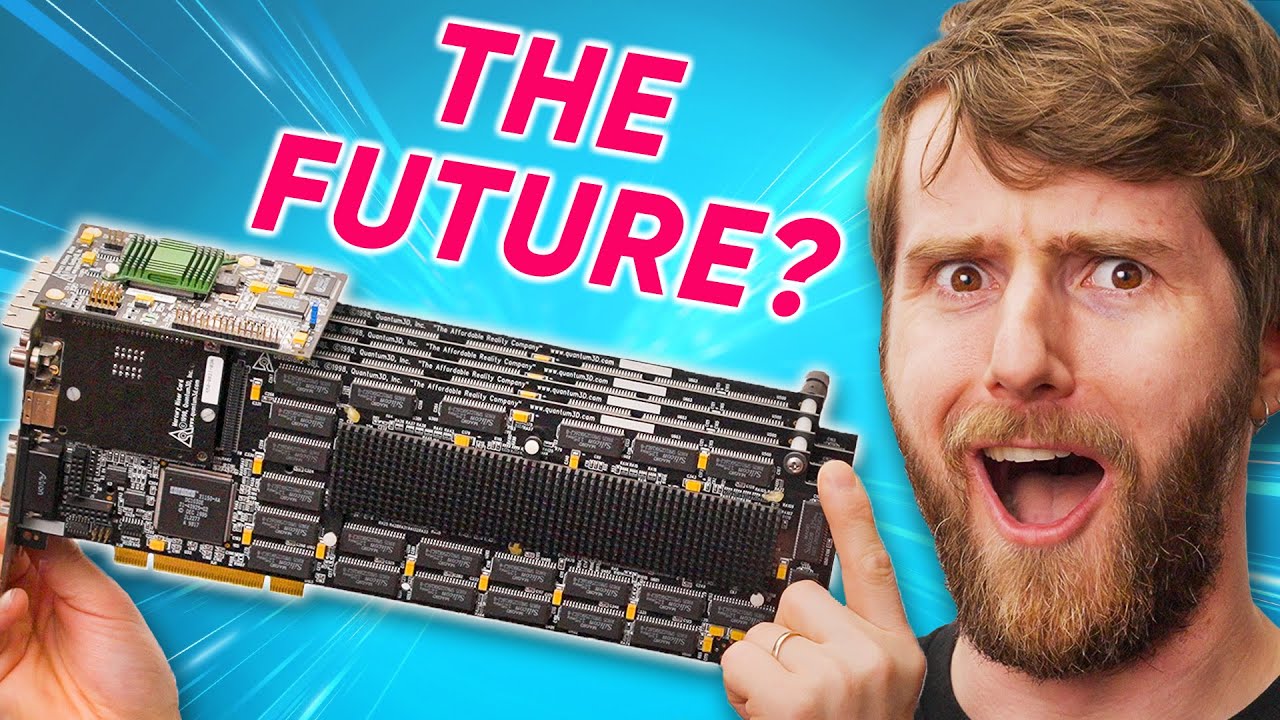
The AMAZING 8-Way SLI VooDoo Brick - Quantum3D Mercury
0 up · 0 down · 0 ratings
Promos
Save 15% with code LinusTechTips at vessi.com Try Zoho One free for 30 days with no credit card required here: zoho.com Multi-GPU setups like SLI and Crossfire once ruled the PC gaming scene, but micro stuttering and development complexity have made them obsolete. Why, then, are we boldly predicting that the future of gaming is multi-GPU? Discuss on the forum: linustechtips.com Ross Tregemba's YouTube channel: @gtastuntcrew302 ► GET MERCH: lttstore.com ► LTX 2023 TICKETS AVAILABLE NOW: lmg.gg ► GET EXCLUSIVE CONTENT ON FLOATPLANE: lmg.gg ► SPONSORS, AFFILIATES, AND PARTNERS: lmg.gg ► EQUIPMENT WE USE TO FILM LTT: lmg.gg ► OUR WAN PODCAST GEAR: lmg.gg FOLLOW US --------------------------------------------------- Twitter: twitter.com Facebook: @LinusTech Instagram: @linustech TikTok: @linustech Twitch: twitch.tv MUSIC CREDIT --------------------------------------------------- Intro: Laszlo - Supernova Video Link: youtube.com iTunes Download Link: itunes.apple.com Artist Link: soundcloud.com Outro: Approaching Nirvana - Sugar High Video Link: youtube.com Listen on Spotify: spoti.fi Artist Link: youtube.com Intro animation by MBarek Abdelwassaa @mbarek_abdel Monitor And Keyboard by vadimmihalkevich / CC BY 4.0 geni.us Mechanical RGB Keyboard by BigBrotherECE / CC BY 4.0 geni.us Mouse Gamer free Model By Oscar Creativo / CC BY 4.0 geni.us CHAPTERS --------------------------------------------------- 0:00 Intro 1:21 Quantum3D made some crazy GPUs 2:31 Setting up the Mercury Brick 3:46 Powering it up and gaming with no jaggies whatsoever 5:42 Turning off anti-aliasing is easy... 6:30 It's a night and day difference 7:08 Simulation demos 8:04 Quantum3D still exists! And they were bigger than you think 11:02 3dfx's demise didn't stop multi-GPU development 12:57 Consumer multi-GPU's demise - Micro-stuttering and support 14:45 Multi-GPU is coming back - And Apple is pioneering it 16:43 Conclusion - It took a long time to get here
The video delves into a fascinating slice of gaming and hardware history by showcasing the Quantum3D Mercury eight-GPU brick, a legendary multi-GPU setup from the late 1990s. It begins by contextualizing multi-GPU as a concept that never truly died, arguing instead that the real challenge has always been performance and software support. The host unpacks the Mercury brick, a four-card, eight-GPU configuration built around two Voodoo 2 GPUs per card, and explains how it could render a single workload with extraordinary anti-aliasing through a bridge-like interconnect. The narrative then moves to the practicalities of running this beast in a 1999 simulator chassis, including the hardware choices, such as dual Pentium III CPUs, a large power supply, and thick cooling, while Windows NT provides the operating environment for both gaming demos and simulator software. Finally, the discussion broadens to the evolution of multi-GPU technology, tracing a line from arcade and simulation use to consumer GPUs, and highlighting how Apple’s M1 Ultra architecture mirrors some of the same ideas, setting the stage for a renewed interest in multi-GPU designs in modern times. The video also examines the benefits and limitations of different multi-GPU approaches, including split frame rendering, alternate frame rendering, and the later CFR (checkerboard frame rendering). It contrasts the high-smoothness, high-AA results achieved in the Mercury brick with the later issues of micro-stuttering and diminishing developer support for consumer multi-GPU configurations. Through archival context, the host shows how early 3dfx and Quantum3D products pushed developers to optimize for multi-GPU workflows and how modern interconnects and packaging solutions could finally overcome bandwidth hurdles. The discussion ties these historical techniques to contemporary hardware trends, such as Apple’s UltraFusion concept, and posits that a new wave of multi-GPU designs could emerge driven by advancements in interconnect speed and chiplet-based architectures. In sum, the video argues that the multi-GPU dream is reviving, driven by both historical lessons and forward-looking hardware innovations, with Apple playing a notable role in this resurgence. As a capstone, the host reflects on the broader implications for gaming, simulation, and professional workloads, noting that the Mercury brick demonstrates how ultra-smooth rendering can be achieved even at lower resolutions when anti-aliasing is aggressively deployed across multiple GPUs. The piece ends by acknowledging Quantum3D’s continued relevance in simulation hardware and software, suggesting that the lineage from 1990s arcade and simulation tech to today’s high-performance GPUs is thinner than many realize. Viewers are left with an appreciation for retro hardware’s influence on modern design and a sense that multi-GPU systems, with the right interconnects and software support, may reemerge as a practical option for certain use cases.
Topics · technology · computing history · hardware · graphics
Questions answered
- What makes the Quantum3D Mercury brick notable in gaming history?
- The Mercury brick is a four-card, eight-GPU system that used two Voodoo 2 GPUs per card and employed a bridge-based interconnect to render a single workload with exceptionally smooth anti-aliasing, a capability unusual for its era.
- How did multi-GPU approaches evolve from the 1990s to today?
- Early multi-GPU setups used master GPUs and external dongles or frame partitioning (split frame rendering) which caused limited resolution and more complexity. Later architectures integrated bridges and CFR-like methods, improving performance but facing issues like micro-stuttering and limited developer adoption until newer interconnects and chiplet-based designs promised better coherency and scalability.
- What modern parallels are drawn in the video between Quantum3D tech and Apple Silicon?
- The video compares the Mercury brick concept to Apple’s UltraFusion in the M1 Ultra, illustrating how two dies can act as a single unit with high bandwidth interconnects, enabling multi-die GPU performance that avoids traditional downsides of multi-GPU setups.