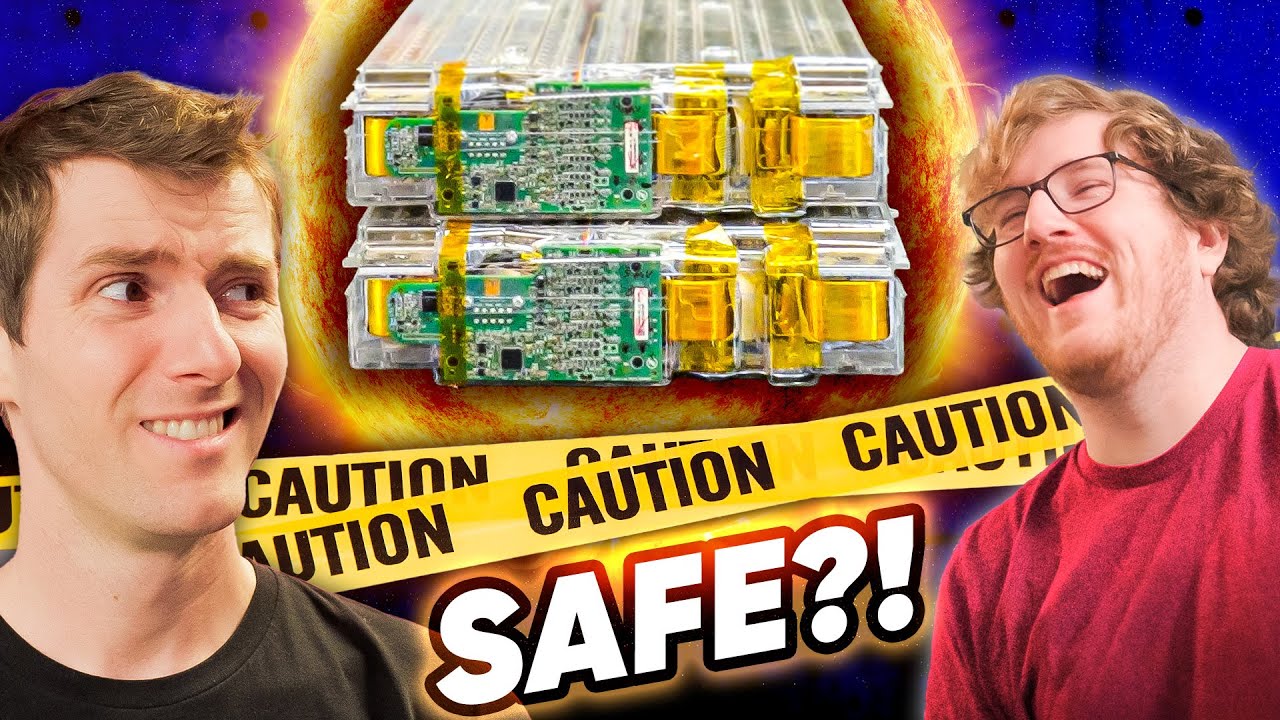
He Promised this DIY House Battery Won’t Explode
0 up · 0 down · 0 ratings
Description
Join us and over 70 million players in one of the most comprehensive vehicle combat games EVER MADE!
Check out War Thunder for free today on PC, Console, and Mobile using our links! PC/Console: playwt.link Mobile: wtm.game Linus has built his home into a tech paradise... PCs, 10-gig networking, screens everywhere, but frequent power outages keep spoiling the fun. But, we're thrifty, so why not make a Tesla-based DIY home battery backup solution? Will these scrapped Model S battery modules finally keep his house online during outages, or will he regret letting Jake tackle this? Discuss on the forum: linustechtips.com Buy a EG4 6000XP Inverter: lmg.gg Buy an EG4 LL 48V 100Ah LFP Rack Mount Battery: lmg.gg Buy a Vero BMS V2: lmg.gg Buy a Vero BMS Display: lmg.gg Buy a Vero 400 Amp Current Sensor: lmg.gg Buy a Vero TE
Contact
Contactor: lmg.gg Buy a Victron Energy Fuse Holder/Bus Bar: geni.us Buy Mouser 150 Amp 70DC Fuses: lmg.gg Buy Mouser 80 Amp 70DC Fuses: lmg.gg Buy a AMZCNC Hydraulic Crimper: geni.us Buy Spartan Power 4AWG Wire: geni.us Buy Mouser 4AWG Ring Terminals: lmg.gg Buy a Leviton I14-30 Plug geni.us Buy a Leviton L6-30 Receptacle: geni.us Buy a Leviton L14-30 Receptacle: geni.us Buy a Leviton L6-30/L14-30 Receptacle Cover: geni.us Buy a Leviton 5-15 Receptacle: geni.us Buy a Leviton 5-15 Receptacle Cover: geni.us Buy a BELL Single Gang Electrical Box: geni.us Buy a Schneider Electric Small Electrical Panel: geni.us Buy a SIEMENS Grounding Bar for Panel: geni.us Buy a Schneider Electric 15 Amp, 2 Pole Breaker: geni.us Buy a Schneider Electric 30 Amp, 2 Pole Breaker: geni.us ► GET OUR MERCH: lttstore.com ► GET EXCLUSIVE CONTENT ON FLOATPLANE: lmg.gg ► GET A VPN: piavpn.com ► SPONSORS, AFFILIATES, AND PARTNERS: lmg.gg Purchases made through some store links may provide some compensation to Linus Media Group. CHAPTERS --------------------------------------------------- 0:00 Intro & The Techie's Dilemma 1:13 Sponsor 1:26 Why Commercial UPS Systems Fall Short 3:04 Scrapped Tesla Battery Modules 4:07 Building Our DIY Battery Packs 5:53 Inverters & Charging Basics Explained 8:03 Adding Essential Safety Measures 10:19 Connecting to Household Power 12:19 Installing and Testing the System 16:02 Linus' Reaction & Battery Details 18:13 Testing the Tesla Powerwall Setup 19:06 Conclusion & Future Plans 19:35 Sponsor 20:28 Credits
This video follows Linus and team as they attempt to solve the power reliability issues in a high-tech home by building a DIY home battery backup using scrapped Tesla Model S modules. The team starts by outlining the problem: frequent outages interrupt a tech-forward lifestyle, even with solar panels on the roof. They decide to pursue a cost-conscious, yet safer, DIY path rather than buying premium commercial UPS systems that only last a few minutes. The plan is to create a 48-volt battery bank by wiring four 24-volt Tesla modules in paired series and then combining those pairs in parallel, with safety interlocks and proper fusing. They introduce the essential components, including an EG4 inverter charger designed for 48-volt systems, a Vero BMS for battery management, fuses, a high-current contactor, and a clamp-on current sensor to monitor charging. The narrative shifts to build details, emphasizing safety features like fuses and a contactor to automatically disconnect if something goes wrong. The crew discusses input and output wiring, the necessity of a 240-volt capable plug to handle both 120 and 240-volt household needs, and the concept of treating the system as a standalone UPS during testing. The video blends hands-on assembly with explanations of electrical concepts, such as DC versus AC power, the role of inverters, and how the BMS communicates with the pack, while also comparing their DIY approach to more expensive off-the-shelf racks using safer lithium iron phosphate cells. Finally, they reflect on performance, potential future upgrades, and how this project could scale into a larger battery wall, all while acknowledging the ongoing need for safe installation practices and professional support for critical power systems.
Topics · science_and_technology · home_improvement · renewable_energy · electronics · diy_projects
Questions answered
- What is the main problem the video aims to solve with a home battery backup?
- The video aims to solve the problem of frequent power outages that disrupt a tech-forward home by creating a reliable, safe, and affordable home battery backup system.
- Why did the team choose Tesla Model S modules for the initial battery pack?
- They chose scrapped Tesla Model S modules because they provide a low-cost source of battery cells with built-in balance and sensor boards, enabling a quicker, cheaper way to assemble a 48-volt pack with safety features.
- What safety features are incorporated into the DIY battery system to prevent hazards?
- Key safety features include fuses for each series pair, a high-current contactor, a Vero BMS for monitoring temperatures and voltages, a clamp-on current sensor, and careful wiring practices to avoid short circuits and overheating.
- What is the role of the EG4 inverter charger in this setup?
- The EG4 inverter charger converts DC from the battery into AC for the house, and can also draw AC from the grid to charge the battery, supporting both backup power and charging.
- Why is 240-volt capability important in this design?
- 240-volt capability allows powering both legs of the house (L1 and L2) and neutral from a single input, enabling the system to back up homes that require 240-volt loads in addition to standard 120-volt circuits.