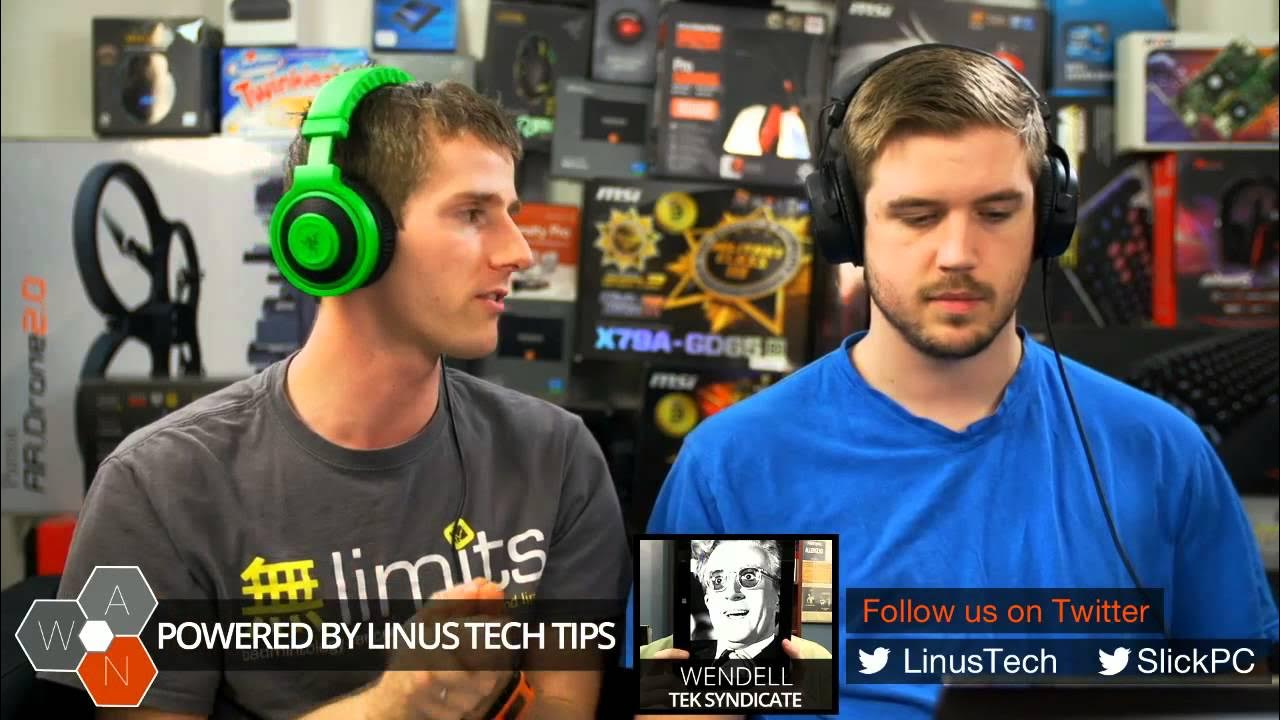
The WAN Show: AMD Press conference, Screw low end stuff and GUEST Wendell Tron - Nov 15, 2013
0 up · 0 down · 0 ratings
Promos
After party : Sorry no official afterparty this week but Luke ran a super long unofficial afterparty on the twitch.tv channel! Live Stream Doc:linustechtips.com Hotspot Shield Link: bit.ly - Offer code LINUS Squarespace giveaway: For a chance to win a free one year subscription of Squarespace create a website using the free trial of Squarespace that you can receive by offer code "LINUS11". Then tweet a link to your website with "#linussquarespace" 5:44 Why we don't review low end stuff 9:10 Wendell Joins the WAN Show! 12:13 Intel fridges and automated food selection(audio issues for about 30 seconds before this point 56:10 AMD Neversettle confusion 1:00:05 Xbox one swims with the fishes(sharks) 1:02:05 Samsung and intel get 36 more companies to back Tizen 1:06:17 Twitter Blitz 1:13:40 Humble bundle store - Good/Bad? 1:17:34 Rootkits banned on some android kitkat phones 1:20:29 AMD to bring TressFX 2.0 with Fur and Grass support
The WAN Show episode dated November 15, 2013 opens with a candid acknowledgment of technical hiccups that delayed the broadcast. Linus and the team explain they had to replace a faulty headphone splitter, fight through display port issues, and reconfigure the audio setup during the pre-show, all while keeping the audience informed about the challenges they faced. They emphasize that the late start was not for lack of content, but for ensuring a stable stream, and they assure viewers that the show would go on despite the obstacles. The first big topic is AMD’s upcoming APU architecture, Steamroller, and the potential performance gains in single-threaded and multi-threaded workloads. Linus relays expectations that Mantle and the Cav APU could significantly boost gaming efficiency and allow for more affordable high-performance systems. The hosts stress that AMD is targeting not only raw speed but also improved efficiency, which could have broad implications for both desktops and integrated graphics solutions. The discussion moves to the practical implications of lower-end GPUs and why Linus often dismisses low-end parts, yet acknowledges the value of the Cav APU as a compelling, cost-effective option for entry-level gaming. The show signals a more nuanced stance on hardware value, arguing that a well-chosen APU can outperform a similarly priced discrete GPU in many scenarios, particularly when paired with a capable motherboard and modest RAM. They outline a plan to build a budget APU-centric system and tease a future build guide that would demonstrate a complete pathway from a basic $500–$600 setup to a more capable, upgradeable rig. The conversation then pivots to how Mantle can reduce CPU bottlenecks and enable the GPU to do more work in parallel, potentially delivering substantial performance gains at affordable price points. They discuss Battlefield 4 demos and the idea that Cav APU configurations could offer competitive gaming experiences without the expense of high-end CPUs and GPUs. The hosts describe their stance on testing low-end hardware, noting that they typically avoid it, but see value in challenging that bias to bring attention to affordable, upgradeable options. The segment transitions to a hands-on demonstration of testing with a Radeon R7240, which becomes a focal point for illustrating the performance-per-dollar argument and spurring conversations about future open standards and platform upgradability. They present a plan to publish a build guide that highlights how you can start with a modest system and scale up by adding a newer GPU or a better CPU later, thus preserving upgrade paths and overall value. The show then welcomes Wendell from Tech Syndicate as a guest, acknowledging audience demand for his expertise and humor, and setting the stage for a broad discussion about AMD, Mantle, and the future of PC gaming. Wendell briefly introduces himself, mentioning his role at Tech Syndicate and his focus on community forums and practical hardware knowledge. The panel delves into Intel’s smart refrigerator concept, evaluating how such IoT appliances could someday coordinate with groceries, recipes, and home automation to optimize nutrition, shopping, and meal preparation. They reflect on a prior college project involving a barcode-scanned microwave and discuss the potential for more sophisticated systems that could automate inventory and meal planning. The conversation broadens to how smart appliances might integrate with services like Amazon grocery delivery and Google Now, enabling proactive meal suggestions based on user preferences, schedules, and health considerations. The hosts articulate potential health benefits and the social implications of a future where technology manages meals, groceries, and even nutrition, while acknowledging the risks of over-automation and the loss of simple human planning. They bounce ideas about how such a system could track freshness, expiration dates, and dietary restrictions, potentially reducing food waste and improving dietary outcomes. The dialog then circles back to AMD Mantle, with rapid commentary on how Mantle could unlock GPU efficiency by reducing CPU-bound bottlenecks, allowing developers to optimize more directly for the hardware and potentially deliver significant performance gains at a lower cost. They deliberate on how Mantle’s open approach could influence the broader graphics ecosystem, including potential cross-platform benefits for Linux and Mac, while speculating about how Microsoft’s Windows DirectX strategy might adapt (or not) to these low-level APIs. The hosts debate the competitive landscape, noting that Nvidia could respond by adopting Mantle-like strategies on Kepler GPUs with hardware-based encoders to minimize latency in streaming scenarios, and they discuss the trade-offs between console-first development and PC optimization. The conversation touches on the Xbox One’s architecture, cross-platform ambitions, and the evolving relationship between PC gaming, consoles, and mobile ecosystems. The show closes with a broad reflection on industry dynamics, the evolving role of game engines like Frostbite, and the potential for indie developers to benefit from Mantle’s reduced CPU overhead, enabling more ambitious cross-platform titles and more accessible upgradability for consumers. Throughout, Linus and Wendell share practical insights about building a balanced system, upgrading gradually, and the importance of open standards in driving consumer value. The broadcast ends with a recap of the key takeaways, including the notion that GPUs and CPUs can be optimized collaboratively through new APIs, and that the future of gaming hardware lies in flexible, upgradeable platforms rather than isolated, high-cost solutions.
Topics · technology · hardware · gaming · consumer-electronics · open-standards · pc-gaming
Questions answered
- What is AMD Cav APU and why is it relevant to gamers?
- Cav APU is AMD’s fused CPU and GPU design intended to improve single-threaded and multi-threaded performance while offering a cost-effective upgrade path. It could enable better gaming performance at lower prices and complement features like Mantle to reduce CPU bottlenecks.
- How does Mantle aim to improve gaming performance?
- Mantle is designed to reduce CPU overhead, allowing the GPU to work more efficiently by enabling more parallel processing and reducing reliance on a monolithic DirectX path, potentially delivering 20 to 50 percent performance gains on existing GPUs with Mantle-enabled games.
- Why talk about smart fridges in this tech show?
- The Intel fridge concept illustrates how connected devices could coordinate with groceries, recipes, and nutrition, highlighting future consumer electronics trends where software and hardware work together to optimize daily life.
- What upgrade strategy did Linus propose for a budget build?
- Start with a low-cost APU system, upgrade the GPU later, and replace or add components as budget allows, emphasizing a pathway from a basic $500–$600 setup to a more capable, upgradeable rig.