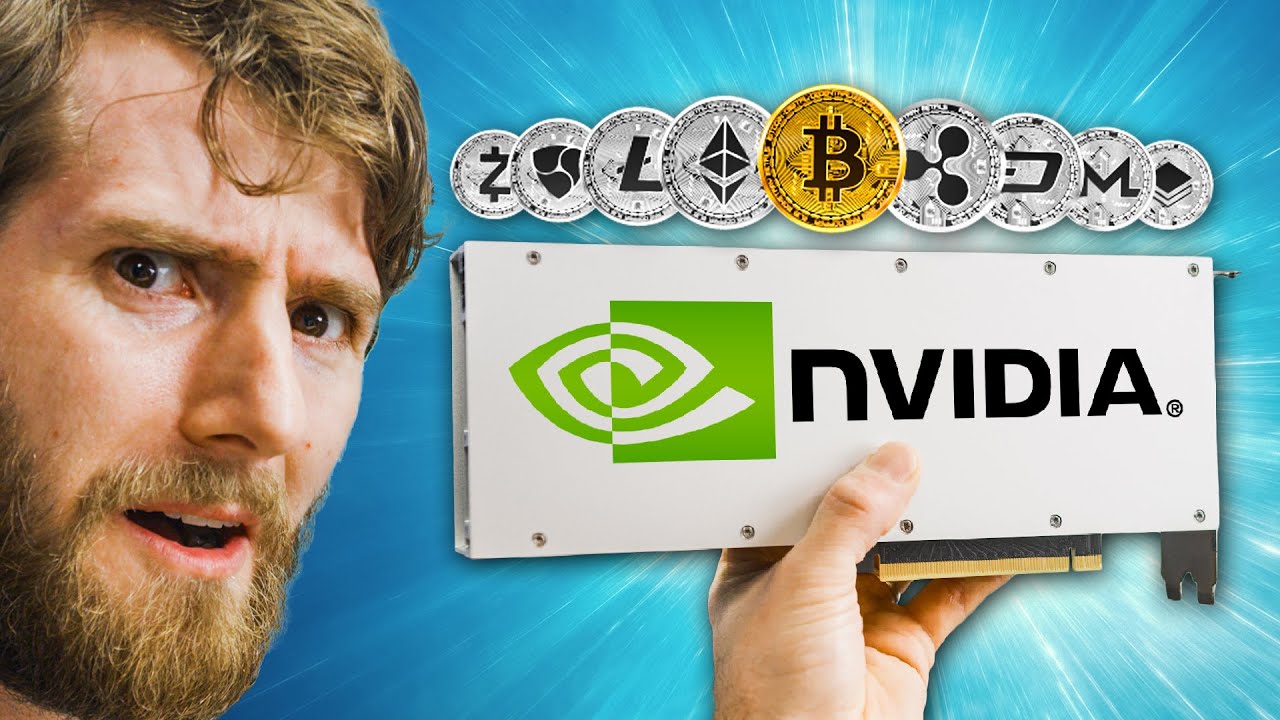
This $5000 Graphics Card Can’t Game - NVIDIA CMP 170HX Mining GPU
0 up · 0 down · 0 ratings
Promos
Get your Toolkit at its lowest pricing today at: ifixit.com We got our hands on NVIDIA's latest ghost-product CMP 170HX crypto mining card graphics card, and it is SUPER weird. Let's check it out. Buy the NVIDIA CMP 170HX at: lmg.gg Buy a RTX 3090 GPU: geni.us Purchases made through some store links may provide some compensation to Linus Media Group. Discuss on the forum: linustechtips.com 3D Printable Fan Duct: thingiverse.com ► GET MERCH: lttstore.com ► AFFILIATES, SPONSORS & REFERRALS: lmg.gg ► PODCAST GEAR: lmg.gg ► SUPPORT US ON FLOATPLANE: floatplane.com FOLLOW US ELSEWHERE --------------------------------------------------- Twitter: twitter.com Facebook: @LinusTech Instagram: @linustech TikTok: @linustech Twitch: twitch.tv MUSIC CREDIT --------------------------------------------------- Intro: Laszlo - Supernova Video Link: youtube.com iTunes Download Link: itunes.apple.com Artist Link: soundcloud.com Outro: Approaching Nirvana - Sugar High Video Link: youtube.com Listen on Spotify: spoti.fi Artist Link: youtube.com Intro animation by MBarek Abdelwassaa @mbarek_abdel Monitor And Keyboard by vadimmihalkevich / CC BY 4.0 geni.us Mechanical RGB Keyboard by BigBrotherECE / CC BY 4.0 geni.us Mouse Gamer free Model By Oscar Creativo / CC BY 4.0 geni.us CHAPTERS --------------------------------------------------- 0:00 - Intro 12:27 - He's a thirsty boi 12:36 - Tape, ducks, and boots
The video dives into the NVIDIA CMP 170HX mining GPU, a so called ghost product that defies the usual gaming GPU narrative. The host explains that the card has no display outputs, is not listed on Nvidia’s official site, and carries a price tag that can exceed five thousand dollars, all while lacking a cooling fan. The team emphasizes this is not a promotion of crypto mining but a genuine curiosity about Nvidia’s CMP line and what makes this specific model tick. Early in the segment they reveal the card arrived via a distributor and note that Nvidia has historically kept CMP cards separate from gaming GPUs, often through board partners, but this model appears to be directly branded by Nvidia and produced through a different contract. They also highlight the “ghost product” status, supported by leaks and the lack of broad official documentation, which sets the stage for a deep dive into form, function, and potential gaming viability. The first major takeaway is that CMP 170HX follows the mining-dedicated design pattern: no video outputs and a strategy aimed at reducing costs and protecting G-Force from cannibalization, while raising questions about the hardware's true purpose and engineering choices. As the video progresses, the team disassembles the card to understand its internal structure and cooling strategy. They observe an unusual aluminum heat sink configuration and question the purpose of certain cosmetic pieces that seem unnecessary. The crew notes that Nvidia used a compact, data-center style cooling approach, removing fans and stacking fins for density, which is not gamer-friendly but optimizes for mining farms. They also point out oddities like a badge that looks almost ceremonial rather than functional and an IHS on the die that hints at a re-appropriated component set. When they try to map the card to a more familiar gaming GPU framework, they find it uses a PCIe connection that behaves unexpectedly with end-user software, further separating it from consumer graphics cards. The segment ends with the promise of hands-on testing to see if the CMP 170HX can at least deliver mining performance or potentially surprising gaming results under constrained conditions. In testing mode, the crew attempts to boot the CMP 170HX in Windows using a mining-specific driver and discovers that standard gaming drivers do not apply. They experiment with Blender to gauge real-world workloads and report dismal gaming performance, confirming the card is not designed for typical gaming workloads. They also observe unusual PCIe behavior, including a PCIe natively listed as 1.1 by 4, which raises questions about data throughput limits and the practical implications for non-mining tasks. The discussion shifts toward mining efficiency, where the team demonstrates that memory bandwidth and silicon process differences underpin the card’s superior kilohash-per-watt ratios in Ethereum mining, despite the lack of gaming relevance. They conclude that while the CMP 170HX is a strong compute device for miners, its value outside mining is minimal, and Nvidia’s broader CMP strategy remains questionable in light of potential shortages affecting gaming GPUs. Towards the close, the presenters reflect on the broader implications for GPU markets, noting the evolving Ethereum roadmap and the question of whether a high-cost mining card will pay for itself given current profitability and the option of staking. They caution that resales and the long tail of mining hardware could still provide some financial recovery in a downturn, but emphasize that this card offers little utility beyond mining. The hosts invite feedback on whether to examine the rest of the CMP lineup in future videos, and pivot to a practical plug for iFixit sponsorship and related repair-topic content. They leave viewers with a nuanced takeaway: Nvidia’s CMP 170HX is a compute-focused device with impressive efficiency for mining, but not a gaming card by any stretch, and its existence underscores ongoing debates about silicon allocation and market dynamics in a volatile GPU landscape.
Topics · technology · hardware · cryptocurrency · gaming · data_center · computing · gpu · mining
Questions answered
- What makes the CMP 170HX a ghost product and why is that significant?
- The CMP 170HX is not listed on Nvidia’s site, has no gaming outputs, and appears to be distributed directly through Nvidia or its partners rather than traditional board partners, indicating a strategy focused on mining compute rather than consumer gaming.
- Can the CMP 170HX run games or use standard gaming drivers?
- No, standard gaming drivers do not apply; gaming drivers do not function with this card, and it requires mining-specific software, with Windows drivers available only in limited, non-typical configurations.
- What drives the CMP 170HX’s mining efficiency?
- Memory bandwidth and silicon process differences underpin the card’s high kilohash per watt performance in Ethereum mining, despite limited utility for gaming.
- Is there any practical use for the CMP 170HX outside mining?
- Outside mining, the card has minimal gaming utility and is generally not suitable for typical consumer workloads, making it more of a specialized mining device.
- What should viewers consider about the CMP lineup and GPU market today?
- Viewers should weigh the potential profitability of mining boards against future Ethereum changes, market shortages, and the resale value of mining hardware, as well as Nvidia’s broader CMP strategy.