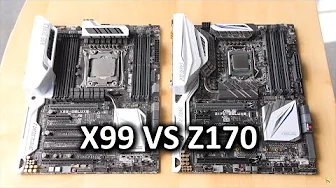
Intel 5820K vs 6700K CPU Showdown
0 up · 0 down · 0 ratings
Channels and socials
Thanks to Braintree for supporting our channel. To learn more, and for your first $50,000 in transactions fee-free, go to braintreepayments.com How much will having more cores on your CPU help you? Should you be investing in an X-series Chipset or will the more mainstream Z-series be more than enough? Logitech link: linustechtips.com Pricing & discussion: linustechtips.com Support us: linustechtips.com Join our community forum: bit.ly twitter.com @LinusTech Intro Screen Music Credit: Title: Laszlo - Supernova Video Link: youtube.com iTunes Download Link: itunes.apple.com Artist Link: soundcloud.com Outro Screen Music Credit: Approaching Nirvana - Sugar High youtube.com
The Intel 5820K versus 6700K CPU showdown examines how an enthusiast-class X99 platform with six cores and 12 threads compares to a mainstream Skylake system with four cores and eight threads, particularly in gaming and productivity workloads. The video starts by explaining why the X99 platform offers more PCIe lanes and quad or triple GPU setups, and why that might be appealing despite higher overall costs. It then details the cost comparison at the time of filming, including motherboard, CPU, and DDR4 RAM, concluding that the X99 setup could run roughly a thousand dollars more than the Z170 option, depending on memory choices and whether you leverage quad channel RAM. The test rig uses consistent components across both platforms to isolate CPU and platform differences, with identical GPUs, SSDs, RAM configurations, and cooling, ensuring a fair comparison. In the benchmarks, the six-core 5820K outperforms the 6700K in multi-core workloads such as Cinebench and SZIP by significant margins, while the 6700K shows clear advantages in single-threaded tasks like web browsing and certain light multi-threaded scenarios. Gaming results vary by title, with the 6700K often edging ahead in several titles at 1080p, though the 5820K still delivers strong frame rates in titles that benefit from more cores. The verdict emphasizes that for pure gaming, the four-core Skylake may offer a more favorable cost-to-performance ratio, while the X99 platform shines for heavy content creation tasks like video encoding and photo editing, plus scenarios requiring extra PCIe lanes. The conclusion also notes that newer platform features such as USB 3.1 are gradually appearing on X99 boards, reducing the gap with mainstream options, and that DDR4 affordability makes building an enthusiast-grade system more practical than ever for users who will leverage additional cores and PCIe lanes. Overall, viewers are encouraged to choose based on workload balance, budget, and future-proofing rather than chasing maximum cores for gaming alone.
Topics · hardware · computing · gaming-pcs · performance-benchmarks · pc-building
Questions answered
- Which CPU has more cores and threads, and what does that mean for multitasking and encoding tasks?
- The 5820K has six cores and 12 threads, while the 6700K has four cores and eight threads. More cores and threads on the 5820K translate to better multicore performance for tasks like video encoding, photo editing, and heavy data processing.
- Is the X99 platform worth the extra cost for gaming versus the Z170 platform?
- For gaming alone, the Z170 platform with the 6700K often provides strong single-thread performance and can be more cost-effective. The X99 platform becomes more compelling if you plan to use multiple GPUs or engage in tasks that benefit from additional PCIe lanes and multi-core throughput.
- What about future-proofing and features like USB 3.1 on X99 boards, does that affect the decision?
- USB 3.1 and other newer features appearing on some X99 boards reduce the gap with mainstream options. If you value newer I/O and potential future upgrades while leveraging extra PCIe lanes for GPUs or SSDs, X99 could offer longer-term usefulness despite higher initial cost.