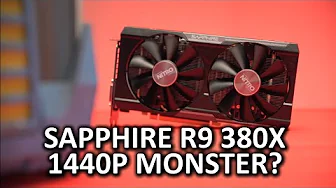
Sapphire Nitro R9 380X Video Card Review - Sweet spot card at 1440p?
0 up · 0 down · 0 ratings
Channels and socials
Does AMD's new R9 380X slide into the existing product stack as nicely as we had expected, or is it a massive head-turner in terms of performance? UpDesk link: updesk.com Corsair link: linustechtips.com Pricing & discussion: linustechtips.com Support us: linustechtips.com Join our community forum: bit.ly twitter.com @LinusTech Intro Screen Music Credit: Title: Laszlo - Supernova Video Link: youtube.com iTunes Download Link: itunes.apple.com Artist Link: soundcloud.com Outro Screen Music Credit: Approaching Nirvana - Sugar High youtube.com Sound effects provided by freesfx.co.uk
The Sapphire Nitro R9 380X Video Card Review focuses on AMD's upper mid-range card aimed at the 1440p market, evaluating whether it fits neatly into the existing GPU stack and whether the performance and value justify its price. The opener sets the stage for 1440p gaming as monitors rise in popularity and prices drop, positioning the 380X as a sweet spot option between 1080p and higher-end graphics solutions. The video outlines the key specifications of the 380X, including a Tonga GPU, 4 GB of GDDR5 memory, a 256-bit memory interface, and a base clock around 970 MHz with DirectX 12 and Mantle support, customizing expectations for power draws and thermals. In testing, the card is compared against mid-range and high-end peers from both AMD and Nvidia, excluding top-tier models like the GTX 980 Ti and the R9 Fury series to reflect its target market. Power consumption sits around 288 Watts under load, with temperatures peaking near 69°C, indicating manageable thermal performance for typical gaming loads. The empirical results show the 380X delivering solid but not groundbreaking performance at 1440p, beating the GTX 960 in several benchmarks like Crisis 3, Far Cry 4, and Tomb Raider, while also revealing that lowering image quality yields a sizable FPS uplift, especially in taxing titles. The narrative then shifts to value, weighing the price-to-performance against alternatives such as the GTX 960, 970, and the R9 390, and concluding that the 380X remains a compelling entry point for 1440p gaming, particularly when budget is a consideration. The conclusion acknowledges that if the goal is near 60 FPS at high or maxed settings in modern titles at 1440p, spending more on a GTX 970 or R9 390 could be a smarter investment, but for those prioritizing a balance of price, performance, and power, the 380X is a solid choice, especially for those invested in 1080p transitioning to 1440p.
Topics · technology · hardware-review · graphics-cards · gaming
Questions answered
- What is the target gaming resolution for the Sapphire Nitro R9 380X according to the review?
- The review targets 1440p gaming as the main focus for the Sapphire Nitro R9 380X.
- Does the 380X offer good value compared to the GTX 960 at the time of the video?
- Yes, the 380X shows a performance edge over the GTX 960 in several tests, with a for-value frame, though the price delta can affect overall value depending on sales and specific prices at the time.