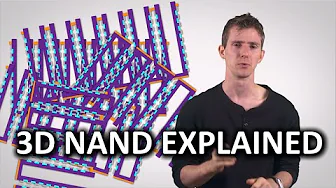
3D NAND as Fast As Possible
0 up · 0 down · 0 ratings
Channels and socials
Is 3D NAND all that great? Or is it just another 3D implementation that will disappoint most, and give some throbbing headaches... Dollar Shave Club message: Visit dollarshaveclub.com to get high quality bathroom supplies delivered directly to your door every month in the US, Canada, Australia,or New Zealand! Twitter: twitter.com Facebook: @linustech Join our community forum: linustechtips.com Credits: “The National Archives UK - WORK 25-208” by The National Archives UK - Flickr: The Fifties in 3D. Licensed under OGL via Wikimedia Commons - commons.wikimedia.org “Nand flash structure” by wikipedia user Cyferz. Licensed under CC BY-SA 3.0 via Wikimedia Commons - commons.wikimedia.org “Flash cell structure”. Licensed under CC BY 2.5 via Wikipedia - en.wikipedia.org Written by: Jeff Kuenle
The video opens with a skeptical take on the frequent use of 3D as a marketing buzzword, then pivots to a clear technical explanation of how 3D NAND works. It describes the traditional horizontal NAND memory cells, how shrinking intercell spacing caused data integrity risks due to quantum effects, and the motivation to stack cells vertically. The host explains the 3D approach by bending a memory line into a U shape and then stacking multiple vertical segments within the same chip width, effectively multiplying storage density and access speeds without the same miniaturization drawbacks. The discussion emphasizes that 3D NAND lowers cost per bit as die sizes grow, because the manufacturing process shifts toward deposition-based construction rather than heavily lithography-driven shaping. The video then addresses a potential concern: what happens when you exhaust the freed-up space by continuing vertical stacking, and how designers plan for future scaling. A humorous pivot introduces a sponsor segment, which blends with the technical content and reinforces the practical value of affordable storage while keeping the presentation engaging. Finally, the host reassures viewers that the era of affordable expandable memory is near, before wrapping with a reminder to like, comment, and subscribe. The overall takeaway is that 3D NAND offers a viable path to higher capacity and lower costs, albeit with the usual engineering challenges and market dynamics that accompany any significant technological shift.
Topics · technology · science · hardware · storage
Questions answered
- What problem does 3D NAND aim to solve compared to traditional NAND memory?
- 3D NAND aims to solve scaling and cost challenges by stacking memory cells vertically, increasing storage density and access speed while reducing the cost per bit as die sizes grow.
- How does the 3D NAND structure differ from the traditional planar NAND?
- Traditional NAND uses horizontally arranged memory cells, while 3D NAND bends a line into a U shape and stacks multiple vertical cell segments within the same chip width to increase density.
- Why is cost per bit able to go down with 3D NAND?
- Because the 3D process relies more on deposition and building steps rather than expensive lithography, allowing more efficient manufacturing as capacity scales.
- What is a potential future concern once the freed-up space is used up in 3D NAND?
- The concern is that further scaling might reintroduce the same data integrity and reliability challenges, requiring new architectural innovations or even different approaches to memory design.