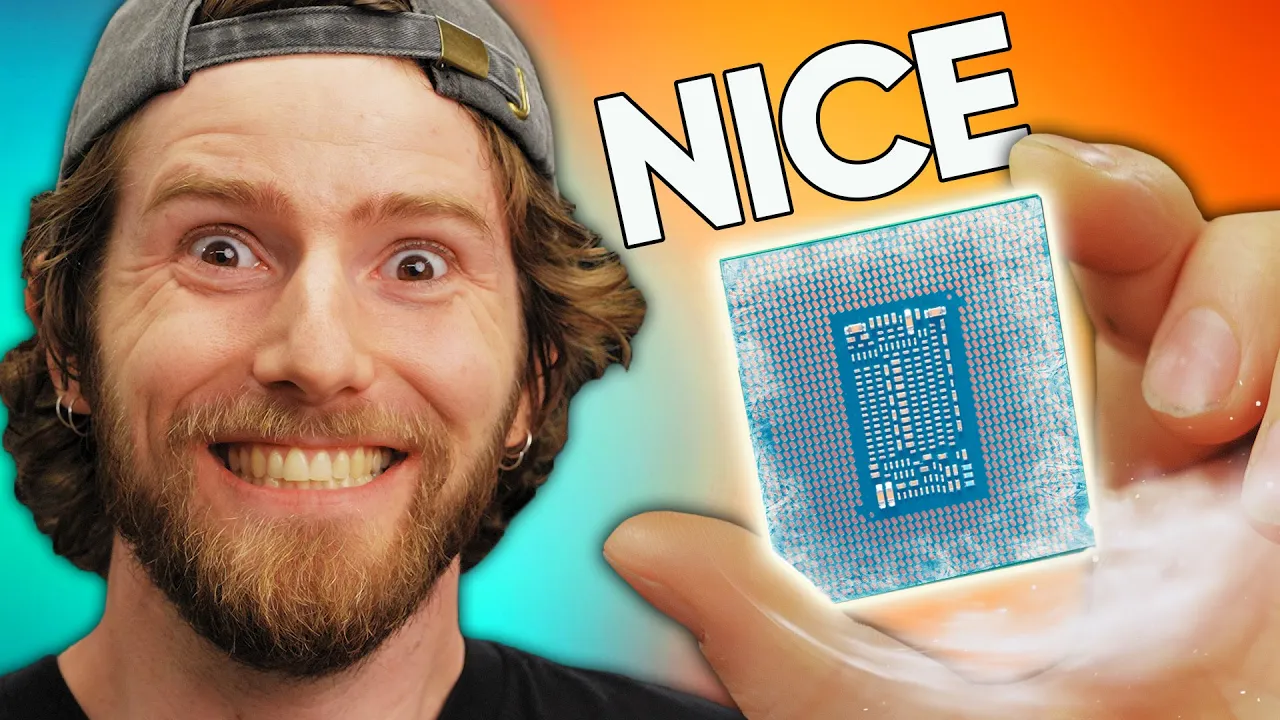
The 6.9GHz CPU - LN2 Cooling
0 up · 0 down · 0 ratings
Promos
Learn more about the MSI RTX 3070 Ti Ventus 3X 8G OC at msi.com Get your UGREEN Nexode 65W charger with up to 26% off using code 15GAN65W at: amzn.to To celebrate the nicest day of the year, 6/9, we recruited overclocker Splave to help us get a CPU up to 6.9GHz. A LOT of liquid nitrogen was used. Make Splave famous: twitter.com @splaveoc Discuss on the forum: linustechtips.com Buy an Intel i9-12900KS: geni.us Buy an ASROCK Z690 Taichi: geni.us Buy a kit of G.Skill TridentZ DDR5: geni.us Purchases made through some store links may provide some compensation to Linus Media Group. Purchases made through some store links may provide some compensation to Linus Media Group. ► GET MERCH: lttstore.com ► SUPPORT US ON FLOATPLANE: floatplane.com ► AFFILIATES, SPONSORS & REFERRALS: lmg.gg ► PODCAST GEAR: lmg.gg FOLLOW US --------------------------------------------------- Twitter: twitter.com Facebook: @LinusTech Instagram: @linustech TikTok: @linustech Twitch: twitch.tv MUSIC CREDIT --------------------------------------------------- Intro: Laszlo - Supernova Video Link: youtube.com iTunes Download Link: itunes.apple.com Artist Link: soundcloud.com Outro: Approaching Nirvana - Sugar High Video Link: youtube.com Listen on Spotify: spoti.fi Artist Link: youtube.com Intro animation by MBarek Abdelwassaa @mbarek_abdel Monitor And Keyboard by vadimmihalkevich / CC BY 4.0 geni.us Mechanical RGB Keyboard by BigBrotherECE / CC BY 4.0 geni.us Mouse Gamer free Model By Oscar Creativo / CC BY 4.0 geni.us CHAPTERS --------------------------------------------------- 0:00 - Linus gets things thrown at him 0:35 - UGreen! 0:49 - Linus plays with LN2 1:49 - Why would you want LN2 for overclocking? 2:30 - How to prep for -193C 5:58 - How to hardcore overclock 8:05 - Alex attempts to overclock 11:25 - Splave does an overclock 13:29 - Linus comes back, is amaze 15:56 - MSI! 16:35 - Outro
The video chronicles an extreme overclocking session where the team pushes a 12900KS-based system to unprecedented frequencies using liquid nitrogen cooling. It opens with a large quantity of LN2 and a veteran overclocker, Allen Splave, in a playful yet highly technical setup. The hosts discuss the basic physics behind clock speed versus heat: higher frequencies generate more heat, which worsens performance due to rising resistance and thermal bottlenecks. They propose LN2 cooling as a path to suppress heat far beyond conventional cooling, framing the experiment as a test of what is physically possible rather than a typical consumer setup. Early segments emphasize the dangers of moisture and condensation on exposed circuitry, prompting the use of moisture control measures such as dielectric compounds, dielectric grease, and a liquid tape approach, which is introduced as a novel technique for protecting delicate VRMs and other sensitive areas. The narrative then shifts to practical preparation steps, including the use of a backboard heater, long ceramic posts, and careful insulation to manage condensation while the CPU is chilled. By combining careful thermal management with aggressive voltage and frequency strategies, the team demonstrates how controlled cold can unlock extraordinary clock speeds, while also acknowledging the non-trivial costs and risks of such a pursuit. As the testing progresses, the discussion moves from the theoretical advantages of LN2 cooling to hands-on experimentation. The participants describe the mounting strategy required to keep condensate away from the CPU, memory, and VRMs, explaining why conventional mounting brackets aren’t sufficient in such extreme conditions. They detail the need to retrain memory after rapid thermal shifts, and the crew experiments with different base frequencies, voltages, and C-state configurations to stabilize boot and run cycles. The dialogue captures the tension between chasing higher numbers and maintaining stability, with moments of triumph followed by the inevitable hardware hiccups that come with pushing silicon to its limits. The crew analyzes Cinebenchscores, compares performance against high-end CPUs, and reflects on the peculiar behavior of chips when subjected to ultra-cold temperatures, including instances of blue screens and unexpected boot behavior. In the climactic sequence, the team achieves a dramatic milestone of 6.9 GHz on the processor with sub-300W power consumption, underscoring how remarkable efficiency can be achieved when the heat is aggressively removed. They celebrate the record with a blend of humor and technical explanation, illustrating how the measurement environment and thermal design choices influence results. The discussion acknowledges the speculative nature of such feats, noting that extreme overclocking is as much about knowledge, experience, and a bit of luck as it is about equipment. The closing segments pivot to sponsor segments and related content, inviting viewers to explore further experiments and related hardware, while reinforcing the sense that extreme overclocking is a challenging but fascinating niche driven by curiosity and the thrill of discovery.
Topics · science_and_technology · hardware_overclocking · extreme_overclocking · liquid_nitrogen_cooling
Questions answered
- What is the main reason LN2 cooling enables higher CPU clock speeds in extreme overclocking?
- LN2 cooling removes heat very efficiently, allowing the CPU to run at much lower temperatures and higher voltages without thermal throttling, which enables higher clock speeds.
- What are the key challenges when using LN2 for CPU overclocking, and how are they mitigated?
- Main challenges include condensation on exposed electronics and thermal management. Mitigations shown include liquid electrical tape, dielectric grease, backboard heaters, long posts for mounting, and absorbing condensation with shop towels to protect sensitive areas.