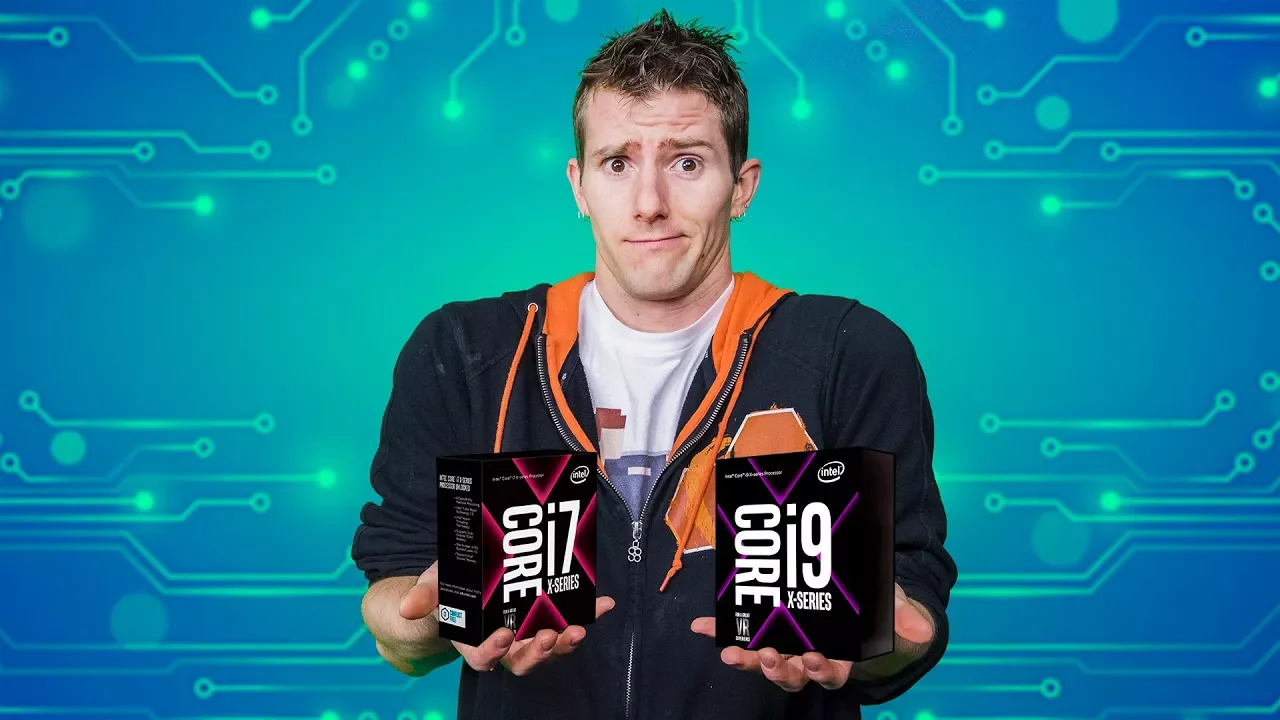
Intel's X-Series Lineup - What you NEED to Know
0 up · 0 down · 0 ratings
Description
Thanks to Intel for sponsoring this video!
Promos
Check out Intel's 2018 Extreme Rig Challenge Enter to win select competitor rigs and other awesome prizes by voting for your favorite team. Search amazon.com for a wide range of tie-in promotions. Check back soon for details including how to vote, where to buy, and where to see the final builds. You're building a new HEDT PC, and you planned on an Intel Core i7. But now there's Core i9... And what's the X for? Time to demystify Intel's lineup! Buy Intel Core i7-7820X: On Amazon: geni.us On Newegg: geni.us Buy Intel Core i9-7900X: On Amazon: geni.us On Newegg: geni.us Buy Intel Core i9-7980XE: On Amazon: geni.us On Newegg: geni.us Discuss on the forum: linustechtips.com Linus Tech Tips merchandise at designbyhumans.com Linus Tech Tips posters at crowdmade.com Our production gear: geni.us Get LTX 2018 tickets at ltxexpo.com Twitter - twitter.com Facebook - @LinusTech Instagram - @linustech Twitch - twitch.tv Intro Screen Music Credit: Title: Laszlo - Supernova Video Link: youtube.com iTunes Download Link: itunes.apple.com Artist Link: soundcloud.com Outro Screen Music Credit: Approaching Nirvana - Sugar High youtube.com Sound effects provided by freesfx.co.uk
The video begins by framing Intel’s X-Series as a platform that can be confusing due to naming conventions and a mixed lineup. It then explains the architectural split within the X299 ecosystem, distinguishing Kaby Lake X as the consumer-leaning, higher-clocked variant with more power draw, and Skylake X as the main high-end desktop tier with two branches for Core i7 and Core i9. The host highlights the core principles of these CPUs: unlocked multipliers for overclocking, hyper-threading, quad-channel DDR4 memory, and AVX extensions, while noting the shared cache structure that favors efficiency despite a smaller level 2 cache per core. Differences across models are tied to core counts, PCI Express lane availability, and Turbo Boost configurations, underscoring how these affect throughput for graphics, NVMe storage, and accelerators. The most practical insight centers on the entry-level Skylake X Core i7 7820X, which offers a robust 28 PCIe lanes for a balanced workstation setup, high base and boost clocks, and suitability for users who need strong single-thread and multi-thread performance without entering extreme core counts. As the discussion advances to higher-end parts, the Core i9 7900X and especially the 7980XE are presented as “tweeners” that fill the gap between mid-range performance and the top-end capabilities, delivering more cores at the cost of power and price. The host concludes by balancing the performance story with real-world tradeoffs, noting that while the 7980XE is a monster in raw throughput, it isn’t the best value for gaming, and the platform as a whole is positioned for workloads that truly benefit from high core counts and fast, diverse PCIe configurations. Viewers are reminded of the practical implications for enthusiasts and professionals alike, and are directed to purchase links and community resources in the video description.
Topics · technology · hardware · computing · highenddesktop · cpus · ocz · ai
Questions answered
- What differentiates Kaby Lake X from Skylake X in the X299 lineup?
- Kaby Lake X targets entry-level high-end desktops with higher clock speeds and greater power consumption, designed for users who want to upgrade a motherboard later. Skylake X represents the main high-end desktop tier with multiple cores, more PCIe lanes, and configurations that support heavier multi-threaded workloads.
- Is the Core i7 7820X a good entry point for most buyers in this platform?
- Yes, the Core i7 7820X provides a solid balance of PCIe lanes, strong base and boost clocks, and enough performance for a capable workstation, making it a sensible entry point for many users who don’t need the extreme core counts of the higher-end CPUs.