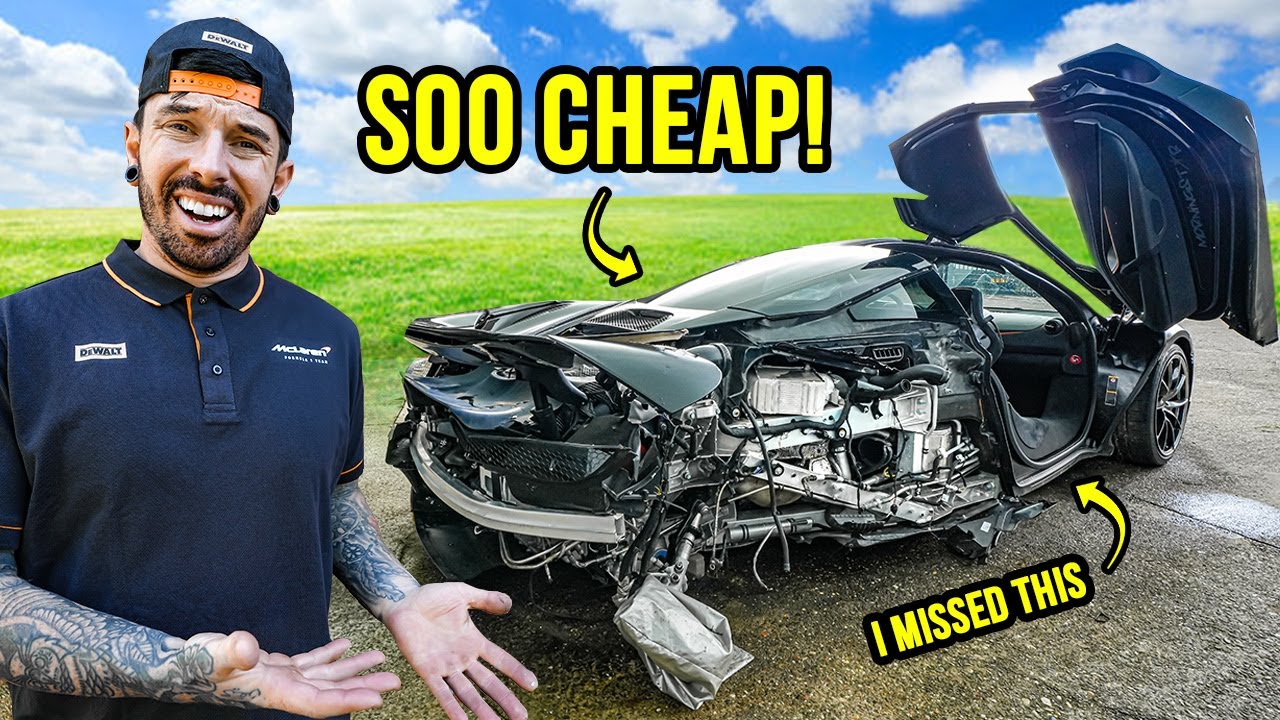
I BOUGHT A WRECKED 720s THAT MCLAREN WONT FIX
0 up · 0 down · 0 ratings
Promos
Check if your car was damaged with Car Vertical - 10% off here carvertical.com I bought a cheap Mclaren 720s from europe thinking i had got myself a bargain rebuild project. But i wasnt until i spotted some hidden damage which required me to take it to a Mclaren repair specialist who have to ask permission from Mclaren themselves to be able to repair it...
ALL MA MERCHANDISE
Channels and socials
FOR MORE CONTENT
CHECK OUT MY SECOND CHANNEL
Follow Me Here Aswell
Notes
This video follows Mat Armstrong as he purchases what he hopes will be a straightforward rebuild project, only to uncover a series of severe and potentially non-repairable issues with a wrecked McLaren 720s. Right from the opening moments, he acknowledges the high risk, describing the car as a bargain that seemed almost too good to be true. The narrative then takes the viewer on a multi-country trip to inspect the car at a breakers yard in Europe, where the bodywork and frame reveal extensive damage beyond cosmetic flaws. The first major revelation is the extent of the rear subframe damage, the broken suspension, and a cracked carbon brake disc, all of which raise questions about whether the tub and carbon components can be salvaged. The video captures the tension of a potential deal turning into a long-term commitment as Mat and his team weigh repair feasibility against cost, especially with the need to obtain McLaren permission for carbon repairs and the ever-present risk of an unrepairable tub. In the middle portion of the build, the team digs deeper into the car’s internal state, discovering that the carbon tub may be damaged, and that the car requires substantial disassembly to access critical components. They document attempts to power and start the car, including battery access, fuse checks, and a risky process of bypassing a blown pyro fuse to test the engine start. This sequence highlights real-world challenges in dealing with a high-end supercar that has seen a serious accident, as well as the uncertainty about engine health and the condition of the gearbox. A unique twist occurs when the crew finds a small woodland resident in the engine bay area, adding an unusual, almost comic interlude to a high-stakes rebuild. The aggregate effect is a strong sense of anticipation about whether any part of the car can be saved and at what financial cost. As the story progresses, professional opinions become central. McLaren repair specialists are consulted, and the video conveys the gravity of their assessment: the tub repair potential hinges on in-person evaluation and manufacturer authorization, which creates a potential bottleneck. The team reveals the car’s price point, the potential resale value, and the stark reality that significant investment might still not yield a roadworthy vehicle. The crew also tests the car’s systems in an interim state, including the airbag status, dashboard electronics, and various electrical harnesses; the results stay inconclusive, underscoring how fragile and tightly engineered these cars are. Emotions run high as the possibility of a successful restoration is balanced against the very real possibility that the car is beyond economical repair. Toward the end, a formal assessment at the McLaren-approved repair facility provides a dramatic pivot. The specialists’ verdict marks a turning point: the tub is deemed not repairable or not viable to repair within the budget, which forces Mat to confront a future where the project may end up as a parts car or a salvage case. The video closes with a candid reflection on the decision process, the financial math, and the learning experience of buying a wrecked hypercar in search of a rebuild. Viewers are left with a sense of the high-stakes nature of exotic car restoration, the limits of repairability for carbon fiber components, and the reality that some bargains simply can’t be realized despite best efforts. The closing moments tease further updates and potential future projects, keeping the audience engaged for the next chapter in this ambitious rebuild.
Topics · autos & vehicles · car restoration · video log · motorsport culture
Questions answered
- What was the first major mechanical issue found on the McLaren 720s?
- The first major issue identified was severe rear subframe damage, with the rear suspension missing parts and the carbon brake disc cracked, indicating substantial structural and component damage.
- Why did the team consider a carbon tub repair risky or questionable?
- Because McLaren carbon tubs are highly sensitive to damage; if the tub is compromised, repairs are often not feasible or may require manufacturer authorization, making restoration uneconomical.
- What obstacle prevented the engine from starting during initial testing?
- A blown pyro fuse cut power to the engine when the airbags deployed, so they needed to bypass the fuse to attempt starting the engine.
- What role did CarVertical play in the video’s decision-making?
- CarVertical was used to check the car’s history, confirm no outstanding finance, and review past damage records and auction history to assess reparability and risk.
- What was the final potential outcome discussed for the tub repair?
- The repair facility’s verdict suggested that the carbon tub repair might not be viable, which could lead to abandoning the tub repair option and reassessing the car's overall rebuild feasibility.