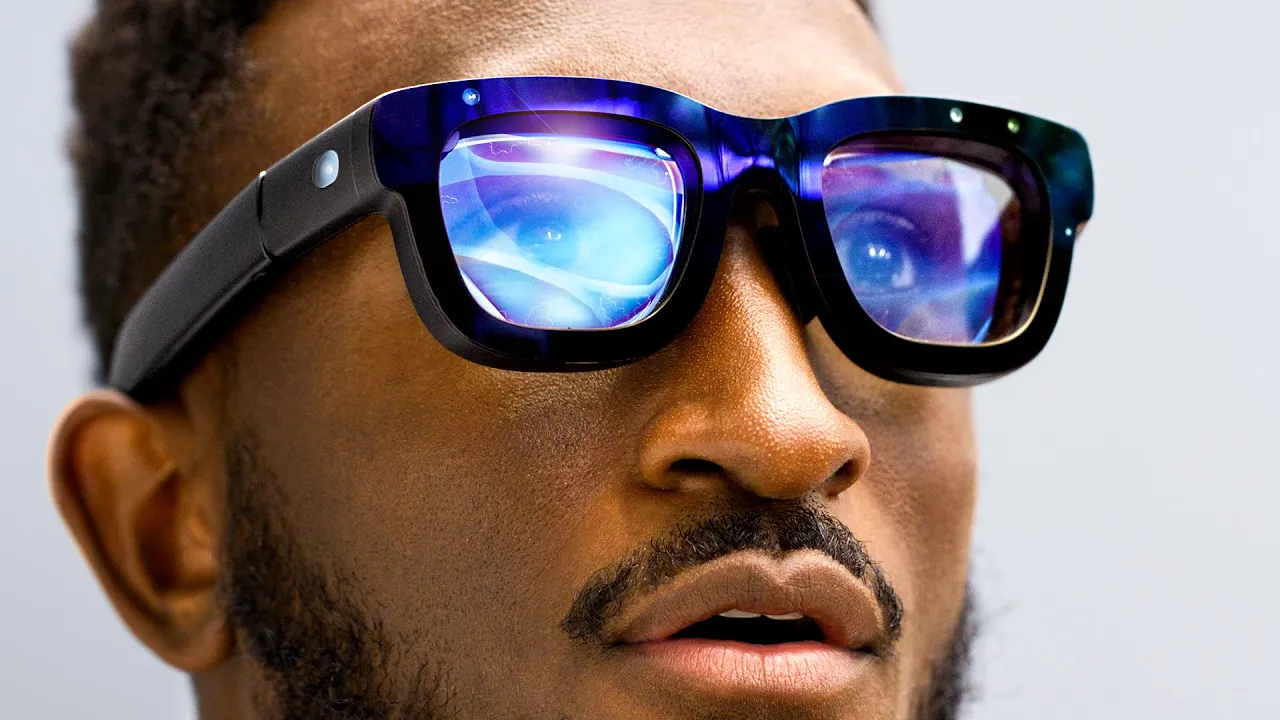
I Tried Real Augmented Reality Glasses!
0 up · 0 down · 0 ratings
Promos
Trying the only real working Augmented Reality glasses in the world! Are they the future? Waveform interview with Boz from Meta: youtu.be MKBHD Merch: shop.mkbhd.com
Channels and socials
Check out the wallpaper at panels.art Tech I'm using right now: amazon.com Playlist of MKBHD Intro music: goo.gl ~ twitter.com @MKBHD @MKBHD
The video opens with the creator expressing awe at a potential future tech category, outlining the landscape of AR versus VR and positioning the two current prototypes in 2024 as the closest look yet at what AR glasses might become. He presents Meta Orion and Snapchat AR Spectacles as two very different approaches that are not currently sellable to the public, but are valuable for understanding the direction of development. The Meta Orion system is described as a three-part setup consisting of glasses, a nearby compute puck, and an EMG wristband used as an input device, with eye tracking and gesture-based controls that map neural signals to interactions. The first demo showcases basic interactions like Instagram windows floating in space, a video call, and messaging, all controlled via hand gestures and eye focus, with audio routed through built-in speakers. The second demo uses AI-assisted object recognition to suggest recipes from a table of ingredients, augmented by blue labels that stay fixed to identified items, illustrating a subtle but impactful example of real-time object labeling. The third demo demonstrates a shared space experience with another user where a QR code anchors a 3D Pong game that both players can see and manipulate, highlighting social and collaborative potential of this technology. The video then delves into technical details such as the seven sensors, custom silicon, and the thermal design that allows the glasses to work for a couple of hours, along with the cool-but-impractical reality that the device is not intended for shipping. The Snapchat Spectacles are described as a different breed entirely, with all components inside the lenses themselves and no separate puck, albeit at a higher mass and different display characteristics such as a tighter field of view and a programmable electrochromic tint for readability. A comparison follows on display quality, field of view, and user immersion, noting that the Meta device offers a larger 70-degree field of view but more edge clipping, while the Snap glasses provide crisper text and a more focused view but at around 46 degrees. The host praises the developer-friendly nature of Snap OS with available apps, a stronger emphasis on public-facing hardware testing, and the potential for shared experiences that don’t require scanning a QR code. Throughout, the host reflects on personal dream use cases like instrument learning overlays and AR airplane window guides that annotate landmarks, suggesting exciting paths for future software and use-case scenarios. The closing analysis emphasizes that while neither device is ready for consumer shipping, both represent meaningful steps toward a future where AR glasses could reduce phone dependence, enable new forms of interaction, and reshape everyday activities, all while noting price and battery life constraints that will need to improve before mass adoption. The video ends with a tease of the Waveform interview with Meta’s Boz to go deeper into the underlying tech and a takeaway that iterative development is the likely path to shipping a practical, higher-performance AR wearable someday.
Topics · technology · wearable-computing · augmented-reality · prototyping · consumer-electronics
Questions answered
- What are the main differences between Meta Orion and Snapchat AR Spectacles?
- Meta Orion uses a three-part system with glasses, a separate compute puck, and an EMG wristband, offering a larger field of view and more modular hardware. Snapchat AR Spectacles embed all components in the glasses themselves, are heavier, and feature a smaller field of view but crisper display and integrated tint for readability.
- How does the input system work on Meta Orion?
- Input is facilitated by an EMG wristband that measures electrical signals from muscle activity to map gestures to controls, with additional hand gestures and eye tracking to navigate overlays.
- What is a notable use case demonstrated for AR in the video?
- A shared space Pong game anchored by a QR code, where two wearers see and interact with the same 3D object in space, illustrating collaborative AR play.
- Are these glasses ready for consumer shipping?
- No, according to the host, neither device is shipping to consumers yet, with Meta emphasizing ongoing iteration and potential future, more practical iterations, while Snapchat is positioned as a developer kit today.