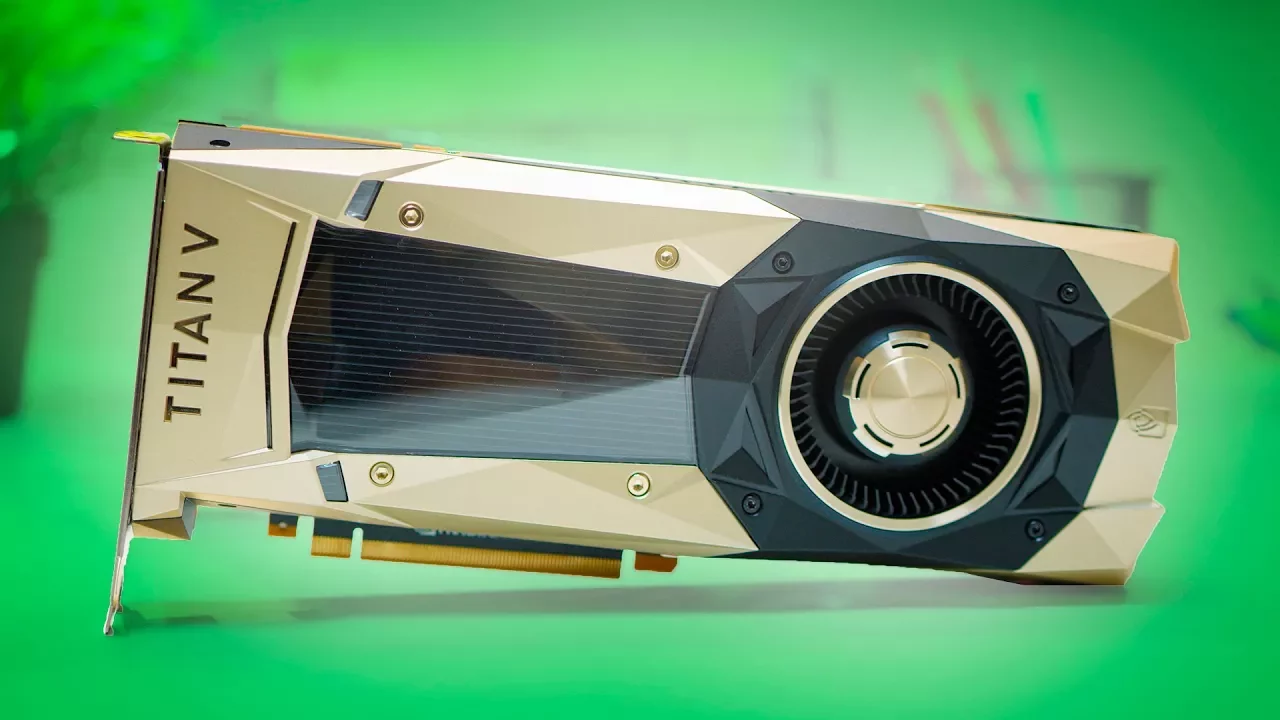
Early Access Hardware? NVIDIA’s $3,000 Titan V!
0 up · 0 down · 0 ratings
Promos
For your unrestricted 30 days free trial, go to freshbooks.com and enter in “Linus Tech Tips” in the how you heard about us section. Get iFixit's Pro Tech Toolkit now for only $59.95 USD at ifixit.com NVIDIA claims the Titan V is the most powerful GPU ever on a card... Could it possibly live up to the hype? Buy(?) a Titan V from NVIDIA (or just learn more): geni.us Discuss on the forum: linustechtips.com Our Affiliates, Referral Programs, and Sponsors: linustechtips.com Linus Tech Tips merchandise at designbyhumans.com Linus Tech Tips posters at crowdmade.com Our production gear: geni.us Twitter - twitter.com Facebook - @LinusTech Instagram - @linustech Twitch - twitch.tv Intro Screen Music Credit: Title: Laszlo - Supernova Video Link: youtube.com iTunes Download Link: itunes.apple.com Artist Link: soundcloud.com Outro Screen Music Credit: Approaching Nirvana - Sugar High youtube.com Sound effects provided by freesfx.co.uk
The Titan V is explained as a member of the Volta architecture, not a gaming oriented card, despite its high-end gaming performance. The host notes that the product name omits the GeForce branding to emphasize the Volta-focused goals, including tensor cores and specialized compute units for deep learning and AI tasks. Testing is organized around two benches: a Z270 for per-thread productivity and gaming workloads, and an X299 for heavier compute workloads that benefit from more cores. Early results position the Titan V as the fastest gaming card on the market in several DirectX 11 and DirectX 12 titles, with notable gains in Deus Ex Mankind Divided and Shadow of War, though Assassin’s Creed Origins shows a smaller uplift. Beyond gaming, the reviewer highlights the card’s strong compute capabilities, including FP16 and FP64 performance, and the advantage of 5120 CUDA cores that promise top-tier throughput for CUDA-enabled tasks. OpenCL remains viable for certain workloads, even as CUDA compatibility shifts to newer compute kernels, causing some software incompatibilities with older CUDA-based workflows. The memory system uses HBM2, which yields a smaller frame buffer than some competitors but can be offset by raw compute power and tensor core acceleration in AI workloads. The video concludes that while the Titan V dominates compute and, in many cases, gaming, its $3,000 price tag makes ROI unattractive for most gamers, and the card is presented more as a teaser for what might come in 2018 than a consumer buy for everyone. Viewers are cautioned about the need to craft CUDA kernels or wait for mainstream driver support at the time, and the host notes that enthusiasts without NVLink or multi-GPU plans should consider this as a high-end crown jewel rather than a mass-market upgrade. In closing, the presenter frames the Titan V as a sign of things to come in 2018, while steering viewers toward alternatives for typical gaming needs and pointing out practical considerations like thermals and power usage.
Topics · technology · hardware · gaming · computing
Questions answered
- What makes the Titan V different from previous Titan models?
- The Titan V is built on the Volta architecture with tensor cores and FP16/FP64 compute, emphasizing compute and AI workloads rather than gaming branding.
- Is the Titan V a good buy for gamers?
- For pure gaming, the Titan V is generally not considered a typical value due to its $3,000 price; its strengths lie in compute performance and professional workloads.