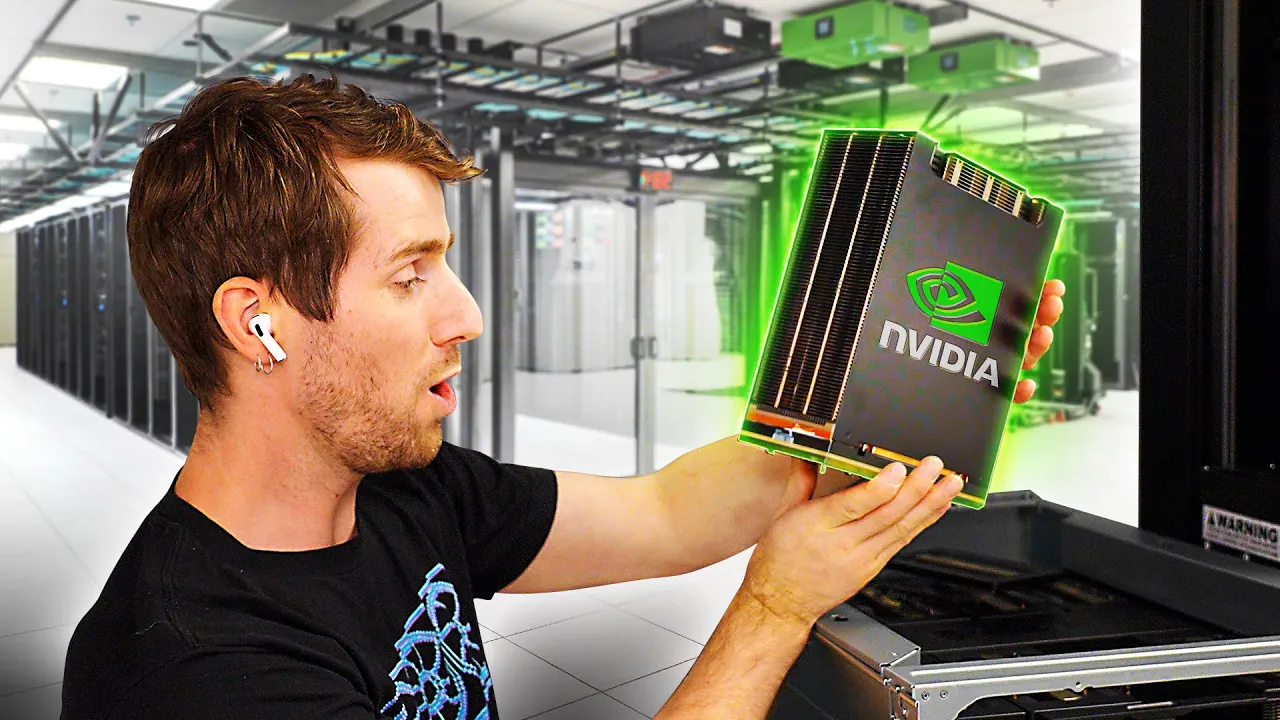
NVIDIA Showed Me Their Supercomputer
0 up · 0 down · 0 ratings
Description
Check out their Crosshair 18 HX AI laptop at msi.gm What kind of computational power does it take to train DLSS? We went to NVIDIA's HQ to take a look at Nyx and see what you get when the company making the hardware sought after by everyone else gets to use it for themselves. Discuss on the forum: linustechtips.com
Promos
Visit squarespace.com and use offer code LTT for 10% off Thanks to MSI for sponsoring this video!
Check out our Channel Partners: Secretlab - Save up to $249 during their holiday sale (ends Jan. 2nd): lmg.gg PIA - Get the VPN of our choice: piavpn.com dbrand - Buy a "Circuit" series skin for your device: dbrand.com ► GET OUR MERCH: lttstore.com ► GET EXCLUSIVE CONTENT ON FLOATPLANE: lmg.gg ► SPONSORS, AFFILIATES, AND PARTNERS: lmg.gg Purchases made through some store links may provide some compensation to Linus Media Group. Affiliate links powered in part by affilimate.com Linus Sebastian is an investor in Framework Computer, Inc CHAPTERS --------------------------------------------------- 0:00 Intro 1:30 Internal Production Space 3:45 The Little Things 5:45 Teardown 7:49 DLSS 11:28 Conclusion 13:08 Outro
NVIDIA Showed Me Their Nyx supercomputer at the Santa Clara campus, where the video takes you through a close look at a large DGX B200 GPU rack deployment. The tour begins by establishing the scale: 1,192 B200 GPUs, each capable of powering up to around 200 watts, arranged in a space designed to support validation and internal production work. The video explains how the Nyx cluster supports a mix of AI research, DLSS upscaling for gaming, and NLP workloads, underscoring Nvidia’s internal use cases that inform customer deployments. You can see the physical layout, including raised floors with water cooling readiness, and the clever cable management and stratified airflow intended to keep hundreds of high-power GPUs performing reliably. The host points out that these spaces are reconfigured frequently for new chip or server designs, with attention paid to signal integrity and maintenance. In summary, the Nyx tour frames the data center as a blueprint for scalable, high-performance AI compute that Nvidia can validate before offering to customers. The second section zooms into the hardware and cooling architecture. Viewers get a tactile sense of the sheer size of the cooling solution, including heat sinks with numerous heat pipes and the Envy Link switching gear, all designed to push air through dense GPU arrays. The narrator demonstrates how the three-phase power distribution and top-mounted PDUs enable rapid in-and-out handling of DGX units. A curiosity-driven moment shows a 415-volt 100-amp plug, illustrating the power infrastructure behind these racks. The video also highlights the SXM interface and power delivery for GPUs, giving a rare glimpse into how Nvidia physically ships and powers the most demanding accelerators. Overall, this segment emphasizes the engineering rigor that goes into making a data center componentry both serviceable and scalable while maintaining airflow and cooling efficacy. The final portion centers on DLSS and the human element behind it. The host explains how DLSS renders games at lower resolutions and uses AI to upscale frames for higher perceived fidelity, which translates into higher frame rates for gamers. An Nvidia engineer (Edward Leu) elaborates on the iterative process of training AI models, the cost of hero runs versus numerous pre-run tests, and the speed at which improvements can be shipped once a tuning cycle is completed. The discussion contrasts native rendering with DLSS improvements across generations, noting that even prior DLSS versions achieved ground-truth-like results in some scenarios. The segment culminates with a broader takeaway: AI-accelerated image enhancement is likely to play a central role in the future of rendering, potentially surpassing traditional methods as models mature. The video ends with a light plug for Squarespace sponsorship and a nod to upcoming tech explorations, rounding out a look at both the tech and the culture around Nvidia’s pioneering hardware.
Topics · science_technology · data_center · ai · hardware · gpu · dlss · machine_learning
Questions answered
- What is Nyx and what does it do at Nvidia's HQ?
- Nyx is Nvidia's internal high-performance compute deployment featuring DGX B200 GPUs used for AI research, DLSS development, and NLP workloads, providing a blueprint for scalable, validated deployments.
- How is the Nyx data center cooled and organized?
- The racks use raised floors, high-density air cooling, and carefully managed cable layouts with top-mounted PDUs and strategically placed fiber optics to maintain signal integrity and airflow.
- What is DLSS and why is it important for Nvidia and gamers?
- DLSS is an AI-assisted upscaling technique that renders at lower resolutions and then upscales to higher display resolutions, enabling higher frame rates with improved perceived image quality.