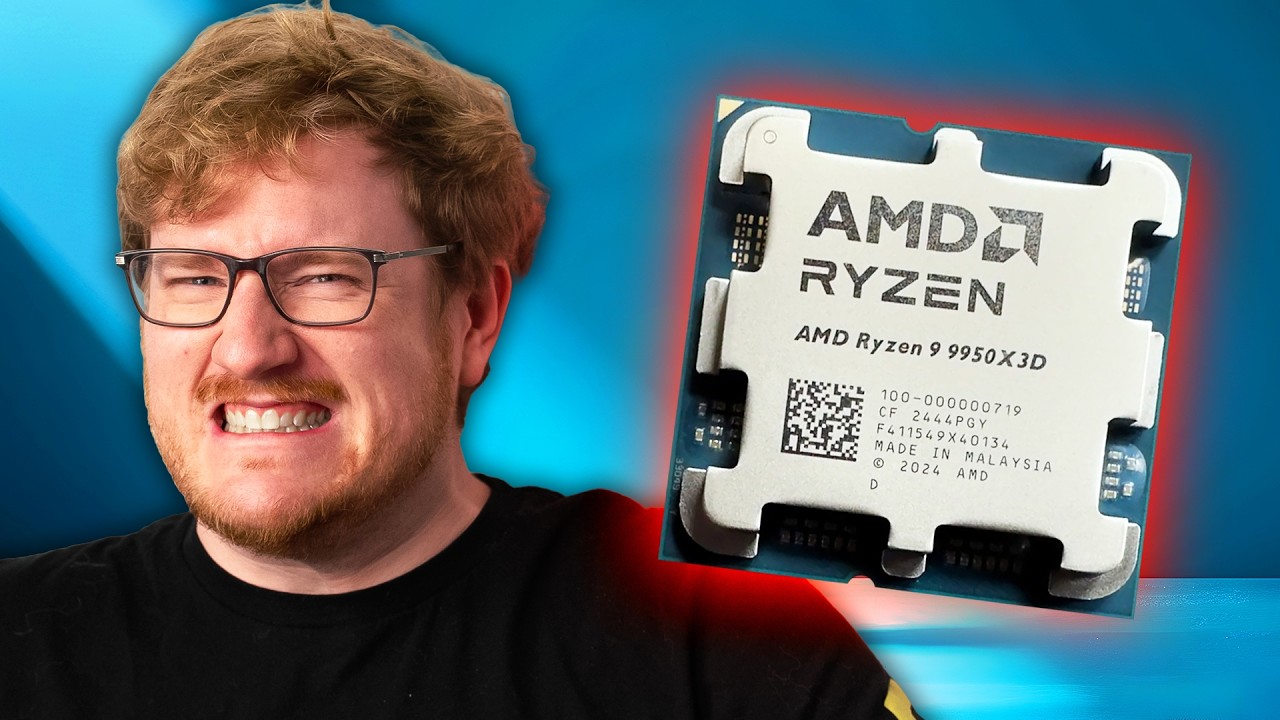
The new “Best" CPU! - AMD Ryzen 9 9950X3D
0 up · 0 down · 0 ratings
Promos
Check out the Secretlab Titan Evo ergonomic gaming chair at lmg.gg and give your back the support it deserves! AMD's newest and great CPU is here -- the Ryzen 9 9950X3D! Jake just bought a 9800X3D, but with upgraded boost clocks, increased cache sizes, and double the cores and threads, the 9950X3D looks like it should be better in every way. Buy an AMD Ryzen 9 9950X3D 16-Core 4.3 GHz CPU: geni.us Buy a GIGABYTE X870E AORUS Master AM5 Motherboard: geni.us Buy 32GB G.SKILL Trident Z5 Neo 6000MT/s CL30 RAM: geni.us Buy a Sabrent 4TB Rocket 4 Plus NVME SSD: geni.us Buy a NVIDIA RTX 4090 GPU: geni.us Purchases made through some store links may provide some compensation to Linus Media Group. Want us to unbox something? Make a suggestion at lmg.gg ► GET MERCH: lttstore.com ► GET A VPN: piavpn.com ► GET EXCLUSIVE CONTENT ON FLOATPLANE: lmg.gg ► SPONSORS, AFFILIATES, AND PARTNERS: lmg.gg CHAPTERS --------------------------------------------------- 0:00 Intro 0:38 What is X3D? 1:35 9950X3D vs. 9950X specs 2:28 Compared to the 7950X3D 5:50 Sponsor 6:21 Checking out the specs in Windows 8:10 Software V-cache optimization 9:44 LABS testing results 13:08 Thermals and power 14:31 Turning on PBO 15:20 Pricing and conclusion 16:29 Credits
The video introduces AMD's Ryzen 9 9950X3D, a 16-core processor marketed as a gaming and productivity powerhouse. The host begins with a light unboxing and immediately explains the core concept of 3D VCache, a stacked cache design that sits on the Ryzen chip to reduce latency and accelerate data access. He emphasizes that the chip combines a high boost clock and a large L3 cache, which AMD claims can deliver strong performance in both gaming and non-gaming workloads. The discussion then shifts to the hardware setup, including the motherboard, fast RAM, and a reference graphics card used for testing, while noting the chip’s 170 W TDP and the new 4 nm fabrication. He also introduces a bios-level feature set including cache optimizations and software tools designed to make the most of the 3D cache, with the goal of enabling high performance across a variety of titles and tasks. The summary concludes with early impressions that the 9950X3D aims to be a top-tier option for gamers who also do productivity work, albeit at a premium price point. In the first major technical segment the host digs into 3D VCache technology, explaining that AMD attaches a large L3 cache beneath the chip and uses Through-Silicon Bias to connect it to the cores, enabling tighter data access with minimal latency. He notes that eight of the sixteen cores get the extra cache while the other eight do not, a detail that historically caused performance dips in games when non-cached cores were invoked. The episode discusses how software improvements and BIOS options now allow prioritizing cores with higher clocks or with the 3D cache, potentially mitigating earlier efficiency gaps. This hardware layout, combined with a 170 W TDP and a 4 nm node, is positioned as the foundation for improved real-world performance in both gaming and creative workloads. The host also describes practical aspects of the build, like cooling arrangements and a sponsored chair, to illustrate a complete high-end PC setup. The testing phase showcases a mix of gaming benchmarks and productivity workloads. The host uses a variety of software tools to monitor cache behavior, including Park Control to manage core parking and a built-in 3D VCache Optimizer, while highlighting new Windows services that expose how the cache and core allocation interact with games. Initial results show that in multiple titles the 9950X3D is competitive with or ahead of the rival 9800X3D, with notable gains in certain configurations that leverage the cache effectively. He observes that in GPU-bound scenarios the performance is often similar across several CPUs, while the real gains appear in workloads that can exploit the cache and multi-core acceleration. The discussion includes a caveat about how the configuration of BIOS settings like PBO and the exact game profile can influence outcomes, reinforcing that results can vary by software, driver updates, and power management choices. In the concluding portion, the host discusses thermals, power draw, and pricing. The 9950X3D reportedly operates around 200 W on average during Cinebench workloads with temperatures in the mid-70s Celsius, clocking up to the 5.2–5.5 GHz range in sustained tests. He notes that although the chip offers strong performance, it also consumes more power than some competitors, yet it remains efficient relative to its throughput in both gaming and productivity tasks. The price is cited at $699, which positions it as a premium option, particularly when compared to the non-3D variant and the 9800X3D. The host concludes that for users who require top gaming performance without sacrificing productivity capabilities, the 9950X3D is a compelling option, though buyers must weigh price against alternative models. He hints at additional comparisons and a continued focus on both gaming and workstation workloads in future coverage.
Topics · computing · pc hardware · cpu · gaming performance · productivity
Questions answered
- What makes the Ryzen 9 9950X3D different from the standard 9950X3D?
- The 9950X3D uses a larger L3 cache, 128 MB, and an underlying 3D VCache design to keep data closer to the cores, aiming to boost gaming and certain productive workloads compared to the standard 9950X.
- How does the 3D VCache affect gaming performance?
- By placing a large cache close to the cores, it reduces memory latency and speeds up data access for frequently used data, which can improve frame rates and responsiveness in many games, especially when cache-hungry scenes occur.
- What should buyers consider besides performance when evaluating this CPU?
- Buyers should consider the price premium, power consumption, cooling requirements, and whether their workload benefits from extra cores and cache, as some productivity tasks may see only modest gains compared to gaming benefits.
- Are there any software features that optimize the 3D VCache on this CPU?
- Yes, there are cache optimizers and a BIOS option set, including a VCache Optimizer service and a game-aware core parking approach that helps steer workload toward cores with the enhanced cache.