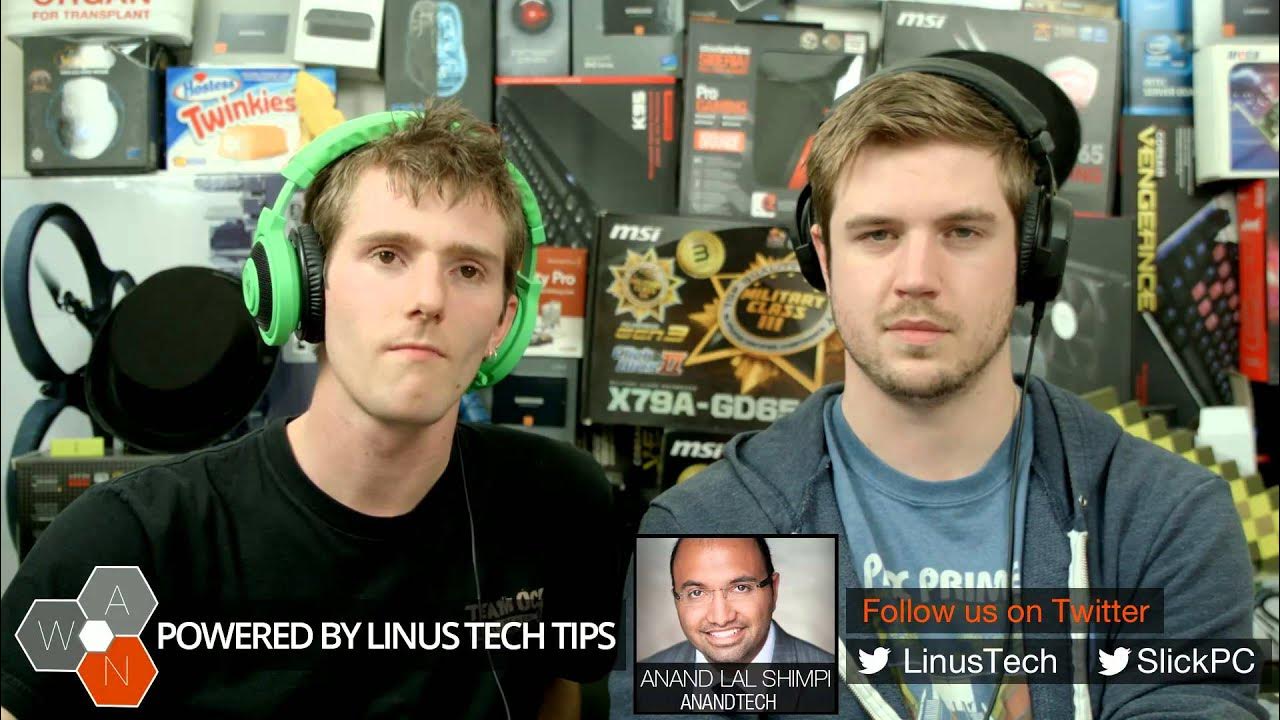
The WAN Show: Steam OS Download, Microsoft Smart Bra' and GUEST Anand Lal Shimpi - Dec 13, 2013
0 up · 0 down · 0 ratings
Channels and socials
After party : Sorry no official afterparty this week but Luke ran a super long unofficial afterparty on the twitch.tv channel! WAN Show Document : linustechtips.com Intel Total War! linustechtips.com 5:05 Oculus raises $75 Million in Stage B funding 11:00 Steam OS is downloadable! 15:28 Microsoft stereotype bra 19:08 Sony micro usb connector OTG 27:20 Anand Lal Shimpi joins us 39:10 Digital Storm SteamOS/Windows Machine 50:55 G-Sync overview 1:04:28 Haswell-E Leaked Specs 1:19:43 Consumer VS. Enterprise HDD reliability 1:23:10 Panel for the dell 28" 4k monitor maybe? 1:26:56 Backwards compatible Xbox-One? NOPE 1:28:05 Iphones in the microwave? 1:29:52 Samsung RAPID will work on 840 Pro's 1:32:10 140,000 VHS tapes of the news found in storage 1:34:30 Nexus 5 had a silent hardware revision 1:36:34 The pirate bay to make their domain name irrelevant
The WAN Show opens with corrections from the previous episode, addressing physics myths about bullets and drones, clarifying that firing straight up may not cause a drone to come down at the same speed, but angled shots can still be dangerous. The hosts admit some misstatements and acknowledge feedback from viewers, including concerns about HDMI 2.0 capabilities and Walmart cost discussions. They pivot to cover forthcoming topics with optimism about the evolving tech landscape, particularly around Haswell-E leaks, the concept of a smart bra, and Anand Lal Shimpi from AnandTech joining as a guest. The discussion quickly moves toSteam OS availability, with emphasis on the beta nature and the educational journey for users beyond a simple Windows replacement. They stress that Steam OS requires Linux know-how and caution viewers about the learning curve, particularly for those not familiar with Linux environments. The hosts highlight the potential of Steam OS in network play and latency considerations, foreshadowing experiments comparing Steam OS performance in local and networked contexts. An emphasis on streaming technology follows, including the possibility of 4K streaming and compression techniques as 10 Gb Ethernet becomes more accessible. The show shifts to hardware showcases, noting Sigma’s new 24-105mm lens and a 4K recorder, signaling a broader preparation for higher-quality content creation. They also discuss USB to Ethernet adapters for Nvidia Shield, aiming to enable 1080p streaming and reduce reliance on wireless connections, with a nod to the broader trend of local device-to-device streaming. A rapid-fire segment covers a Sony micro USB thumb drive, Patriot offerings, and the evolving landscape of portable storage options, underscoring the competition and feature sets in the space. The hosts tease an upcoming fiber internet upgrade for their lab, explaining how higher upstream speeds could enable better cloud- and streaming-based workflows, and they share their anticipation for improved online experiences. Throughout, the team engages with the audience via Twitter, inviting viewer opinions on wearable tech like smart bras and the future of networked gaming experiences, even as humor and skepticism color their commentary. The guest Anand Lal Shimpi joins mid-show, and Linus greets him with genuine fan enthusiasm, setting a collaborative and respectful tone for a substantive technical discussion. Anand reflects on his career, the print-to-digital transition, and how his site grew from a teenage project into a trusted voice in tech journalism, emphasizing consistency and professional presentation. He recounts the origins of AnandTech, the value of sharing knowledge, and the importance of audience trust, demonstrating how early curiosity evolved into a lasting platform for tech analysis. The conversation then broadens to discuss the post-PC era, arguing that desktop and traditional work setups will persist while device form factors evolve, enabling more portable and flexible computing experiences rather than replacing traditional desks entirely. The WAN Show writers explore the idea that all consumer devices are essentially PCs in different shells, whether they are consoles, mobile devices, or steam box form factors, and suggest Valve’s Steam Box could redefine the traditional console landscape over the coming decade. They touch on Digital Storm’s Steam OS/Windows dual-boot rig, highlighting the balance between Steam OS’s open ecosystem and the practicality of Windows for gaming, while noting potential pricing and hardware choices. The hosts examine the broader ecosystem of streaming and cloud-inspired gameplay, with a focus on networking performance, latency, and user experience, rather than raw horsepower alone. They discuss the role of accessories and peripherals in expanding the VR and gaming experience beyond a headset, referencing the Omni and other input devices that could bridge the gap between keyboard, mouse, and immersive interfaces. The show closes the segment by forecasting how cross-device streaming and local networks will shape gaming and productivity in the years ahead, hinting at hands-on testing and future benchmarks to come. The first guest interview session centers on AnandTech’s philosophy, with Anand elaborating on his personal brand, professional ethos, and the decision to wear a suit as a symbol of professionalism in tech journalism, a topic that underscores the balance between accessibility and credibility. Anand describes his journey from a young writer to a recognized tech authority, outlining the importance of rigorous testing, transparent methodology, and practical advice for readers who want to understand hardware performance beyond hype. The pair then discuss how the industry has evolved since Anand’s early days, including shifts in coverage focus from PCs to mobile and Apple devices, while maintaining a core commitment to comprehensive, technically grounded reviews. They address the market’s pace and the challenges of staying current, noting how consumer interests transition from desktops to mobile computing, and how editorial teams navigate these shifts while preserving trust. The conversation returns to Valve’s Steam Box and the potential for new PC-like consoles to blur the lines between traditional computing and living room entertainment, reinforcing the notion that “PCs everywhere” is a guiding trend rather than a temporary fad. The WAN Show closes with a forward-looking view on the role of enthusiasts and the importance of accessibility in technology education, encouraging viewers to tinker, test, and learn through hands-on exploration, while acknowledging that the road to mastery is long but rewarding. Finally, the episode ends on a high note with enthusiasm for upcoming gear and experiments, inviting viewers to stay tuned for more rigorous benchmarks, thoughtful analysis, and collaborative content with AnandTech and other industry voices.
Topics · technology · media_tech · hardware · pc_components · home_theater · virtual_reality · streaming_media
Questions answered
- What is the main topic about Steam OS in this episode and what should viewers expect from trying it?
- Steam OS is available in a beta form, and viewers should expect a learning curve as it is not fully ready for effortless installation on any PC; it is best for Linux enthusiasts and those interested in Steam Box hardware experiments, with a focus on network play and latency testing rather than pure local graphics benchmarking.
- Who is the guest on this WAN Show and why is he significant?
- The guest is Anand Lal Shimpi from AnandTech, a respected tech journalist known for in-depth hardware analysis and long-standing influence in PC hardware coverage, whose presence brings expert insights into the desktop and mobile computing landscape.
- What wearable tech topic is discussed and what are the concerns?
- The show discusses a Microsoft smart bra designed to monitor stress and heart rate to influence eating behavior. Concerns include practicality, potential misuse, gender-specific design limitations, and the broader question of whether wearable tech should actively intervene in personal health habits.