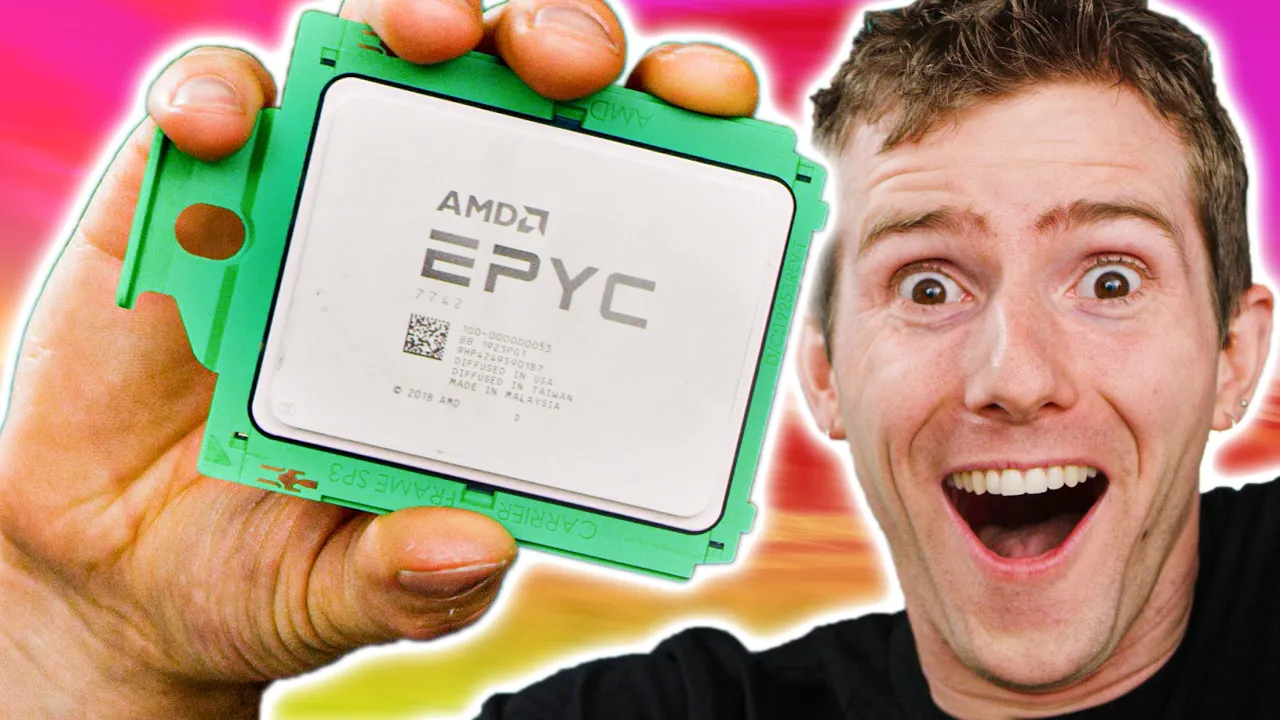
64 Core EPYC CPU – HOLY $H!T
0 up · 0 down · 0 ratings
Promos
Go to privacy.com to get $5 off your first purchase! Use code LINUS and get 25% off GlassWire at lmg.gg We FINALLY got our hands on AMD’s new EPYC Rome processor – Let’s see what 64 Zen 2 cores can do, shall we? Buy a Supermicro H11SSL-NC with 64-core EPYC pre-installed: On Newegg: lmg.gg Or buy a Threadripper instead: On Amazon: geni.us On Newegg: lmg.gg On Best Buy: shop-links.co Or maybe settle for a consumer AMD CPU! On Amazon: geni.us On Newegg: lmg.gg On Best Buy: shop-links.co Purchases made through some store links may provide some compensation to Linus Media Group. Discuss on the forum: linustechtips.com Our Affiliates, Referral Programs, and Sponsors: lmg.gg Get Private Internet Access today at geni.us Displate metal posters: lmg.gg Linus Tech Tips merchandise at lttstore.com Linus Tech Tips posters at crowdmade.com Our Test Benches on Amazon: amazon.com Our production gear: geni.us Twitter - twitter.com Facebook - @LinusTech Instagram - @linustech Twitch - twitch.tv Intro Screen Music Credit: Title: Laszlo - Supernova Video Link: youtube.com iTunes Download Link: itunes.apple.com Artist Link: soundcloud.com Outro Screen Music Credit: Approaching Nirvana - Sugar High youtube.com
The video opens with a detailed unboxing of AMD’s second‑generation EPYC 7742, a 64‑core, 128‑thread CPU that boasts a 225 W TDP, eight‑channel memory, and PCIe Gen 4. The presenter demonstrates the processor’s integration of memory controller and PCIe lanes directly into the CPU, highlighting how this design reduces board complexity and cost. In the first half of the video, the reviewer runs Cinebench R15 and R20 benchmarks, achieving scores of 8 450 and 8 500 respectively, and compares the EPYC 7742’s performance to a dual‑socket Xeon Platinum 8168. The second half focuses on real‑world gaming performance, with the CPU tested in “Crisis” at 720p (144 fps) and “Apex” at 144 fps with turbo frequencies of 3.3–3.4 GHz, while also noting a sustained 2.5 GHz under Prime95 and a thermal readout of around 50 °C. Throughout the video, the presenter emphasizes the EPYC 7742’s scalability and thermal efficiency, noting that the system uses 256 GB of DDR4 (four 32‑GB DIMMs) and a Noctua cooler. The reviewer also mentions a competitive gaming session, the importance of a virtual card from privacy.com for credit card protection, and plans to add more content around AMD’s EPYC processors. The video concludes with a call to action: subscribe, visit the forum, and watch a related video on upgrading a petabyte project, reinforcing the channel’s focus on PC building and performance reviews.
The comment section shows strong enthusiasm for the EPYC 7742, with over 4 300 k likes and a mix of technical praise and humor. Viewers frequently praise the benchmark results and the clarity of the unboxing, while some jokes about “Rome is burning” and “CPQU” add a lighthearted tone. The most liked comment (6 000 likes) highlights the 256 GB RAM and the 1 TB memory claim, indicating that the audience values the system’s memory capacity. Overall, the community responds positively, with a userScore of 8.5.
Topics · review · pc · tech · amd · cpu · performance
Questions answered
- What benchmark scores did the EPYC 7742 achieve in Cinebench R15 and R20?
- The EPYC 7742 scored 8 450 in Cinebench R15 and 8 500 in Cinebench R20.
- How much memory does the reviewed system use?
- The system uses 256 GB of DDR4 memory, configured as four 32‑GB DIMMs.
- What cooling solution is used in the build?
- A Noctua cooler is installed on the EPYC 7742.
- At what frame rates did the CPU perform in the games “Crisis” and “Apex”?
- The CPU achieved 144 fps in “Crisis” at 720p and 144 fps in “Apex” with turbo frequencies of 3.3–3.4 GHz.