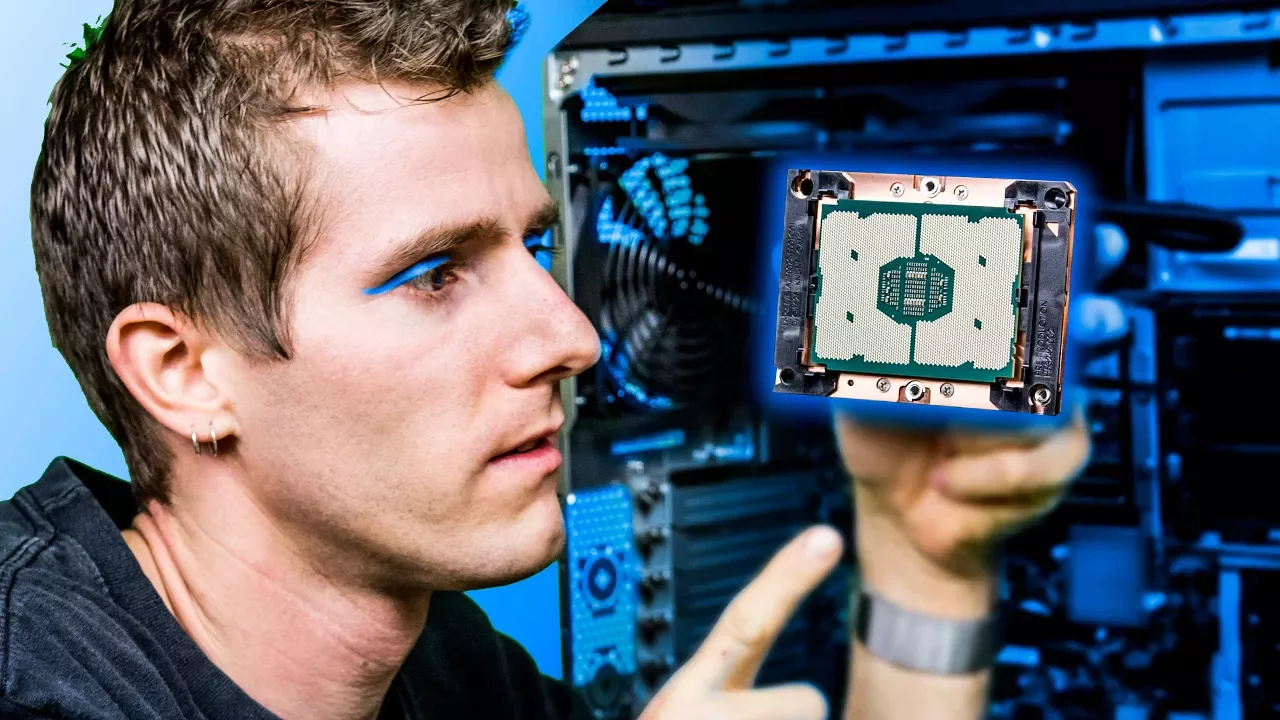
A REAL 64 Core CPU - For SCIENCE!
0 up · 0 down · 0 ratings
Promos
Forget Threadripper and Core i9 - Xeon Phi is the go-to for x86 core count. But how does it actually perform? Visit squarespace.com and use offer code LTT for 10% off Try Tunnelbear for free, no credit card required, at tunnelbear.com More info on the Supermicro SuperServer 5038K-I: geni.us Buy a Xeon Phi processor on Amazon(?): geni.us Discuss on the forum: linustechtips.com Our Affiliates, Referral Programs, and Sponsors: linustechtips.com Linus Tech Tips merchandise at designbyhumans.com Linus Tech Tips posters at crowdmade.com Our production gear: geni.us Twitter - twitter.com Facebook - @LinusTech Instagram - @linustech Twitch - twitch.tv Intro Screen Music Credit: Title: Laszlo - Supernova Video Link: youtube.com iTunes Download Link: itunes.apple.com Artist Link: soundcloud.com Outro Screen Music Credit: Approaching Nirvana - Sugar High youtube.com Sound effects provided by freesfx.co.uk
The video delves into Intel’s Knights Landing Xeon Phi, a heterogeneous many-core processor designed to maximize throughput through a large number of threads rather than per-core performance. Early on, the host explains the hardware concept, noting the 64-core, 256-thread configuration and speeds around 1.3 to 1.5 GHz with substantial cache, framing the chip as a basis for massive parallel computation rather than traditional desktop performance. The host traces Knights Landing from its origins in the Larrabee project, highlighting its evolution into a PCIe add-in card and its role in the world of supercomputing until mid-2016. The presentation then defines the target workloads, including protein folding, weather prediction, AI and neural network research, and molecular dynamics with libraries like TensorFlow and NAMD, emphasizing that this platform is intended for HPC environments with large compute banks and GPUs in concert. Productivity and gaming benchmarks are acknowledged as not representative of its strengths, with the Xeon Phi showing weak desktop performance and limited gaming capability given its design goals and price. The segment featuring Puget Systems’ Dr. Kinghorn provides a crucial real-world benchmark discussion, comparing Knights Landing to a 14-core Xeon baseline and detailing how LINPACK and molecular dynamics tests scale with problem size, core count, and memory bandwidth. The conclusion frames Xeon Phi as a specialized accelerator that can outperform traditional Xeons in certain HPC tasks and as a valuable supplement to GPUs, while noting its superiority is context-specific and not a universal upgrade for all workloads. Finally, the sponsor segment and closing statements reiterate the video’s intent to explore high-performance computing hardware, acknowledging that the audience is unlikely to own such devices personally but that the research and development surrounding these systems benefits broader scientific and computational fields.
Topics · hardware · science · technology · high-performance-computing