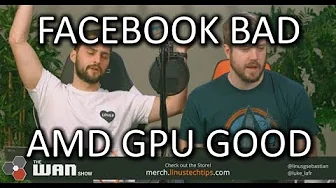
Facebook sucks, Future AMD GPUs could be GREAT! - WAN Show Apr.13 2018
0 up · 0 down · 0 ratings
Promos
Share your mouse and keyboard between multiple computers with Synergy 2 at symless.com Buy the be quiet! Dark Rock 4 CPU Cooler on Newegg: geni.us Buy the be quiet! Dark Rock Pro 4 CPU Cooler on Newegg: geni.us Visit squarespace.com and use offer code WAN for 10% off Soundcloud: soundcloud.com Forum: linustechtips.com Timestamps courtesy of JJMC89. 00:07:20 - Facebook users aren't changing privacy settings, despite uproar 00:20:45 - AMD Navi 00:29:17 - Google-branded 4K Android TV dongle 00:34:17 - Floatplane 00:38:17 - Sponsor: Symless 00:39:59 - Sponsor: be quiet! 00:41:22 - Sponsor: Squarespace 00:42:25 - WebAuthn 00:51:24 - Ransomware asks you to play PUBG 00:43:11 - FTC staff warns companies that it is illegal to condition warranty coverage on the use of specified parts or services 00:54:37 - Apple's HomePod isn't the hot seller it wanted 01:03:33 - New Gmail confidential mode
The WAN Show episode from April 13, 2018 opens with Linus and Luke (Laser James) discussing a mix of privacy news and tech rumors, setting a tone that blends current events with hardware chatter. They acknowledge a somewhat altered studio setup and reflect on Pax and the evolution of Linus Tech Tips’ event coverage, noting how the show has grown but sometimes become more corporate and less niche. The hosts tease a diverse agenda, including Facebook privacy uproar, the AMD Navi rumors, a Google branded 4K Android TV dongle, Floatplane updates, and multiple sponsor segments. Throughout, they balance light banter with informed commentary, giving viewers a frame of reference for why privacy regulation might look different in practice compared to theoretical models. The discussion then pivots to an in-depth look at Facebook’s privacy landscape and public reaction, highlighting that many users do not alter privacy settings despite the controversy. They explore three possible regulatory paths for Facebook and the wider social-media industry: self-regulation by Facebook, industry-wide regulation, and a dedicated third-party regulator, weighing the pros and cons of each. The straw poll segment reveals broad skepticism about heavy-handed regulation while acknowledging the value of some safeguards, with audience input shaping the debate. The conversation shifts to AMD Navi, explaining that Navi is a 7nm process targeting the mainstream GPU segment and potentially delivering GTX-1080 level performance for about $250, a price point designed to disrupt current high-end pricing. They discuss manufacturing challenges of 7nm, yield concerns, and the strategic implications for AMD as they compete with Nvidia, including insights from Pax现场 showing strong AMD booth interest and a sign of growing consumer confidence. The hosts speculate on how such pricing could affect mining-driven GPU prices and mining demand, noting that price dynamics are fluid depending on mining profitability and supply. They then broaden the hardware conversation to Google’s 4K Android TV dongle rumors, comparing to Chromecast and Fire TV Stick ecosystems, and explaining how a future Android TV device with voice remote could integrate with Google Assistant to improve day-to-day TV navigation and content casting. The show includes sponsor segments for Symless, Be Quiet, Squarespace, and Floatplane, with practical explanations of how Synergy software enables seamless mouse and keyboard sharing across multiple machines, and how Floatplane is evolving as the show’s distribution platform. Interspersed are light touches about tech nostalgia, retro hardware, and personal anecdotes about Pax past, with the hosts weaving in jokes and fan interactions to keep the discussion accessible. The AMD Navi segment returns to strategic implications, noting the potential democratization of high-end GPU performance for mainstream buyers and the possible impact on the PC gaming market over the next few years. The episode also touches on other tech news such as WebAuthn and new Gmail confidential mode, concluding with a balanced view of how tech policy, consumer behavior, and hardware innovation intersect in the real world. Overall, the WAN Show provides a multi-faceted snapshot of tech culture in 2018, balancing industry speculation with consumer-focused hardware analysis while encouraging viewer engagement through polls and feedback. The closing moments reinforce the show’s ongoing mission to bring complex tech topics to a broad audience with humor, clarity, and practical insights for builders and enthusiasts alike.
Topics · technology · privacy · hardware