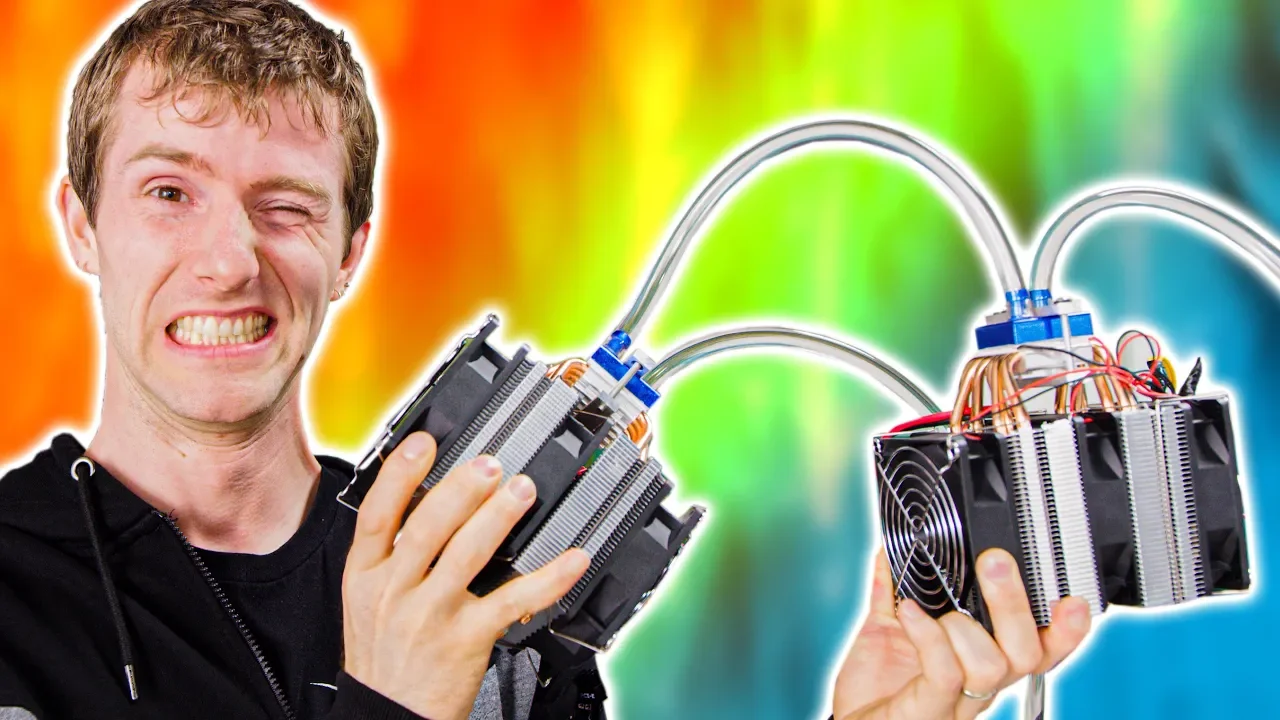
Thermoelectric Cooling is a Bad Idea
0 up · 0 down · 0 ratings
Promos
Sign up for Private Internet Access VPN at lmg.gg Vincero Watches' 5th-anniversary sale is on now at vincerowatches.com People keep emailing us saying “Hey Linus, you should look at Peltier Coolers!” – and I’ve finally given in, so here is a video about why it’s a bad idea. Buy Noctua NH-U12A: On Amazon: geni.us On Newegg: geni.us Discuss on the forum: linustechtips.com Our Affiliates, Referral Programs, and Sponsors: linustechtips.com Get Private Internet Access today at geni.us Displate metal posters: lmg.gg Linus Tech Tips merchandise at lttstore.com Linus Tech Tips posters at crowdmade.com Our Test Benches on Amazon: amazon.com Our production gear: geni.us Twitter - twitter.com Facebook - @LinusTech Instagram - @linustech Twitch - twitch.tv Intro Screen Music Credit: Title: Laszlo - Supernova Video Link: youtube.com iTunes Download Link: itunes.apple.com Artist Link: soundcloud.com Outro Screen Music Credit: Approaching Nirvana - Sugar High youtube.com
The video debunks the hype around thermoelectric cooling for CPUs by examining a commercial peltier cooler and a DIY aquarium cooler used to chill a high-end processor. The host explains the basic operation of thermoelectric coolers, where electric current moves heat from one side to the other, creating a cold side and a hot side with a practical limit on the temperature differential. Early on, the video uses a Kickstarted desktop cooler as an example, showing that its claimed eco friendliness hinges on inefficient heat transfer and excessive electricity draw, ultimately producing hot water rather than meaningful room cooling. A deeper investigation compares the tech cooler to conventional air and water cooling paths, highlighting that thermoelectric devices can be surprisingly power hungry and generate more heat than they remove when under real load. The team then experiments with a larger peltier module connected to a beefy water cooling loop, showing that even with a robust radiator and fans, the system struggles to keep temperatures in check under heavy CPU load. The conclusion emphasizes four key drawbacks of thermoelectric cooling for PCs: compactness is illusory due to the need to reject the generated heat, power consumption is enormous for the results obtained, cost is high for marginal performance, and real workloads quickly overwhelm the technology. The host clarifies that peltiers are not inherently useless, but their practicality depends on context, and hints at future content exploring higher wattage peltiers and more robust implementations. Throughout the video the tone stays playful yet technically grounded, contrasting marketing claims with measured data and stressing thermodynamics as the governing rule. Viewers are reminded to subscribe for future explorations of cooling methods and potential upgrades, while sponsor placements and merchandise plugs are interwoven with the technical discussion in a typical Linus Tech Tips style.
Topics · science · technology · hardware · experimentation · education