The (Inevitable) United States Debt Crisis
0 up · 0 down · 0 ratings
Channels and socials
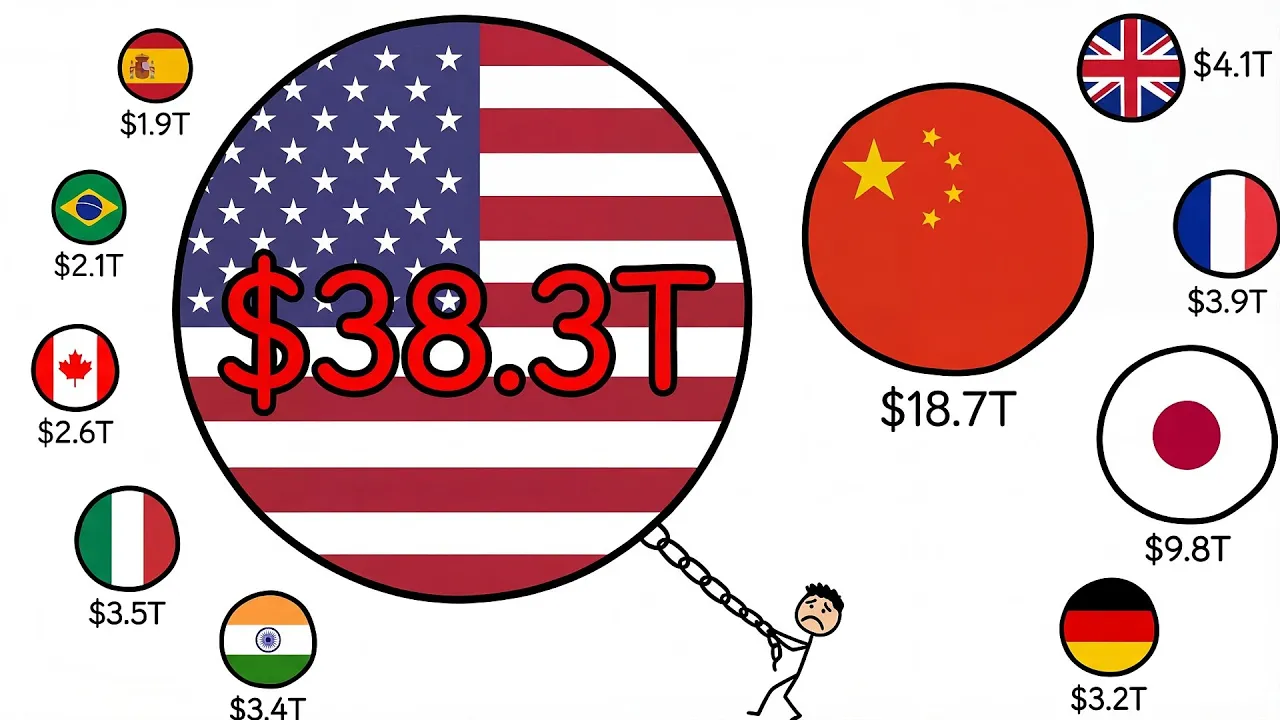
The United States is in serious trouble. We're running a $1.8 trillion deficit, carrying $38 trillion in national debt, and there’s still no real plan to fix any of it. Which raises the question: Is it actually possible to fix this mess? In this video, I'll break down: • How bad is the United States debt? • What caused the U.S. debt problem? • Who owns the debt? • Can we fix the U.S. debt problem? Complex topics, simple breakdowns. Join my free weekly newsletter to stay ahead of what's actually happening in markets: casualmarkets.co #finance #investing #stocks #economics #debt Disclaimer: The information provided in this video and on this channel (collectively, the “Content”) is for informational, educational, and entertainment purposes only and does not constitute investment, financial, legal, or tax advice, nor a recommendation to buy, sell, or hold any security or investment strategy. Investing involves risk and you must do your own research. Nothing in the Content should be interpreted as creating a fiduciary relationship, financial advisory relationship, or client relationship of any kind. The host, the channel, and all affiliated entities expressly disclaim any and all liability for any direct or consequential loss or damage arising directly or indirectly from the use of, reliance upon, or interpretation of the Content. By viewing or interacting with the Content, you acknowledge and agree to these terms and release the host and all related parties from any and all claims related to your reliance on the information provided.
The video opens with a midlife-crisis metaphor for the United States government, using humor to frame a debt and spending problem that keeps repeating year after year. It cites a nearly $2 trillion deficit and a national debt that has grown beyond $38 trillion, then immediately asks whether the U.S. can actually fix the situation. The host argues the key constraint is that the U.S. has been operating like a business that has been unprofitable since 2001, and the gap widened sharply beginning in 2020 with trillion-dollar deficits each year. To set up the analysis, the video explains that a deficit happens when government spending exceeds government revenue, and it uses the idea of borrowing the difference as the mechanism that drives debt growth. The segment ends by promising a clear breakdown of where the money goes and what options remain, described as “ugly,” “unpopular,” and guaranteed to upset millions. Next, the video lays out how federal spending is organized and why small, politically popular changes often do not move the overall deficit enough. It divides spending into mandatory spending, discretionary spending, and net interest on the existing debt. Mandatory spending is presented as legally locked in programs such as Social Security, Medicare, and Medicaid, while discretionary spending includes items like national defense, education, and foreign aid. The host emphasizes that the federal budget is dominated by five large line items, stating they account for nearly 70% of spending, then gives a concrete example that foreign aid in 2024 was about $78 billion, roughly 1% of the federal budget. From that, the video argues that cutting foreign aid to zero would only cover a short period of Social Security payments and would not solve the broader deficit trend. It then frames the “two real options” as cutting national defense spending or cutting mandatory spending, with the host arguing that defense cuts are politically sticky while mandatory spending, especially Social Security and Medicare-type programs, is the main structural lever. The final section moves through the mandatory spending programs and then connects the policy choices to financial market consequences. For Social Security, it highlights reliance on payroll taxes and states the Social Security Trust Fund is projected to be insolvent by 2034, which would trigger automatic benefit cuts of around 20% once reserves run out. It outlines two potential changes: lifting or eliminating the payroll tax cap of $170,000, and adjusting benefits for high-income retirees, arguing that giving benefits to very high earners does not align with the program’s purpose. For Medicare, it describes Medicare as covering health care for more than 65 million Americans and says the Medicare Hospital Insurance Trust Fund is estimated to become insolvent by 2033, leading to automatic cuts of around 11% after reserves are exhausted. The video also discusses Medicare Advantage payment issues, citing an estimate that plans are overpaid by 22% to 39% on average and suggesting reform could reduce waste but would face political resistance from the health insurance industry. For Medicaid, it states Medicaid covers around 70 million Americans and is financed via a federal and state partnership, then argues a practical fix is cracking down on Medicaid fraud and improper payments, described as over 5% of Medicaid spend. The closing argument is that if the U.S. continues borrowing without a credible plan, investors will demand higher returns, raising interest rates that then make borrowing for mortgages, car loans, business loans, and credit cards more expensive, and the host concludes that doing nothing is not an option because the window to act narrows as fewer choices remain.
Viewers largely praise the channel for consistently high-quality, informative, and digestible explanations, with many comments saying the content is great, impressive, or among their favorites. A recurring sentiment is support for the host’s effort to find legitimate solutions rather than only doomsaying, even when commenters disagree with specific prescriptions. Several commenters focus criticism or additional suggestions on healthcare cost drivers such as pharma pricing, private insurance behavior, fraud, and calls for single payer or nationalization of parts of the health system. Others argue the video should have focused more on defense-related waste, fraud, kickbacks, and contractor incentives, while a smaller group frames the core issue as political influence, lobbying, or campaign finance structure. Humor also appears frequently, with many reactions to the midlife-crisis metaphor, jokes about “dollars printers go brrr,” and light comments about making complex budget issues easier to visualize. Some viewers ask for missing supporting materials, such as links to where graphs were found, or raise follow-up questions about tax and bond mechanics.
Topics · finance · economics · debt markets · markets · stock market · education
Questions answered
- What is a government budget deficit?
- A budget deficit occurs when government spending is higher than government revenue.
- What are the three buckets of federal government spending used to explain the U.S. budget?
- The video groups federal spending into mandatory spending, discretionary spending, and net interest on the existing debt.
- Why does cutting foreign aid not solve the U.S. deficit problem by itself?
- The video states foreign aid in 2024 was about $78 billion, around 1% of the federal budget, so eliminating it would not materially change the deficit compared with much larger mandatory spending and interest costs.
- What two real options does the video say the U.S. has to address the deficit at the root level?
- It frames the options as either cutting national defense spending or cutting mandatory spending, specifically programs like Social Security, Medicare, or Medicaid.
- When is the Social Security Trust Fund projected to become insolvent, and what happens then?
- The video says the Social Security Trust Fund is projected to be insolvent by 2034, and when that happens benefits would be automatically cut by about 20% based on ongoing tax income.
- How does the video suggest improving Social Security funding by changing payroll taxes?
- It suggests lifting or eliminating the payroll tax cap of $170,000 on earnings, which it says would close about 73% of long-term Social Security funding shortfalls.
- When is the Medicare Hospital Insurance Trust Fund estimated to become insolvent, and what happens then?
- The video states it is estimated to be insolvent by 2033, and after reserves are exhausted spending would be limited to incoming tax revenue, leading to automatic benefit cuts of around 11%.
- What does the video say about Medicare Advantage payment overpayments?
- It cites an estimate that Medicare Advantage plans are overpaid by 22% to 39% on average, equaling roughly $83 billion to $127 billion annually, with reform framed as politically difficult.