Something Feels Off About 2026...
0 up · 0 down · 0 ratings
Promos
Upgrade your setup with FlexiSpot standing desk and get a big discount! Use my code "YTE730" to save EXTRA $30 off on the E7 and E7 Pro standing desk. FlexiSpot E7 Pro Standing Desk: bit.ly (US) | bit.ly (CA) Everyone has a 2026 market prediction. Most of them are wrong. Bulls are calling for another melt-up. Bears are calling for a crash. But both sides are overlooking the obvious. In this video, I'll cover: • Why AI stocks are trading on hope, not fundamentals • How 7 stocks now control a massive chunk of the market • What interest rate cuts mean for valuations • Why the most dangerous outlook in the stock market isn't a crash or a rally Complex topics, simple breakdowns. Join my free weekly newsletter to stay ahead of what's actually happening in markets: casualmarkets.co #finance #stockmarket #economics #businessnews Disclaimer: The information provided in this video and on this channel (collectively, the “Content”) is for informational, educational, and entertainment purposes only and does not constitute investment, financial, legal, or tax advice, nor a recommendation to buy, sell, or hold any security or investment strategy. Investing involves risk and you must do your own research. Nothing in the Content should be interpreted as creating a fiduciary relationship, financial advisory relationship, or client relationship of any kind. The host, the channel, and all affiliated entities expressly disclaim any and all liability for any direct or consequential loss or damage arising directly or indirectly from the use of, reliance upon, or interpretation of the Content. By viewing or interacting with the Content, you acknowledge and agree to these terms and release the host and all related parties from any and all claims related to your reliance on the information provided.
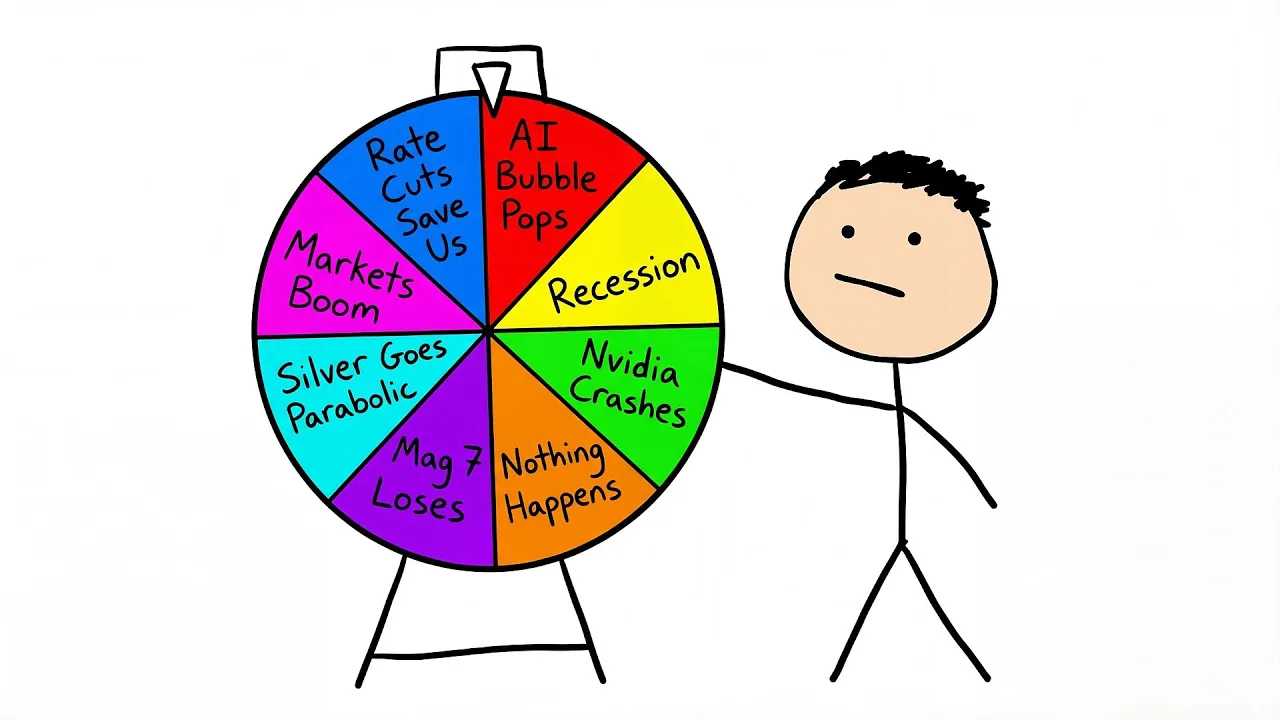
The video opens with the host describing the recent economy and markets as “financial chicken,” where bears warn about recession while bulls buy “AI stocks” aggressively. He cites recent support under the surface, saying unemployment stayed relatively low and consumers kept using credit cards, which made the environment feel confusing rather than obviously bearish. As the discussion shifts into 2026, he frames it as a year that could swing between a melt-up and a crash, while also noting there is an “uncomfortable gray area in between” that many people ignore. He then sets up two competing outlooks, starting with a bear case, before moving into a bull case and finally arguing for a third scenario. The overall conclusion he builds toward is that investors may be most exposed when markets enter a middling regime that is hard to position for. In the bear case, the host argues that AI narratives may have moved ahead of fundamentals, using specific valuation multiples as evidence. He mentions Nvidia trading around 47 times earnings, Palantir around 400 times earnings, and Datadog over 430 times earnings, and he concludes that this level of valuation implies investors are “pre-ordering hope” rather than buying on fundamentals. He then links those AI names to broader market performance, saying that when Nvidia rises it lifts semiconductors, the tech sector, and the S&P 500, so the whole index ends up trading on elevated expectations. He adds that the S&P 500 is trading at nearly 31 times earnings versus a long-term average of around 16, and he warns that if multiples normalize, it could pressure the entire market, not just AI stocks. After that, he emphasizes index concentration, saying returns and market cap are heavily driven by a small group commonly referred to as the Magnificent Seven, and he argues that passive, market-cap-weighted investing can amplify this concentration through a feedback loop. In the bull case, he pivots to macro tailwinds, especially interest rates, describing expectations for cuts into 2026. He states that 2025 ended with three consecutive 25 basis point cuts and that the median expectation entering 2026 is at least one additional cut, which he connects to cheaper capital, higher valuations, and more comfort paying premiums for future earnings. He then brings in fiscal policy, arguing that the U.S. runs on a more than trillion dollar deficit annually and that government spending can support consumer demand and corporate revenues in the short term. He cautions that markets rarely move in clean ways when fundamental tailwinds collide with structural risks, setting up the key takeaway he thinks most people miss. That “most likely outcome,” in his view, is not a melt-up or a crash, but a choppy, sideways “Blur” type year where headlines flip frequently, rallies stall as confidence rises, and dips feel scary without creating clear opportunities. He ends by telling viewers that if anyone claims certainty, they may be lying or trying to sell something, and he encourages viewers to absorb information and form their own conclusions.
Viewers broadly agree with the overall framing that 2026 feels tense, uncertain, and like markets are waiting for a catalyst, with many comments describing a “chop” or “blur” market. A common sentiment is appreciation for the clear, neutral, and funny explanations, with multiple viewers saying the video helped them understand markets without feeling lost or bored. Several commenters praise the bear case logic around stretched fundamentals and especially the warning about market concentration, while a few criticize the video for simplifying too much, missing topics like geopolitical risk, or feeling detached from “industrial reality.” Some viewers also express frustration that the content can feel like it offers no firm conclusions, while others interpret that uncertainty as the correct lesson and recommend systematic approaches like DCA and staying prepared. Humor shows up frequently in the comments, including references to apocalypse-style predictions, Monty Python, stick-figure jokes, and playful comparisons to concepts like “waiting for a grenade.”
Topics · finance · stock market · economics · business · education · debt markets
Questions answered
- Why are AI stocks trading on hope instead of fundamentals, based on valuation multiples?
- When major AI-related stocks trade at extremely high earnings multiples, it implies investors are pricing in future success rather than current fundamentals, meaning the market expectation is largely speculative rather than supported by earnings today.
- How do interest rate cuts affect stock market valuations according to the explanation?
- Lower interest rates typically reduce the cost of capital, which can increase valuations by encouraging investors to pay higher multiples for future earnings, and it can also loosen liquidity and ease financial conditions.
- What does it mean when the stock market becomes top-heavy with the Magnificent Seven?
- It means a small group of very large companies drives a large share of index market capitalization and returns, so index performance becomes less representative of broad diversification across many companies.
- What is the alternative market scenario most investors may be unprepared for in 2026?
- A choppy sideways market where headlines flip often, rallies stall as confidence rises, and dips feel scary without delivering attractive opportunities.