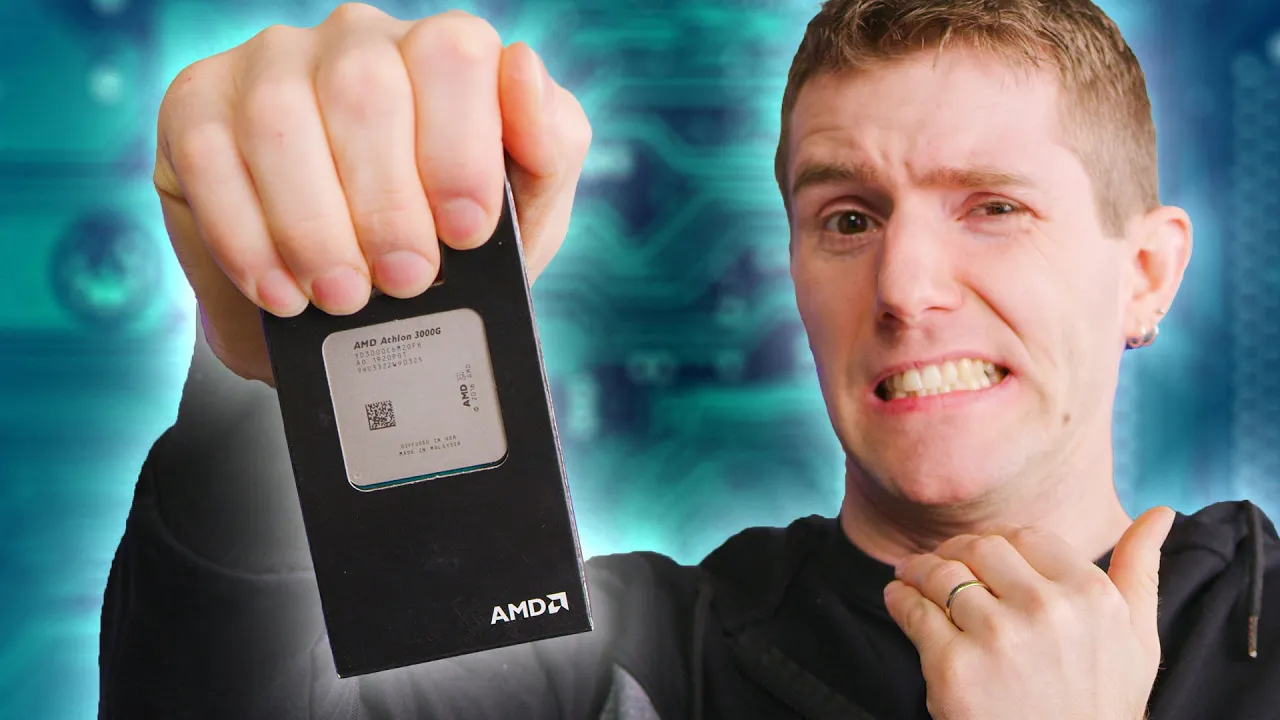
Should you buy a $50 CPU??
0 up · 0 down · 0 ratings
Promos
Get 20% OFF + Free Shipping at Manscaped.com with code TECH - mnscpd.com Use code LINUS and get 25% off GlassWire at lmg.gg At just $50 AMD's new Athlon 3000G looks darn compelling - but can we overclock it enough for it to make sense for gamers? Buy the AMD Athlon 3000G On Amazon (PAID LINK): geni.us On Newegg (PAID LINK): lmg.gg Purchases made through some store links may provide some compensation to Linus Media Group. Discuss on the forum: linustechtips.com Our Affiliates, Referral Programs, and Sponsors: linustechtips.com Displate metal posters: lmg.gg Linus Tech Tips merchandise at lttstore.com Our Test Benches on Amazon: amazon.com Our production gear: geni.us Our Chrono.gg game store: ltt.chrono.gg Twitter - twitter.com Facebook - @LinusTech Instagram - @linustech Twitch - twitch.tv Intro Screen Music Credit: Title: Laszlo - Supernova Video Link: youtube.com iTunes Download Link: itunes.apple.com Artist Link: soundcloud.com Outro Screen Music Credit: Approaching Nirvana - Sugar High youtube.com
The video investigates whether the AMD Athlon 3000G, a $50 CPU, can punch above its weight in gaming and where it fits in a modern budget setup. The host starts by laying out a side-by-side comparison against an Intel Pentium G4560, then announces a goal to overclock the Athlon to see how far it can be pushed before stability or thermals become prohibitive. Early testing includes Cinebench style benchmarking and a practical gaming test using Rainbow Six Siege with and without a discrete GPU, illustrating how the CPU bottleneck affects performance. The presenter emphasizes that even a budget system should be balanced, noting that upgrading the CPU alone does not guarantee proportional gains if the rest of the system is not aligned for a strong overall experience. As the testing progresses, the video explores different upgrade paths, such as pairing the Athlon with a GTX 1650 Super or considering a Ryzen 3 3200G, to approach the performance of more expensive CPUs while remaining mindful of total system cost. The discussion then pivots to the value proposition of legacy or used hardware, the importance of dual-channel RAM for integrated graphics, and the broader takeaway that a well-balanced machine delivers the best bang for buck rather than chasing singular high-end parts. The host closes with guidance on where the $50 CPU makes sense, under what circumstances it falls short, and how to plan future upgrades for a budget gaming build, followed by a sponsored segment and recommendations for related budget gaming content. The overarching message is that multi-core CPUs and balanced configurations typically yield the best long term value, even in ultra-budget scenarios.
Topics · hardware · budget computing · pc gaming · overclocking · system building
Questions answered
- What is the base performance of the AMD Athlon 3000G in simple benchmarks and why does it matter for budget builds?
- The Athlon 3000G has two cores and four threads with a base clock of 3.5 GHz and Radeon Vega 3 graphics. In budget builds, this matters because it sets the ceiling for integrated graphics performance and determines how much benefit you gain from adding a discrete GPU. Real-world gaming and synthetic benchmarks show the CPU can be a bottleneck, so expectation management is crucial when planning a sub $100 system.
- Is upgrading to a Ryzen 3 3200G or a Ryzen 5 3600 a better value for a budget gamer, and when should you consider each option?
- A Ryzen 3 3200G offers a notable step up in cores and graphics over the Athlon 3000G and is typically a better budget upgrade if you still want integrated graphics. A Ryzen 5 3600 provides far higher performance and better future-proofing, making it the preferred choice if you plan to add a dedicated GPU and expect longer-term use. The decision depends on overall budget, upgrade path, and whether you value immediate gaming performance vs future headroom.
- Why is dual-channel memory important for budget builds, especially when using integrated graphics?
- Dual-channel memory provides higher bandwidth to the memory subsystem, which benefits integrated graphics and overall system responsiveness. In a budget build with a single RAM stick, performance can be notably limited, so upgrading to a 2x4GB or 2x8GB kit often delivers measurable gains in frame rates and smoothness, sometimes outweighing small CPU clock gains.