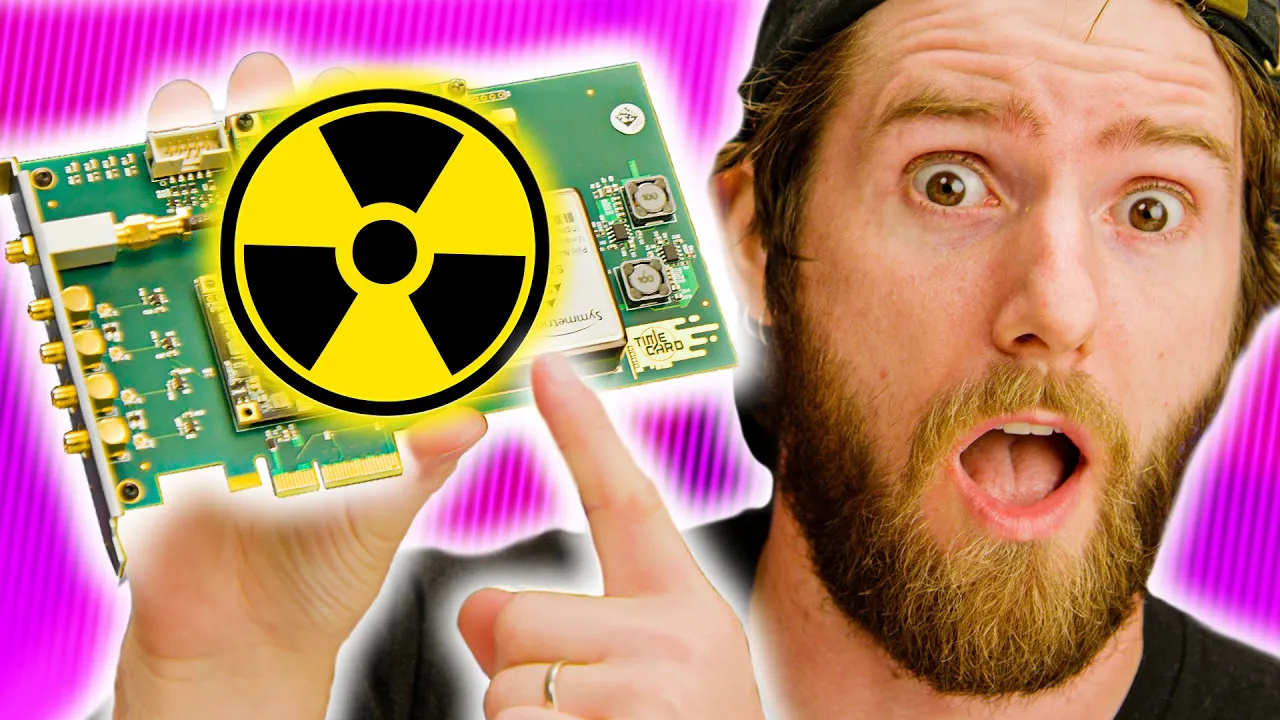
Why is this PCIe Card RADIOACTIVE?
0 up · 0 down · 0 ratings
Promos
Visit squarespace.com and use offer code LTT for 10% off Use code LINUS and get 25% off GlassWire at lmg.gg By using an Atomic Clock the clocks between different computers can be synced to within a dozen nanoseconds, and with that performance can sky rocket.
Check out the Open Compute Project: opencompute.org Build your own Time Card: github.com Buy a NVIDIA GeForce RTX 3090 Amazon (PAID LINK): geni.us Best Buy (PAID LINK): geni.us Newegg (PAID LINK): geni.us Purchases made through some store links may provide some compensation to Linus Media Group. Discuss on the forum: linustechtips.com ► GET MERCH: lttstore.com ► AFFILIATES, SPONSORS & REFERRALS: lmg.gg ► PODCAST GEAR: lmg.gg ► SUPPORT US ON FLOATPLANE: floatplane.com FOLLOW US ELSEWHERE --------------------------------------------------- Twitter: twitter.com Facebook: @LinusTech Instagram: @linustech TikTok: @linustech Twitch: twitch.tv MUSIC CREDIT --------------------------------------------------- Intro: Laszlo - Supernova Video Link: youtube.com iTunes Download Link: itunes.apple.com Artist Link: soundcloud.com Outro: Approaching Nirvana - Sugar High Video Link: youtube.com Listen on Spotify: spoti.fi Artist Link: youtube.com Intro animation by MBarek Abdelwassaa @mbarek_abdel Monitor And Keyboard by vadimmihalkevich / CC BY 4.0 geni.us Mechanical RGB Keyboard by BigBrotherECE / CC BY 4.0 geni.us Mouse Gamer free Model By Oscar Creativo / CC BY 4.0 geni.us CHAPTERS --------------------------------------------------- 0:00 - Atomic Clock?!? 1:05 - GlassWire 1:15 - Intro 1:25 - Highly precise timing 2:05 - Test setup 2:48 - NTP (Network Time Protocol) 4:26 - TY Ahmad 5:35 - Precision Time Protocol Enabled 6:14 - Why precise timing matters 9:15 - It is open source! 9:24 - lttstore.com 9:31 - Gaming implications 10:31 - Fiber optic cables are cool 11:55 - Security 12:20 - Streaming 12:40 - Again, it is open source 13:20 - Squarespace! 14:01 - Outro
The video opens with Linus holding a real rubidium atomic clock and sets the stage for a dramatic claim: syncing computers to nanosecond precision could unlock huge gains in performance and capabilities. The host explains that precise timing is already mature but historically expensive, and this PCIe card-based Time Appliance brings that capability into a more affordable realm for data centers and even consumer setups. Early on, the discussion establishes why nanosecond-level synchronization matters: it reduces the overhead spent on compensating timing delays, improves streaming synchronization for live broadcasts, and enables tighter coordination across distributed systems. The presentation then walks through a hands-on test setup, including two machines and a nearby rubidium clock that periodically synchronizes to GPS time, illustrating how even small clock drifts translate into noticeable misalignment over data streams. The segment emphasizes that the real breakthrough is not just the clock itself, but the open source ecosystem surrounding the project, including the Time Appliance Project and the Precision Time Protocol (PTP) support that dramatically tightens synchronization. In short, the video argues that bringing precise timing into ordinary hardware can have wide-ranging implications from data center efficiency to fairer online gaming and more robust streaming integrity.
Topics · technology · networking · open_source · data_center · security · gaming
Questions answered
- How does a rubidium atomic clock improve network timing, and why is GPS time used for calibration?
- A rubidium atomic clock provides a highly stable frequency reference, which reduces clock drift between devices. GPS time is used to periodically calibrate and lock the local clock to a universal time standard, ensuring all machines agree on true time to nanosecond-level precision.
- What is the practical impact of switching from NTP to PTP in a data center or gaming setup?
- PTP tightens synchronization between devices much more precisely than NTP, enabling lower latency and more accurate timestamping of packets. This reduces misordering, improves streaming quality, and can give fairer competition in latency-sensitive applications like online gaming.
- Is this timing technology widely accessible to typical consumers, or is it mainly for data centers?
- The technology is becoming more accessible through PCIe cards and open-source projects, but widespread consumer adoption depends on cost, power, and integration ease. In principle, many devices already have compatible hardware, and open-source implementations could enable broader use cases over time.